
Coriolis Flowmeters: Where Premium Accuracy Pays for Itself

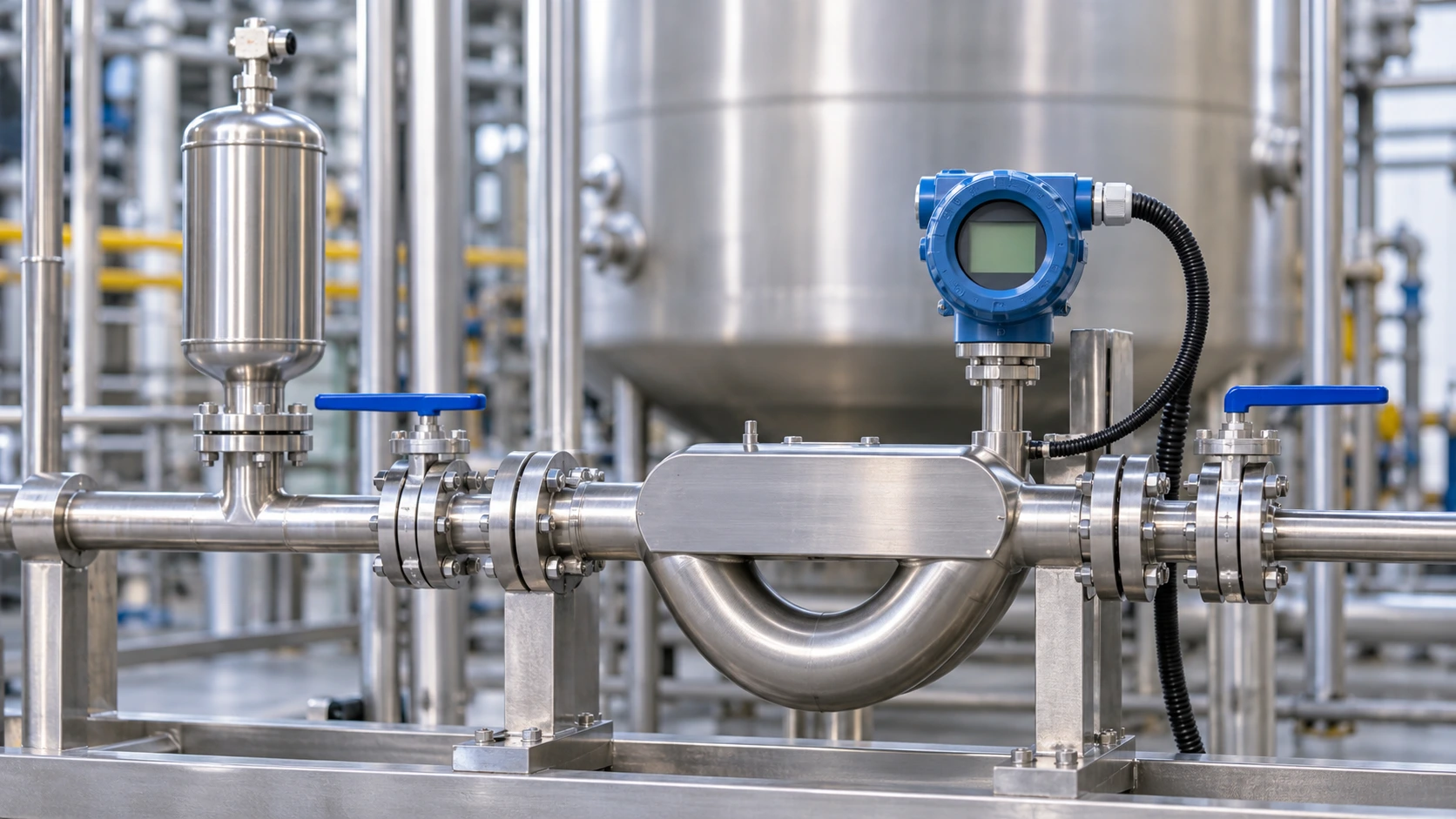
Quick Answer
A Coriolis flowmeter measures mass flow and density directly, with accuracy no other technology matches on liquids. Here is how it works, where the price is justified, what it cannot do, and where the Promass 83F fits.
Most flowmeters estimate how much fluid went past by measuring something else: a velocity, a pressure drop, a frequency of vortices. Then the fluid changes. The density shifts with temperature, the viscosity doubles in winter, the conductivity drops, and the estimate drifts. A plant that pays for the fluid by the tonne, or that doses a reagent by the kilogram, ends up reconciling meter readings against tank dips and scale tickets at the end of the month, and finding a gap it cannot explain.
A Coriolis flowmeter closes that gap by measuring mass directly. It does not infer mass from volume, and it does not care what the viscosity, density, temperature or conductivity of the fluid is. That is why the Coriolis flowmeter is the reference choice for custody transfer, batching, dosing and blending, and why its price is higher than any other meter of the same size. This guide covers how Coriolis flow measurement works, what a Coriolis mass flow meter reports besides flow, how it compares with other technologies, where the Coriolis flow meter cost is justified, what limits its accuracy, and where the Endress+Hauser Promass 83F sits in the range.
The Measurement Problem That Volume Meters Cannot Solve
A volumetric meter reports how many cubic meters passed. A process often needs to know how many kilograms. Between the two sits density, and density moves. A hydrocarbon expands roughly 0.07 to 0.1 percent for each degree Celsius, so a product metered at 15 °C in the morning and 35 °C in the afternoon changes in mass per cubic meter by around 2 percent with no change in the meter. A syrup, a polymer solution or a slurry changes in density with concentration too, so a volume reading is no guide to how much active material was delivered.
Correcting a volume reading to mass needs a separate density measurement, plus a temperature and pressure compensation model that must be kept current. Every extra instrument adds its own error and its own maintenance. The cleaner solution is a meter whose output is mass, and that is what the Coriolis principle delivers.
A volume meter tells you how much space the fluid filled. A Coriolis flowmeter tells you how much fluid there was, which is the number the invoice and the recipe are written in.
Coriolis Flow Measurement: How the Vibrating Tubes Work
Inside a Coriolis flowmeter, one or two tubes, straight or curved, are made to vibrate at their natural frequency by an electromagnetic driver, like a tuning fork that fluid flows through. Two sensors, one near the inlet and one near the outlet, record the motion of the tubes.
With no flow, both sensors see the tube moving in step. When fluid flows, it moves through a vibrating tube, and the Coriolis effect, the same effect that bends winds on a rotating planet, makes the inlet half of the tube lag and the outlet half lead. The tube twists slightly, and the two sensors see their signals shift in time. The time difference is proportional to the mass flow rate. A heavier flow produces a bigger twist, and the transmitter converts the time shift directly to kilograms per hour.
The tube's vibration frequency also depends on the mass inside it. A tube full of denser fluid vibrates at a lower frequency, so the transmitter measures density from the frequency at the same time. A temperature sensor on the tube corrects for the stiffness of the metal. One physical measurement therefore produces mass flow, density and temperature together. Because the measurement works on mass and not on velocity, the profile of the flow, the viscosity of the liquid and the conductivity of the fluid do not enter into it, and no straight pipe run is needed upstream or downstream.
What a Coriolis Mass Flow Meter Reports Besides Flow
The extra variables are what make a Coriolis mass flow meter more than an accurate flowmeter. Density gives a direct reading of fluid identity and concentration. In a dairy it separates milk from cleaning water. In a brewery or a syrup line it reads sugar content through a calculated Brix value. In a chemical plant it shows the concentration of an acid or an alkali. At a product interface in a batch line, the density jump shows the exact moment the next product arrives, so the transmitter can switch a valve at the correct point.
Volume flow can be calculated from mass and density when it is needed, and the result follows the true density at line conditions. Net oil or net water in an oil and water mixture can be derived from the density and the known densities of each phase, within the limits set by gas content. Temperature, the third variable, supports compensation and monitoring.
The Promass 83F shows the combination in practice. The Endress+Hauser technical information lists a mass flow accuracy of ±0.05 percent with PremiumCal calibration and a liquid density accuracy of ±0.0005 g/cm³, and the TCC catalog lists ±0.1 percent as the standard figure. The transmitter carries filling and dosing functions and diagnostics on a four-line display.
Coriolis vs Other Flow Technologies
A Coriolis flow meter competes with several technologies, each of which wins somewhere. The table lists typical performance, and individual products vary.
| Technology | What it measures | Typical accuracy on liquid | Fluid limits | Where it wins |
|---|---|---|---|---|
| Coriolis | Mass flow, density, temperature | About 0.05 to 0.2 percent of reading | Gas content, vibration | Custody, dosing, density-sensitive duty |
| Electromagnetic | Volume flow from induced voltage | About 0.2 to 0.5 percent | Conductive liquids only | Water, wastewater, slurries, no pressure drop |
| Ultrasonic transit-time | Volume flow from sound speed | About 0.5 to 2 percent | Clean fluids for inline, various for clamp-on | Large pipes, no cutting, retrofit |
| Vortex | Volume flow from vortex frequency | About 1 percent | Needs turbulence, fluids with some limits | Steam, gas, clean liquids |
| Oval gear (positive displacement) | Volume from fixed chambers | About 0.2 to 0.5 percent | Clean fluids, particles damage gears | Viscous liquids, fuel, oils |
An electromagnetic meter cannot measure a non-conductive liquid such as a hydrocarbon, and a clamp-on ultrasonic meter does not match the accuracy of an inline Coriolis. The post on types of industrial flowmeters covers the full field, and the one on clamp-on ultrasonic flow meters explains where that technology is the right call. For positive displacement on viscous fluids such as diesel, see how an oval gear flow meter works.
Thermal Mass Flow Meter vs Coriolis for Gas
For gas, the real contest is thermal mass flow meter vs Coriolis, because both report mass. A thermal meter heats a sensor and measures the heat that flowing gas carries away. It is cheaper than a Coriolis meter, has a wide turndown and almost no pressure drop, and suits compressed air, biogas and natural gas lines. Its weakness is that heat transfer depends on the gas composition, so a change in composition, or moisture in the gas, shifts the reading until the meter is recalibrated.
A Coriolis meter on gas measures mass without depending on composition, which makes it the choice for custody transfer of natural gas and for gas of varying makeup. The limit is sensitivity: at low pressure the gas density is so small that the tubes carry very little mass, and the signal is weak, so Coriolis suits gas best at higher pressure. The article on thermal mass flow controllers explains the thermal side, including the calibration-gas question that determines whether a thermal reading can be trusted.
Coriolis Flow Meter Cost: Where the Premium Pays Back
The purchase price of a Coriolis meter is typically a multiple of an electromagnetic meter of similar size, and the gap is hardest to justify on water and utility lines where an accurate volume reading is enough. The case for the Coriolis flow meter cost rests on four situations.
The first is a product that is bought or sold by mass. Each fraction of a percent of error is money, and the meter pays for itself in avoided disputes and avoided giveaway. The second is a dosing or blending step where the recipe is in kilograms. A mass reading removes the density correction and improves batch consistency. The third is a line where one instrument replaces two, since the Coriolis delivers density and flow and removes the need for a separate density meter. The fourth is a fluid that other technologies cannot handle: non-conductive, viscous, variable in density, or containing solids that foul a turbine or an orifice.
A simple illustration, with invented figures, shows the arithmetic. A plant doses a reagent at 1000 kg/h for 7000 hours a year, a total of 7,000,000 kg, at a cost of 1.20 per kg, or 8.4 million per year. An older meter with an effective error of 0.5 percent after compensation costs or gives away up to 42,000 per year. A Coriolis meter at 0.1 percent reduces that to 8,400, a gain of 33,600 per year before counting the saved density instrument and reduced reconciliation work. On those numbers, a meter costing several times the price of the older one repays itself inside a year or two. On a line carrying cooling water at a cost of a few cents per tonne, the same arithmetic gives a payback of decades.
Sizing a Coriolis Flowmeter: Match the Flow, Not the Pipe
Pipe size is a poor guide to meter size. A Coriolis meter should be chosen so the normal flow sits in the upper part of its range, where the zero-stability error is a small share of the reading. Many plants fit a Coriolis flowmeter one size smaller than the line and use reducers, since the smaller tubes give a stronger signal and a better zero at low flow, at the cost of more pressure drop. The right compromise comes from three numbers: the minimum, normal and maximum flow, the pressure available across the meter, and the fluid viscosity at the lowest operating temperature, because a cold, thick fluid raises the pressure loss sharply.
Manufacturers publish sizing tables and software that calculate pressure drop for the actual fluid. Use them at the quotation stage, with the winter viscosity and not the summer one. A meter selected for the mid-range flow and checked at both ends of the operating envelope usually performs as the datasheet says.
Limits: Entrained Gas, Pressure Drop, Vibration and Zero
A Coriolis meter has weaknesses that decide where it should not be used. Entrained gas is the most serious. Bubbles in a liquid make the fluid inside the tubes less dense and less uniform, so the density reading is wrong and the mass reading is affected. Endress+Hauser describes the problem in its own white paper, and notes that signal processing can reduce the effect in some cases but cannot eliminate it in viscous fluids with suspended bubbles. Keep the meter full of liquid, install it where air cannot collect, and put an air eliminator ahead of it on lines that can draw air.
Pressure drop is the second. The flow path in a curved-tube meter is longer and narrower than the pipe, so the pressure loss is higher than in an electromagnetic meter, and for viscous fluids at high flow it can be significant. The meter size is chosen with the pressure available in mind, and sometimes a size smaller than the pipe is selected to keep the signal strong, with reducers fitted.
Vibration and pipe stress are the third and fourth. A pump or a compressor close to the meter can inject vibration at a frequency near the tube's resonance. Pipe misalignment or thermal expansion can load the sensor body and shift the zero. Support the pipe on both sides, avoid rigid connection to vibrating machinery, and follow the manufacturer's mounting guidance.
Zero stability is the fifth. A Coriolis meter has a zero point, the signal at no flow, and the installation needs a zero adjustment with the pipe full and the flow stopped, usually by closing a valve downstream. A zero set with the pipe part-empty, or with flow leaking past a valve, adds an error that is most visible at low flow. For large meters and for very low flow rates, the zero stability figure on the datasheet counts for as much as the percent-of-reading accuracy.
Real-World Scenario: Dosing a Reagent by Mass
The following case is an illustration, not a client record. A mineral processing plant doses a flotation reagent into a conditioning tank. The recipe is set in grams of reagent per tonne of ore, so the operators need the delivered mass of reagent, but the existing meter reads volume and the reagent's density changes with temperature between a cool night and a hot afternoon. The operators correct for it with a table, and the correction is wrong half the time.
The plant fits a Coriolis flowmeter on the dosing line. The transmitter reports mass flow directly, so the recipe is delivered in kilograms with no table. The density output adds a second benefit: when a new drum of reagent is connected and its concentration differs slightly from the last, the density reading shows it at once, and the operators adjust the dose to match. A drift in density during a shift also flags dilution from water leaking into the supply line, a fault the old meter could never have shown.
The results are a more stable recovery in the process, less reagent used for the same recovery, and an end to monthly reconciliation arguments between the stores and the process team. The meter sits on the dosing skid with a valve downstream for zeroing, an air eliminator upstream because the drum connection can draw air, and a pipe support on each side. The installation record states the zero value, the density check against water, and the totalized mass against a weighed drum, and those three numbers are the baseline for every later check.
The Promass 83F in Context
The Promass 83F is the Endress+Hauser premium Coriolis flowmeter listed in the TCC catalog. It is sold in sizes from DN8 to DN250, with a measuring range up to 2,200,000 kg/h, and the standard medium temperature range runs from −50 to +200 °C, with a high-temperature version to +350 °C. It measures liquids and gases, includes filling and dosing functions, and carries the diagnostics of its generation. A compact relative, the Promass 40E, covers smaller, lower-cost applications.
One caution belongs in any article on this model. The 83F is an earlier generation of the Promass F line, and Endress+Hauser's own regional pages now direct buyers to the newer generation of transmitters. For a new installation, confirm with TCC which Promass model is current and how it differs. For a plant that already runs 83F meters, the Endress+Hauser Promass 83F listing is useful for like-for-like replacement and spares, and the same sensor sizes keep the piping unchanged.
Installation and Verification Checklist
Installation determines whether the datasheet accuracy appears on site. Orient the meter so the tubes stay full of liquid; for liquids and slurries, upward flow in a vertical run helps bubbles escape, and in a horizontal line a position with the tubes below the pipe prevents gas collecting in them. For gas, orient the tubes so that condensate drains out. Put the meter where it can be isolated and zeroed, with a valve downstream and a bypass if the line cannot be stopped. Support the adjoining pipes, keep the meter clear of vibration sources, and avoid placing a control valve upstream where it can cause cavitation.
Commissioning includes a zero adjustment under real conditions, a density check against water or a known reference liquid, and a comparison of the totalized mass against a weighed batch, a master meter or a prover. These checks are the cheapest insurance against a configuration error, such as a wrong pipe size or a wrong units setting.
Verification continues through the life of the meter. Check the diagnostic values the transmitter provides, the drive gain, the tube frequency and the zero, against their commissioning values; a rising drive gain suggests coating, damage or air. Re-check the zero at planned stops, and recalibrate on the schedule set by the application, with a certified procedure where the meter is used for trade. The flowmeter troubleshooting article lists the symptoms that apply to every meter type, and the post on pressure transmitter calibration covers the habits that keep the pressure and temperature inputs trustworthy. TCC's instrumentation and control team selects, installs, zeros and verifies Coriolis meters, and keeps the commissioning record that later checks compare against.
Frequently Asked Questions
How does a Coriolis flowmeter work?
Fluid flows through one or two vibrating tubes. The Coriolis effect makes the inlet and outlet halves of each tube move out of step, and sensors measure the time shift, which is proportional to mass flow. The tube's vibration frequency gives the fluid density, and a temperature sensor corrects the reading, so one device reports mass flow, density and temperature.
Why is a Coriolis flow meter more expensive than other meters?
It contains precision tubes, a driver, sensors and a processor, and its construction is costly in stainless steel or high-grade alloys. It also delivers a direct mass measurement and density in one device, with accuracy typically in the range of 0.05 to 0.2 percent of reading. The price is justified where product is bought or sold by mass, where dosing needs mass, or where it replaces two instruments.
What are the limitations of a Coriolis meter?
Entrained gas in a liquid disturbs the density and mass readings. Pressure drop is higher than in an electromagnetic meter. Strong vibration and pipe stress can shift the zero, and the zero must be adjusted with the pipe full and the flow stopped. Gas measurement at low pressure gives a weak signal because the gas density is low.
Should I use a thermal mass flow meter or a Coriolis meter for gas?
A thermal mass flow meter costs less, has wide turndown and low pressure drop, and suits compressed air, biogas and similar uses where the gas composition is stable. A Coriolis meter measures mass independently of the composition, so it suits custody transfer and variable gases at higher pressure, at a higher price. Pick thermal for stable, lower-cost duty and Coriolis for accuracy or changing composition.
Related products
Components from our catalogue relevant to this article — request a quote for availability, lead time and pricing.
/Endress+Hauser 8F1B25-AADBBCISAFMWA+AAEBZ1-Electromagnetic flowmeter.webp "Endress+Hauser 8F1B25-AADBBCISAFMWA+AAEBZ1 Endress+Hauser - Proline Promass F 100 Coriolis Flowmeter | Coriolis mass flowmeter, DN 25, ultra-compact transmitter")
8F1B25-AADBBCISAFMWA+AAEBZ1 Endress+Hauser - Proline Promass F 100 Coriolis Flowmeter
Coriolis mass flowmeter, DN 25, ultra-compact transmitter
/Endress+Hauser 8F3B25-AAILAEAFADSAD2SBA1-Coriolis flowmeter.webp "Endress+Hauser 8F3B25-AAILAEAFADSAD2SBA1 Endress+Hauser - Proline Promass F 300 Coriolis Flowmeter DN 25 | Coriolis mass flowmeter, DN 25, compact dual-compartment transmitter")
8F3B25-AAILAEAFADSAD2SBA1 Endress+Hauser - Proline Promass F 300 Coriolis Flowmeter DN 25
Coriolis mass flowmeter, DN 25, compact dual-compartment transmitter
/Endress+Hauser Proline Promass F 300- Coriolis flowmeter.webp "Endress+Hauser Proline Promass F 300 Endress+Hauser - Coriolis Flowmeter 8F3B | Coriolis flowmeter series, DN 8 to 250, compact transmitter")
Proline Promass F 300 Endress+Hauser - Coriolis Flowmeter 8F3B
Coriolis flowmeter series, DN 8 to 250, compact transmitter
/Endress+Hauser Proline Promass F 500- Coriolis flowmeter.webp "Endress+Hauser Proline Promass F 500 Endress+Hauser - Remote Coriolis Flowmeter | Remote-mount Coriolis flowmeter, DN 8 to 250, up to 4 I/Os")
Proline Promass F 500 Endress+Hauser - Remote Coriolis Flowmeter
Remote-mount Coriolis flowmeter, DN 8 to 250, up to 4 I/Os