
Marine UPS Systems: How They Differ from a Standard Online UPS

Quick Answer
A marine UPS is built and approved for ships and offshore platforms, where vibration, tilt, heat, humidity and class society rules rule out an office-grade unit. Here is what changes and how to specify one.
A ship's bridge runs on electronics that cannot lose power for even a moment: navigation, radar, chart displays, alarm panels, communications. When the generator breaker changes over, or a fault trips a switchboard, the bridge has to keep working, and the device that bridges the gap is a UPS. Install an office UPS in that role and it will usually fail before the first class survey. The cabinet rattles loose, the humidity corrodes the boards, the battery spills when the vessel rolls, and the class society will not accept it anyway.
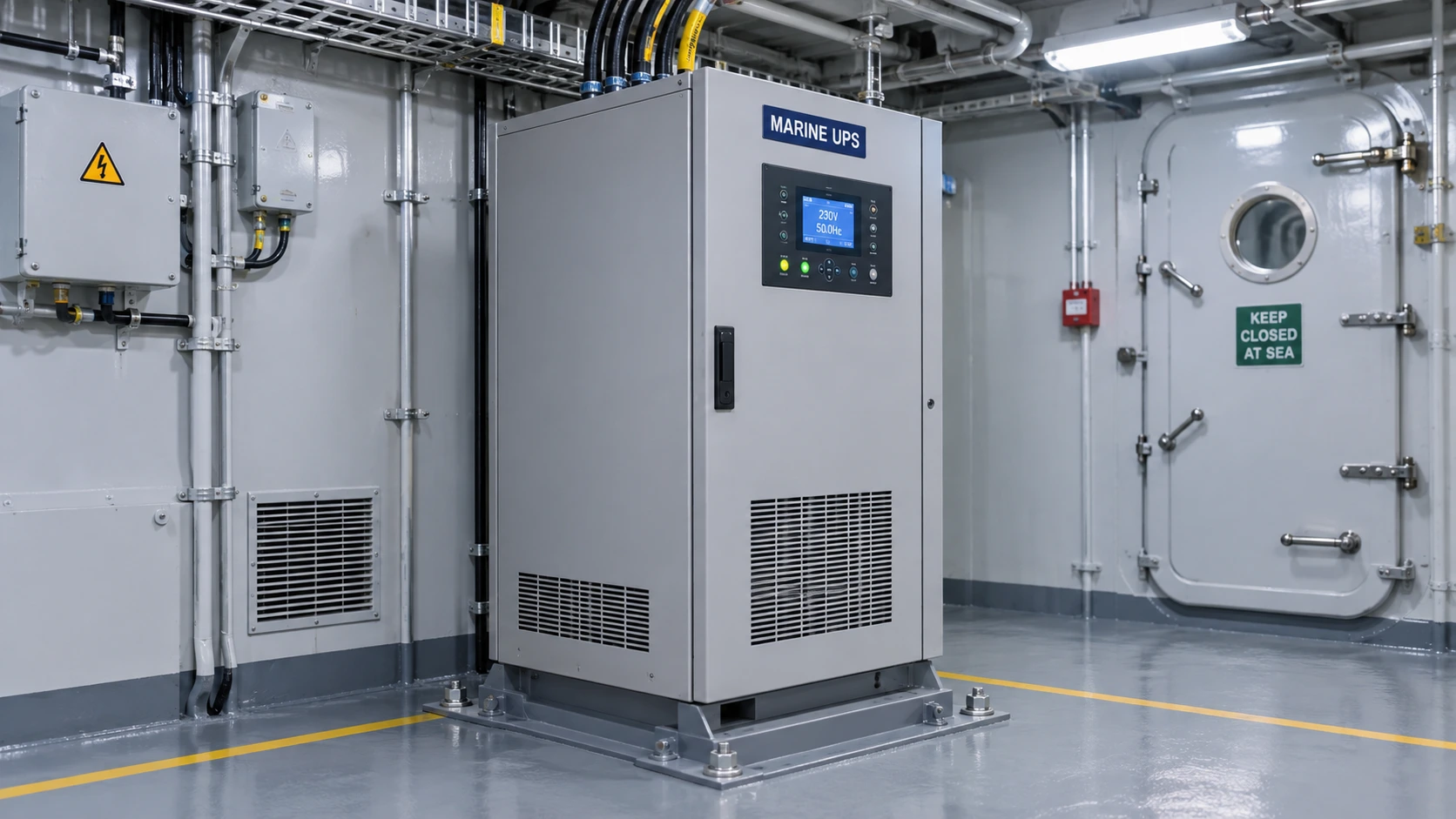
A marine UPS is an uninterruptible power supply designed, tested and certified for use on ships and offshore installations. It is normally an online double conversion UPS with a reinforced mechanical design, tolerance for the ship's electrical supply, batteries that can handle tilt and vibration, and a type approval certificate from a classification society. This guide explains what changes between a standard unit and a UPS for ships, how marine type approval works, what to check on the electrical side and the batteries, and how an offshore UPS such as the Eaton 9155 is specified.
What a UPS Does on a Vessel or Platform
A ship or offshore platform generates its own power, and its supply is less stable than a utility grid. Generators are started, stopped and paralleled. Large motors such as bow thrusters and compressors start across the line and pull the voltage down. Variable speed drives add harmonic distortion. A fault in one section is cleared by isolating it, which removes power from the equipment behind it for a moment.
A UPS rides through all of this on its battery and gives the protected load a clean supply. The protected loads are the essential services: navigation and communication equipment on the bridge, alarm and monitoring systems, programmable controllers for propulsion and auxiliary systems, dynamic positioning on vessels that hold station, and on offshore platforms the fire and gas detection and shutdown systems. An offshore UPS often sits in a safe-area equipment room with its own battery ventilation, since the platform's hazardous-area rules apply to anything installed outside it. Safety regulations and class rules specify which of these must have a no-break supply and for how long. The UPS is part of the safety case, not an accessory.
The runtime is set by the same rules and by the owner's specification. Some loads need only enough runtime for a generator changeover, a minute or less. Others, such as navigation equipment, need time to start the emergency generator and bring it online, often tens of minutes. Some systems need several hours. Each requirement sets the battery size, and the battery drives the weight, cost and space of the installation.
The Online Double Conversion UPS Principle
Three UPS topologies exist, and ships use the most protective one. In a standby design, the load runs from the supply and the UPS switches to its battery on failure, with a short transfer gap. A line-interactive design adds voltage regulation but still transfers. An online double conversion UPS always powers the load from its inverter. A rectifier converts the incoming AC to DC, which feeds the inverter and keeps the battery charged, and the inverter rebuilds a fresh sine wave. If the input fails, the battery takes over the DC bus without any break in the output.
The result is a load that never sees the disturbances on the input. Voltage dips, spikes, frequency swings and harmonics stop at the rectifier. That isolation is the reason an online double conversion UPS is the standard for essential loads at sea. The price is efficiency, since power passes through two conversions, and a modern unit reaches roughly 90 to 95 percent. The Eaton 9155 marine UPS in the TCC catalog lists 91 percent overall efficiency. The wasted energy appears as heat, and in a closed ship's compartment, heat is a design constraint.
What the Marine Environment Does to an Ordinary UPS
Five factors defeat commercial equipment at sea.
Vibration comes first. A ship's structure vibrates with the engines, the propeller and the waves, and equipment mounted on bulkheads and decks sees continuous low-frequency movement. Connectors loosen, capacitors fatigue, solder joints crack and heavy batteries shift. A marine design uses reinforced frames, locked connectors, secured components and batteries that are clamped in place.
Inclination is second. A vessel rolls and pitches, and in a fault or a heavy sea it can sit at a steep angle for a long time. A UPS must keep working while tilted, and its batteries must not leak. Class tests include operation at an inclination of around 22.5 degrees for emergency equipment. A flooded battery would spill acid at that angle, so sealed batteries are the norm.
Humidity and salt are third. The air is damp and carries salt, which corrodes copper, connectors and circuit boards, and condensation forms when equipment cools. The damp heat test in the marine type approval test specification cycles equipment at 55 °C and 95 percent humidity and measures insulation resistance before and after. Marine units use conformal coating on circuit boards, corrosion-resistant fasteners and enclosures with suitable ingress protection.
Temperature is fourth. Engine rooms and enclosed compartments can run hot, and a UPS inside a steel box at sea has no free cooling. The test specification covers high and low temperature limits for each location class, and a UPS that is rated only for a 25 °C office will derate or shut down.
Electromagnetic disturbance is fifth. A ship carries high-power radio and radar transmitters, large drives and long cable runs, so electromagnetic compatibility testing for marine equipment is stricter than for commercial equipment. All five are covered in the type approval tests.
Marine Type Approval and Class Society Rules
A ship is built and operated under the rules of a classification society, an organization that sets technical standards, surveys the vessel and issues certificates that insurers and flag states rely on. Equipment that serves essential or emergency functions normally needs approval from the society. The common route is marine type approval: the manufacturer submits a product design, the society reviews it and witnesses or accepts type tests, and the society issues a certificate for the product.
The International Association of Classification Societies publishes a unified requirement, UR E10, which defines the test specification for type approval of electrical, electronic and programmable equipment. Its tests include dry heat, damp heat, cold, vibration, inclination, electromagnetic compatibility, power supply variation and insulation. Revision 9, dated August 2023, applies to equipment whose type approval application date is on or after 1 July 2024. The inclination and vibration tests refer to the IEC 60092-504 standard for ships' control and instrumentation.
A certificate is only useful if it matches the installation. Check four things. The certificate must name the exact model or range, and the variant: a unit with single-phase input and a unit with three-phase input are different models. It must be valid and unexpired. It must cover the power range of the unit being supplied. And it must come from the society that the vessel is classed with, or from one the class society accepts. The Eaton 9155 is a good example. Eaton's catalog lists DNV type approval, BV type approval and ABS design assessment for the 8 to 15 kVA range, while its published material describes testing and certification with Lloyd's Register as in progress. A vessel classed with Lloyd's Register needs to confirm the position before ordering.
Electrical Differences: Ship Supply, Earthing and Harmonics
The input to a marine UPS comes from the ship's switchboard, which behaves differently from a utility supply. Voltage and frequency vary more, within the limits set by class rules, and the waveform carries distortion from drives and other non-linear loads. A UPS for ships has to accept the wider window without dropping to battery, because a UPS that goes to battery on every disturbance drains its cells and leaves nothing for a real outage. A wide input range and a rectifier that tolerates distortion are specified for that reason.
Earthing is the next difference. Many ships use an insulated neutral system, called an IT system, where no live conductor is solidly connected to the hull. A single earth fault does not trip the supply, and an insulation monitor warns of it. The UPS has to fit that scheme. Its input and output isolation, its filter capacitors to earth, and its leakage current all interact with the insulation monitoring, so the electrical drawings and the manufacturer's data need to be checked together. A UPS with a large earth leakage can cause a false insulation alarm.
Input and output arrangements follow the loads. The Eaton 9155 8 kVA unit in the catalog takes a three-phase input and gives a single-phase output, which suits a ship's switchboard feeding a bridge distribution board. The output may feed a changeover or distribution panel that includes a bypass, and the bypass arrangement should be agreed with the class surveyor, since a maintenance bypass that connects the load straight to a distorted supply defeats the purpose.
Short-circuit behavior also needs attention. Ship switchboards have high fault levels, and the UPS must be protected by correctly rated breakers or fuses upstream and must allow protective devices downstream to clear faults through its inverter current limit. Our article on industrial surge protection covers the transient side of the same problem, which is acute on a ship with long cable runs.
Batteries: Sealed Lead Acid, Lithium and Sizing
Most marine UPS units use valve-regulated sealed lead acid batteries, because they are maintenance-free, do not spill, and tolerate inclination. Lithium options exist, and classification societies publish specific rules for them because of fire risk. The battery is the part that wears out, and it dictates both the runtime and the maintenance plan.
Sizing starts with the load and the runtime. Take a load of 3.6 kW that needs to run for 15 minutes. The energy at the output is 3.6 kW × 0.25 h, or 0.9 kWh. With an inverter efficiency of about 92 percent, the battery must supply about 0.98 kWh. Batteries age, so designers apply an ageing factor, commonly 1.25 under IEEE 485 practice for lead acid cells, and they allow for the depth of discharge limit, which is often 80 percent of nominal. The nameplate battery energy needed is therefore about 0.98 × 1.25 ÷ 0.8, or roughly 1.5 kWh, and that is before a temperature correction for a cold or hot compartment. The same load for a one-hour runtime needs four times that.
Temperature is the dominant factor in battery life. A common engineering rule holds that each 8 to 10 °C above the rated temperature, usually 20 to 25 °C, roughly halves the life of a sealed lead acid battery. A UPS in a hot engine control room can lose half its battery life in a few years, so battery placement and compartment cooling are part of the design, and replacement is scheduled by age and test results, not by waiting for failure. The article on lead acid battery safety data sheets explains the documentation that travels with these batteries, and the post on how battery energy storage systems work covers lithium design in the larger format.
Standard Online UPS vs Marine UPS
The table summarizes where the two differ. The Eaton 9155 column uses figures from the TCC catalog and Eaton's published literature.
| Feature | Standard online UPS | Marine UPS | Eaton 9155 8 kVA |
|---|---|---|---|
| Mechanical design | Office or data room cabinet | Reinforced frame, secured parts, bolted down | Free-standing tower, 119 kg |
| Vibration and tilt | Not tested | Tested to marine type approval | Marine type approval |
| Humidity and salt | Controlled room assumed | Conformal coating, corrosion protection | Marine-rated construction |
| Input supply | Utility, narrow tolerance | Ship supply, wide tolerance | Three-phase input model |
| Battery | Often user-replaceable, upright use | Sealed, clamped, works when inclined | Internal battery modules, ABM charging |
| Approvals | CE, IEC 62040 | Class society certificate | DNV and BV type approval, ABS design assessment |
| Efficiency | 93 to 96 percent common | 90 to 94 percent typical | 91 percent overall |
| Documentation | Datasheet | Type approval certificate and test reports | Certificate per model variant |
A type approval certificate is part of the equipment. A marine UPS delivered without the right certificate cannot be installed, however good the hardware is.
The Eaton 9155 8 kVA as a Worked Example
The Eaton 9155 marine UPS in the TCC catalog is an online double conversion unit rated 8 kVA and 7.2 kW, with three-phase input and single-phase output, marine type approval, and the CE marking for the IEC and EN 62040 series. It uses Eaton's ABM battery management charger technology, reaches 91 percent overall efficiency, and is a free-standing tower weighing 119 kg.
Several points follow from that data sheet. The 119 kg weight needs a lifting plan and a deck or bulkhead position with the structural support to take it, plus bolting down with the approved fixings. The three-phase input suits a ship's switchboard, while the single-phase 230 V output feeds a bridge or control distribution board. The efficiency figure means about 0.7 kW of heat at full load, which the compartment ventilation must remove. And the type approval applies to the 8 to 15 kVA family, so confirm that the specific model with the three-phase input is covered by the certificate that the surveyor will see.
The Eaton 9155 8 kVA marine UPS is one option among many. Larger vessels and platforms use higher-rated marine units, and small craft use compact ones. The right size follows from the load list, not from the catalog.
Real-World Scenario: Replacing an Office UPS on an Offshore Support Vessel
This case is illustrative. An offshore support vessel has an office-grade 6 kVA UPS feeding the bridge navigation and alarm panels. After two years in service it has failed twice. The first time, a vibration-loosened battery connector caused a drop-out during a generator changeover. The second time, humidity and salt air corroded a control board. The class surveyor notes that the UPS has no type approval, and a condition of class requires a replacement.
The owner collects the load list first. The bridge and alarm loads total 3.4 kW at 0.9 power factor, about 3.8 kVA, and the specification asks for 30 minutes of runtime. The owner picks an 8 kVA marine UPS to leave headroom for later additions and for battery ageing, which is a larger size than the load alone requires. The supplier provides the type approval certificate, and the surveyor confirms it covers the three-phase input model.
Installation follows the approved arrangement. The unit is bolted to a bulkhead-supported plinth with locking fasteners, its input is fed from the essential services board through a rated breaker, and the output goes to the bridge distribution board. The insulation monitor is checked after commissioning to confirm the UPS does not trigger false earth fault alarms, and a runtime test confirms that the battery carries the load for the required time. The owner receives the certificate, the test record and the maintenance schedule, and the class condition is closed.
Specifying and Maintaining a Marine UPS
A short specification covers most of the decisions. Define the load list in kW and kVA, the power factor, and which loads are essential. Define the runtime for each load group, and state whether the requirement comes from class rules or from the owner. Define the input supply, voltage, frequency, phases and tolerance, and the output. State the installation location, with temperature range, humidity, vibration class and the ingress protection needed. Name the classification society and require the type approval certificate for the exact model. State the battery type, the life expectancy and the arrangement for replacement. Ask for alarm outputs, communications such as Modbus or dry contacts to the alarm system, and the spare parts list.
Maintenance follows the battery. Check the temperature in the compartment, test the battery with a load discharge test at least yearly, record the results, and replace cells or modules by age and measured capacity, since a battery that has fallen below about 80 percent of rated capacity is near the end of its life. Check connector torque and fan condition, and keep firmware current where the manufacturer recommends. TCC's electrical maintenance and reliability team supports battery testing and UPS servicing, and its electrical engineering team handles load calculations, selection and installation drawings. For a broader view of UPS selection on land, see our guide to choosing the right UPS for industrial control systems.
Frequently Asked Questions
What is a marine UPS?
A marine UPS is an uninterruptible power supply designed and tested for ships and offshore installations. It is usually an online double conversion unit with a reinforced mechanical design, tolerance for the ship's power supply, sealed batteries that work when tilted, and a type approval certificate from a classification society such as DNV, BV or ABS.
Why can't I use a standard UPS on a ship?
A standard UPS is not tested for vibration, inclination, salt-laden humidity or the wider voltage and frequency variation of a ship's supply, so it is likely to fail early. It also lacks the class society certificate that surveyors require for essential equipment. Even if it works for a while, the vessel can be refused class approval for the installation.
What is marine type approval?
Marine type approval is a certificate issued by a classification society after reviewing a product's design and witnessing or accepting its tests. For electrical and electronic equipment, the test program follows IACS UR E10 and covers heat, damp heat, cold, vibration, inclination, electromagnetic compatibility and supply variation. The certificate applies to a named model or range, so it must be checked against the exact unit supplied.
How long should a marine UPS battery last?
Sealed lead acid batteries in a marine UPS typically last several years, and their life depends heavily on temperature. A common rule is that every 8 to 10 °C above the rated temperature roughly halves battery life. Plan replacement by age and by yearly discharge tests, and replace the battery when measured capacity falls to around 80 percent of rated capacity.
Related products
Components from our catalogue relevant to this article — request a quote for availability, lead time and pricing.
/1031616 Eaton - 9155-8-N-M-0-64X0AH TA.webp "Eaton Eaton 9155 Marine UPS, 8 kVA / 7.2 kW | Online double-conversion marine UPS, 8kVA, 3-phase in / 1-phase out")
Eaton 9155 Marine UPS, 8 kVA / 7.2 kW
Online double-conversion marine UPS, 8kVA, 3-phase in / 1-phase out
/GHB3030-GR1 Eaton.webp "Eaton GHB3030-GR1 Eaton | Eaton GHB Circuit Breaker")
GHB3030-GR1 Eaton
Eaton GHB Circuit Breaker
/010005 Eaton - DILEM-10(24V50HZ).webp "Eaton 010005 Eaton - DILEM-10(24V50HZ) | Eaton DILEM contactor")
010005 Eaton - DILEM-10(24V50HZ)
Eaton DILEM contactor
/009737 Eaton - ZW7-240.webp "Eaton 009737 Eaton - ZW7-240 | Eaton Overload Relay")
009737 Eaton - ZW7-240
Eaton Overload Relay