
Air Circuit Breakers: Where a 6300 A Masterpact MTZ3 Sits in an Industrial LV System

Quick Answer
An air circuit breaker is the main protection device at the head of a low voltage switchboard. Here is how it works, how it differs from an MCCB, and where a 6300 A Masterpact MTZ3 belongs in an industrial LV system.
A 4000 kVA transformer feeding a 415 V busbar can deliver more than 90 kA into a fault at its own terminals. The first device that sees that current is the breaker at the head of the switchboard, and it has about two cycles to open a circuit that is carrying more energy than most plants will ever draw in normal use. Molded case breakers stop at around 1600 to 2500 A. Above that, the device in the incomer cubicle is an air circuit breaker.
An air circuit breaker, usually shortened to ACB, is a draw-out or fixed low voltage breaker that interrupts current in air at atmospheric pressure, with ratings from about 800 A up to 6300 A. It is built to be maintained, adjusted and tested, and to withstand a fault for a short time without tripping so that breakers further down the system can clear it first. This guide explains the air circuit breaker working principle, the ratings that decide a selection, the difference between an ACB vs MCCB, and where a 6300 A Masterpact MTZ3 sits in an industrial system.
Where an ACB Sits: Transformer Secondary, Bus Section and Generator Incomer
In a plant substation, ACBs appear in four places. The main incomer takes power from each transformer secondary. A bus coupler, or bus tie, joins two sections of a split board so that one transformer can carry both if the other trips. A generator incomer connects a standby set, interlocked with the mains breaker. And the largest outgoing feeders, such as a motor control center, a compressor house or a bus duct to a remote building, may need an ACB when their current exceeds what molded case devices handle.
The load current at a transformer secondary is simple arithmetic: kVA divided by the product of root three and the line voltage. A 2000 kVA transformer at 415 V gives about 2780 A, a 2500 kVA unit about 3480 A, a 3150 kVA unit about 4380 A, and a 4000 kVA unit about 5560 A. A 6300 A frame covers the 4000 kVA case with margin for the fan-cooled rating and for heating inside the cubicle.
The fault side of the same transformer is just as simple to estimate. With a 6 percent transformer impedance, a 4000 kVA unit can push roughly 5560 divided by 0.06, or about 93 kA, into a bolted fault if the upstream grid is strong. The breaker's breaking capacity must exceed that value, and the busbar must withstand it. Our short circuit current calculation guide shows the full method, including source impedance and motor contribution. The ACB rating is chosen after that study, not before it.
Air Circuit Breaker Working Principle: How the Arc Is Beaten
When contacts separate under load, current keeps flowing through an arc of ionized air. An ACB has to extinguish that arc in a few milliseconds without damaging the contacts or the enclosure, and the air circuit breaker working principle is built around making the arc longer, colder and easier to quench.
Each pole has two sets of contacts. The main contacts, usually silver alloy, carry current when closed. The arcing contacts, made of a harder material, open last and close first, so the arc forms on them and the main contacts stay clean. As the contacts part, magnetic forces from the current itself push the arc upward into an arc chute, a stack of steel plates. The plates split the arc into many short arcs in series, and each short arc adds a voltage drop. When the sum of those drops exceeds the system voltage, the arc cannot sustain itself, and at the next natural current zero of the AC waveform it goes out and does not reignite. Cooling by the plates and by the air carries the heat away.
The energy to move the contacts comes from a spring. A motor or a hand lever charges a closing spring, and a release coil lets it drive the contacts shut and charge a separate opening spring at the same time. A shunt trip coil, an undervoltage release or the protection unit releases that opening spring. Because the energy is stored, the breaker can open even if the control supply has failed, which is why it is a safe choice for a main incomer.
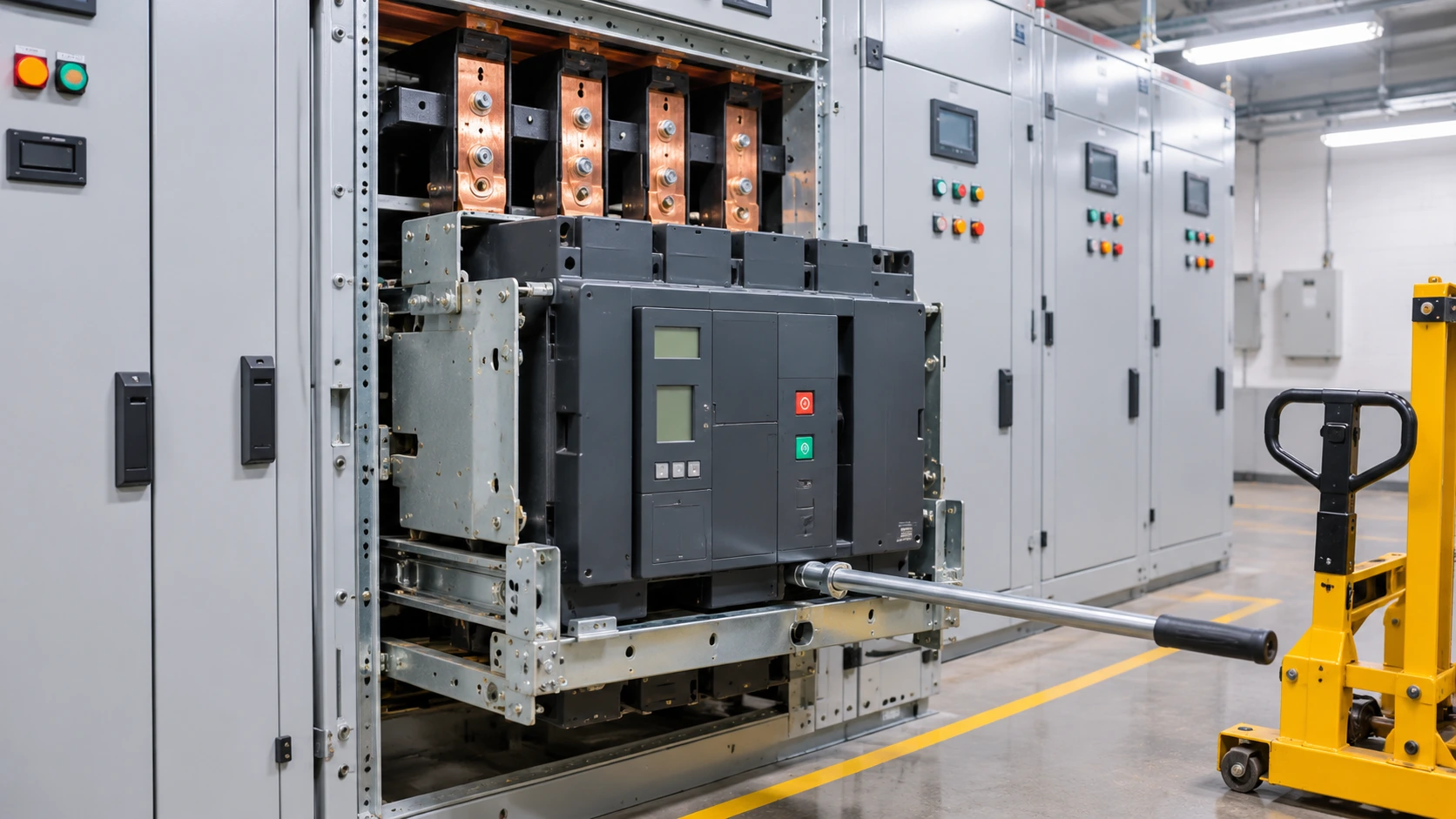
Most ACBs sit on a draw-out cradle. The breaker can be racked between connected, test and disconnected positions, so a technician can isolate it, test its operation without energizing the circuit, and swap it for a spare. Fixed versions bolt directly to the busbar and are cheaper but take longer to maintain.
The Ratings That Decide Selection: Icu, Ics, Icw and Category B
IEC 60947-2 defines the ratings. The table below lists those that decide an ACB selection and shows the values for the Masterpact MTZ3 63H2 listed in the TCC catalog. Where a figure comes from the manufacturer's published tables, the exact catalog number should be checked on the datasheet.
| Rating | What it means | MTZ3 63H2 (6300 A, 415 V) |
|---|---|---|
| In | Rated current of the frame | 6300 A |
| Icu | Ultimate breaking capacity: the highest fault current it can interrupt, once | 150 kA at 220 to 415 V |
| Ics | Service breaking capacity, as a percentage of Icu: how much it can interrupt and stay in service | 100 percent of Icu |
| Icm | Making capacity: the peak current it can close onto | 330 kA peak |
| Icw | Short-time withstand: the current it can carry for a set time without opening | About 100 kA for 0.5 s (manufacturer table) |
| Utilization category | A has no deliberate delay, B can be delayed for selectivity | Category B |
The relationship between Icu and Icm is fixed by the standard, which uses a factor of 2.2 for breaking capacities above 50 kA, so a 150 kA breaker has to close on 330 kA peak. Icw is lower than Icu because holding a fault for hundreds of milliseconds heats the contacts far beyond what interrupting it in a few milliseconds does.
The nameplate rating belongs to the breaker. The rating that counts belongs to the weakest item in the chain: busbar, cable, enclosure or breaker.
Category B is the property that makes selective coordination possible. A category B breaker is designed to ride through a fault long enough for a downstream breaker to clear it, while an ordinary molded case breaker of category A trips as fast as it can. Selectivity keeps one faulty feeder from taking out the whole board.
ACB vs MCCB: Which One Belongs Where
The question of ACB vs MCCB comes down to current, construction and what the owner expects to do with the breaker afterwards. The two are complementary, and a typical board uses both: an ACB at the head, MCCBs on the outgoing feeders.
| Feature | ACB | MCCB |
|---|---|---|
| Typical current range | About 800 to 6300 A | Up to about 1600 to 2500 A |
| Construction | Open frame, serviceable, draw-out or fixed | Sealed molded case, replaced as a unit |
| Short-time withstand | Yes, category B | Usually none, category A |
| Settings | Wide range of protection curves and delays | Narrower range, thermal-magnetic or electronic |
| Maintenance | Contacts, springs, trip unit all serviceable | Test and replace |
| Size and weight | Large and heavy | Compact |
| Cost | Higher | Lower |
Fault limiting is a further difference. Some MCCBs open so fast that they cut the peak of the fault current, which protects downstream equipment. An ACB does not limit current in the same way, and instead relies on its high withstand rating and on the strength of the busbar behind it. Where a downstream device is only rated for modest fault levels, a current-limiting MCCB or fuse protects it, and the ACB above rides through.
In North America the same class of device is called a low voltage power circuit breaker, and the standards differ. UL 1066, along with the ANSI C37 series, covers power circuit breakers in enclosures, while IEC 60947-2 governs the global market. An IEC-rated breaker does not automatically meet a UL specification, so a project that names UL needs a UL-listed device.
The Masterpact MTZ3 in Context
Schneider Electric's Masterpact MTZ range is built around three frame sizes, and the MTZ3 covers the top of the range, up to 6300 A. The catalog listing for the Masterpact MTZ3 63H2 is a fixed four-pole breaker with the H2 breaking capacity of 150 kA at 415 V and 330 kA making capacity. It is rated IP30 and for −25 °C to +70 °C ambient, and it weighs 160 kg. The companion listing, the MTZ3 50H1, is a drawout 5000 A unit at 100 kA breaking capacity and 220 kA making capacity, and it weighs 300 kg because the cradle is included.
Those weights decide a question that specifiers often miss. A 300 kg drawout breaker cannot be lifted by two people. The switchroom needs a lifting truck, a clear aisle and floor loading to match, and the switchgear manufacturer needs to provide the rails and the racking handle for the cradle.
Both catalog entries are listed without the control unit. The MTZ3 frame accepts MicroLogic X and Xi control units, with MicroLogic 2.0, 5.0, 6.0 and 7.0 variants offering progressively more protection and measurement functions, and the unit is ordered separately. A quotation that lists only the frame is incomplete. The MTZ3 63H2 also has four poles, so the neutral is switched, which suits systems with unbalanced or non-linear loads where a three-pole device would leave the neutral unprotected.
Installation Details That Decide Whether a 6300 A Breaker Performs
A 6300 A air circuit breaker only delivers its nameplate current if the cubicle around it lets the heat escape. The breaker's own losses, plus the losses in the busbar running to it, turn into heat inside a closed cubicle, and the manufacturer's rating assumes a specified enclosure, ventilation and ambient temperature. In a hot switchroom, such as a Gulf site where outdoor shade temperatures pass 45 °C, or a substation without air conditioning, the cubicle can run well above the test conditions. The result is derating: a 6300 A frame that carries 6300 A in a lab may carry noticeably less in the field. Ask the switchgear builder for the temperature rise test or derating curve for the actual assembly, and size the incomer with that in mind.
Connections are the next weak point. A joint between breaker terminals and busbar that is under-torqued, or that uses mismatched plating, heats under load, and at thousands of amps even a small resistance dissipates substantial power. Torque values come from the manufacturer's installation manual and should be recorded on the commissioning sheet. Where aluminum bus meets copper terminals, the right washers and joint compound prevent galvanic corrosion.
Environment completes the list. Dust from coal handling, cement or grain settles on insulating surfaces and, with humidity, forms conductive tracks. Coastal air carries salt. An enclosure with the right ingress rating, anti-condensation heaters in damp rooms, and a routine cleaning schedule keep a 6300 A air circuit breaker and its busbars clean. Door interlocks and padlocking provisions on the cradle protect the person racking the breaker, and arc-fault considerations apply to a main incomer at this fault level, so ask whether the switchboard has been tested for internal arc withstand per IEC TR 61641 and whether the room layout suits it.
Control Units, Settings and Selectivity
An electronic control unit gives the ACB its protection curve. The main adjustable functions follow a standard pattern, usually written LSIG. The long-time function, L, covers overloads, with a pickup current and a delay that follows an inverse-time curve. The short-time function, S, covers moderate faults with an adjustable pickup and a deliberate delay, which is what makes selectivity possible. The instantaneous function, I, trips with no delay above a high threshold. The ground-fault function, G, detects earth leakage and often needs a separate sensor on the neutral.
Zone selective interlocking, known as ZSI, refines selectivity. Each breaker signals the one above it when it sees a fault. If the downstream breaker is already handling the fault, the upstream unit keeps its delay. If no downstream breaker reports, the upstream one trips without waiting. The result is faster clearance for a fault right at the main busbar, where the stress on the equipment is highest, without losing selectivity elsewhere.
The control unit also measures current, voltage, power and energy, and it can communicate over Modbus or Ethernet. The manufacturer cites IEC 61557-12 for the metering function, which makes the readings suitable for energy monitoring. The settings come out of a protection coordination study. They should not be left at the factory defaults, because a default long-time pickup may be too close to the ampacity of the cables or the busbar. Our post on protection relay replacement covers what has to be re-checked whenever protection hardware changes.
Real-World Scenario: Upgrading a Main Incomer After an Expansion
A manufacturing plant runs two 3150 kVA transformers, each feeding a 415 V board through a 5000 A ACB, with a bus coupler between them. An expansion adds a production line, and the utility offers to change the transformers to 4000 kVA. The facts below are an illustration, not a client record.
The load current at each secondary rises from about 4380 A to 5560 A. The existing 5000 A breakers would be overloaded, so the incomers need a 6300 A frame. The fault level rises too: with 6 percent impedance and a strong grid, the available current increases from roughly 73 kA to about 93 kA. The existing breakers carry a lower rating than that, so the breaking capacity needs the H2 class.
The breaker is only one link. The busbar in the switchboard has its own short-time withstand rating under IEC 61439, and if the busbar is rated for 65 kA it cannot take 93 kA no matter what the breaker is rated for. The cables or bus duct from the transformer have to match. The room ventilation has to remove the heat of a larger breaker and the busbar running near its rating. And the downstream feeders need a new selectivity study, since every outgoing MCCB now sees a higher prospective fault level.
The result is a package of work: a new incomer and a larger bus section where required, a short-circuit study, a settings revision, and a primary injection test of the trip units. Replacing the breaker alone would have created a mismatch that a fault would eventually reveal.
Maintenance: Keeping an ACB Ready for the Fault
An incomer breaker may sit closed for years, and the design only proves itself on the one day it has to open. Grease dries and hardens in the mechanism, spring charge motors seize, and contacts accumulate resistance from oxidation and slight wear. A breaker that has not moved in five years can fail to open on command, which is why maintenance plans include exercising it.
A routine visit covers a visual check of the cubicle and the arc chutes for debris or discoloration, cleaning, and lubricating the mechanism per the manufacturer's schedule. It records the operations counter and the contact wear indicator. A contact resistance test with a micro-ohmmeter shows heating before it becomes visible, and an insulation resistance test checks the breaker and its cradle. The control unit is tested by secondary injection for the protection curves, and a primary injection test, which pushes real current through the breaker, proves the whole chain including the current sensors. Infrared thermography under load, from the front of the cubicle, finds loose joints on the busbar connections.
The LV panel commissioning test guide covers the checks that apply when a new board is first energized, and the same tests carry over to periodic maintenance. A common standard for acceptance and maintenance testing, ANSI/NETA MTS, lists the test and its tolerances for low voltage power circuit breakers. TCC's electrical maintenance and reliability team runs those tests on ACBs, records the as-found values, and compares them year to year. For new boards and expansions, our electrical engineering team handles the fault study, breaker selection and settings, and our power system audit service reviews existing boards where the breakers and the fault level may no longer match.
Frequently Asked Questions
What is an air circuit breaker?
An air circuit breaker, or ACB, is a low voltage breaker that interrupts current in air at atmospheric pressure. It is typically rated from about 800 A to 6300 A, can be fixed or draw-out, and is fitted with an electronic protection unit. Plants use it as the main incomer, bus coupler or generator breaker, where high current and high fault levels exceed molded case breaker limits.
What is the difference between ACB and MCCB?
An MCCB is a sealed molded case breaker, usually up to about 1600 to 2500 A, that is replaced as a unit. An ACB is an open-frame breaker, usually from about 800 A up to 6300 A, that can be maintained, adjusted and fitted with a draw-out cradle. ACBs normally have short-time withstand ratings, which allow selective coordination with downstream breakers, and MCCBs usually do not.
How does an air circuit breaker work?
Contacts separate when a trip signal releases a stored-energy spring. The arc that forms is pushed by magnetic force into an arc chute, where steel plates split and cool it. The combined arc voltage rises above the system voltage, and the arc goes out at the next current zero. The electronic trip unit measures current and decides when to release the spring, based on its settings.
What does a 6300 A air circuit breaker connect to?
At 415 V, a 6300 A frame suits the secondary of a transformer up to about 4000 kVA, which carries around 5560 A. It can also serve as a bus coupler on a large board or as an incomer for a large generator. The busbar, cables and enclosure must carry the same current and withstand the same fault level, so the breaker rating alone does not make the system adequate.
Related products
Components from our catalogue relevant to this article — request a quote for availability, lead time and pricing.
/48092 Schneider Electric.webp "Schneider Electric Schneider Electric Masterpact NW40H1 Air Circuit Breaker, 4000A | Fixed air circuit breaker, 4000A, 3-pole, 65kA, without trip unit")
Schneider Electric Masterpact NW40H1 Air Circuit Breaker, 4000A
Fixed air circuit breaker, 4000A, 3-pole, 65kA, without trip unit
/48106 Schneider Electric.webp "Schneider Electric Schneider Electric Masterpact NW40bH1 Air Circuit Breaker, 4000A, 3P | Fixed air circuit breaker, 4000A, 3-pole, 100kA, without trip unit")
Schneider Electric Masterpact NW40bH1 Air Circuit Breaker, 4000A, 3P
Fixed air circuit breaker, 4000A, 3-pole, 100kA, without trip unit
/48318 Schneider Electric.webp "Schneider Electric Schneider Electric Masterpact NW32H2 Air Circuit Breaker, 3200A, Drawout | Drawout air circuit breaker, 3200A, 4-pole, 100kA, without trip unit")
Schneider Electric Masterpact NW32H2 Air Circuit Breaker, 3200A, Drawout
Drawout air circuit breaker, 3200A, 4-pole, 100kA, without trip unit
/48339 Schneider Electric.webp "Schneider Electric Schneider Electric Masterpact NW40bH1 Air Circuit Breaker, 4000A, 4P | Drawout air circuit breaker, 4000A, 4-pole, 100kA, without trip unit")
Schneider Electric Masterpact NW40bH1 Air Circuit Breaker, 4000A, 4P
Drawout air circuit breaker, 4000A, 4-pole, 100kA, without trip unit