
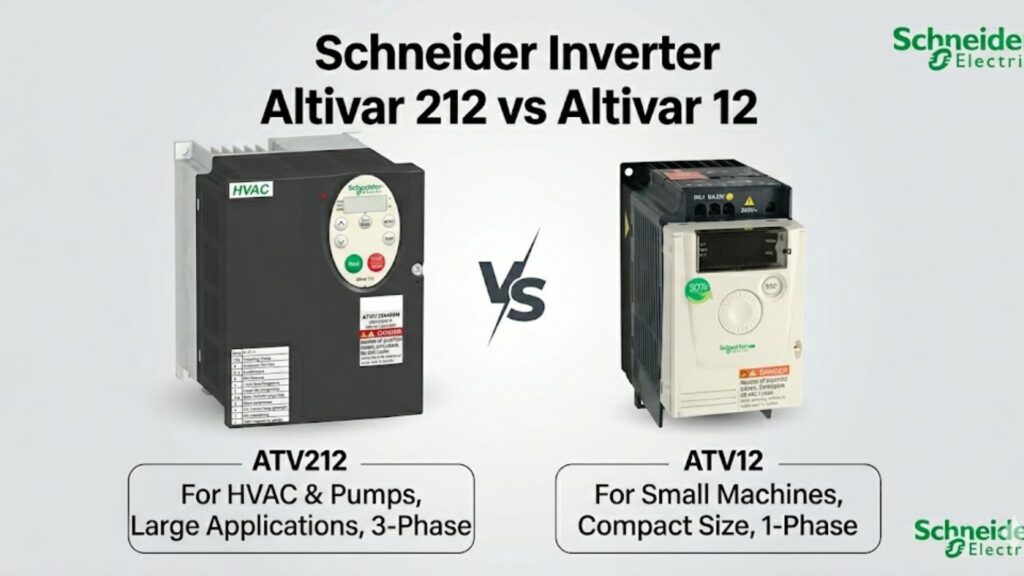
Schneider Inverter Altivar 212 vs Schneider Inverter Altivar 12 – Complete VFD Comparison Guide
When selecting a reliable Schneider inverter for motor control, two popular options are the Schneider inverter Altivar 212 and the Schneider inverter Altivar 12. Both drives are designed by Schneider Electric, but they are made for different types of applications. The Altivar 212 is mainly developed for HVAC, pumps, fans, and building automation systems, while the Altivar 12 is a compact variable frequency drive for small machines, simple motor control, conveyors, pumps, extractors, access barriers, and commercial equipment.
Choosing between Altivar 212 and Altivar 12 depends on your motor size, application type, input voltage, communication requirements, installation space, and energy-saving goals. This comparison guide explains the difference between both Schneider VFD models in a clear and practical way.
Quick Verdict: Which Schneider Inverter Is Better?
If your application is HVAC, building automation, pumps, fans, ventilation, or air conditioning, the Schneider inverter Altivar 212 is the better choice. It is designed specifically for HVAC and fluid management applications and supports communication protocols such as Modbus, BACnet, METASYS N2, APOGEE FLN P1, and optional LonWorks. Schneider states that Altivar 212 is designed for up to 70% energy consumption reduction compared with conventional control systems.
If your application is a small machine, small pump, conveyor, extractor, treadmill, access barrier, or basic motor control system, the Schneider inverter Altivar 12 is more suitable. It is compact, simple to install, easy to configure, and available in low power ratings such as 0.18 kW to 4 kW depending on the supply type.
Schneider Inverter Altivar 212 Overview
The Schneider inverter Altivar 212 is a variable speed drive designed for 3-phase asynchronous motors used in HVAC and building services. It is commonly used in heating, ventilation, air conditioning, pumping, fan control, and fluid management applications.
The Altivar 212 is built for energy efficiency. In many buildings, HVAC systems run for long hours every day. A fixed-speed motor can waste energy because it runs at full speed even when the system does not need full output. The Altivar 212 VFD adjusts motor speed according to demand, helping reduce power consumption, improve comfort, and increase equipment life.
The Altivar 212 range covers motor power ratings from 0.75 kW to 75 kW and is available for 200–240 V three-phase and 380–480 V three-phase supply ranges depending on the model. It is also available in IP21 and UL Type 12/IP55 versions.
Main Uses of Altivar 212
The Schneider VFD Altivar 212 is best for:
HVAC systems
Chilled water pumps
Booster pumps
Ventilation fans
Cooling tower fans
Air handling units
Heating systems
Air conditioning systems
Commercial building automation
Industrial fluid management
Schneider Inverter Altivar 12 Overview
The Schneider inverter Altivar 12 is a compact VFD designed for simple machines and small motor applications. It is often selected where space is limited and the motor power is relatively low.
The Altivar 12 VFD is commonly used for small pumps, conveyors, mixers, extractors, access barriers, treadmills, swimming pool pumps, irrigation pumps, and commercial equipment. It is suitable for users who need a simple, reliable, and cost-effective Schneider inverter for basic speed control.
The Altivar 12 range generally covers 0.18 kW to 4 kW, depending on the supply version. It is available in 100–120 V single-phase, 200–240 V single-phase, and 200–240 V three-phase versions. Schneider documentation also notes that the Altivar 12 output voltage is 200–240 V three-phase, regardless of line supply type.
Main Uses of Altivar 12
The Schneider inverter Altivar 12 is best for:
Small conveyors
Small pumps
Extractors
Access barriers
Treadmills
Mixers
Commercial equipment
Simple machines
Small HVAC machines
Basic motor speed control
Altivar 212 vs Altivar 12 Comparison Table
| Feature | Schneider Altivar 212 | Schneider Altivar 12 |
|---|---|---|
| Product Type | Variable speed drive / VFD | Variable speed drive / VFD |
| Best Application | HVAC, pumps, fans, building automation | Small machines, conveyors, pumps, extractors |
| Motor Type | 3-phase asynchronous motors | Mainly 3-phase asynchronous motor output |
| Power Range | 0.75 kW to 75 kW | 0.18 kW to 4 kW |
| Voltage Range | 200–240 V 3-phase, 380–480 V 3-phase | 100–120 V 1-phase, 200–240 V 1-phase, 200–240 V 3-phase |
| Main Strength | HVAC energy saving and BMS integration | Compact size and simple machine control |
| Communication | Modbus, BACnet, METASYS N2, APOGEE FLN P1, optional LonWorks | Integrated Modbus via RJ45 |
| Installation Type | IP21 and IP55/UL Type 12 options | Heatsink and base plate versions |
| Energy Saving | Up to 70% in suitable HVAC applications | Energy saving for small pumps and machines |
| Best For | Buildings, HVAC plants, pump rooms | OEM machines and small equipment |
| Manual Keywords | Altivar 212 manual, Altivar 212 VFD manual, Altivar 212 programming manual | Altivar 12 manual, Altivar 12 user manual, Altivar 12 programming |
Major Difference Between Schneider Altivar 212 and Altivar 12
The main difference is application size and purpose. The Altivar 212 is a more specialized HVAC drive for building automation, pumps, fans, and large energy-saving applications. It is suitable for commercial buildings where motor control must integrate with a Building Management System.
The Altivar 12, on the other hand, is made for small machines and compact installations. It is easier to use for basic applications where advanced HVAC communication is not required.
In simple words:
Choose Altivar 212 for HVAC, pumps, fans, and BMS integration.
Choose Altivar 12 for compact machines, small motors, and simple speed control.
Schneider Altivar 212 Features
The Schneider inverter Altivar 212 offers strong features for HVAC users:
Energy-saving design for pumps and fans
Designed for heating, ventilation, and air conditioning
Suitable for 3-phase asynchronous motors
Communication with Modbus and BACnet
METASYS N2 and APOGEE FLN P1 support
Optional LonWorks communication card
IP21 and IP55 options depending on model
Built-in EMC filter in selected models
Reduced current harmonics
Energy consumption monitoring
Ideal for building automation systems
These features make the Altivar 212 a professional choice for facility managers, HVAC contractors, industrial automation companies, and commercial building operators.
Schneider Altivar 12 Features
The Schneider inverter Altivar 12 is designed around simplicity, compact size, and easy commissioning. Its main features include:
Compact VFD design
Easy installation and wiring
Suitable for small machines
Integrated Modbus communication
Quick motor control settings
Advanced PID function in selected applications
Catch-on-the-fly function
Heatsink and base plate versions
Compatible with SoMove software
Suitable for conveyors, pumps, extractors, access barriers, and treadmills
The Altivar 12 is a good choice when you need a small Schneider VFD that is easy to install and does not require complicated setup.
Altivar 212 Manual and Programming Guide
Before installation, users should always check the Altivar 212 manual and Altivar 212 VFD manual. The manual provides important safety, wiring, input voltage, mounting, and configuration instructions.
The Altivar 212 programming manual is especially important when setting up motor parameters, acceleration time, deceleration time, input/output functions, communication settings, fault reset, and energy-saving functions.
Important search terms for documentation include:
Schneider VFD Altivar 212 manual
Altivar 212 programming manual
Altivar 212 manual
Altivar 212 VFD manual
Altivar 212 installation manual PDF
Altivar 212 input wiring
These manuals help technicians install and configure the drive correctly for HVAC and pumping applications.
Altivar 12 Manual and User Guide
The Altivar 12 manual is also important for correct installation and programming. Schneider’s ATV12 user manual explains mechanical and electrical information and shows how to install, wire, and program the drive. The latest Schneider document page lists the ATV12 user manual as a user guide for installation, wiring, and programming.
Common documentation search terms include:
Altivar 12 manual
Altivar 12 user manual
Altivar 12 programming manual
Schneider Altivar 12 VFD manual
Altivar 12 installation guide
Altivar 12 wiring diagram
For small machines, the Altivar 12 manual helps with basic motor control settings, input/output configuration, Modbus setup, and fault troubleshooting.
Altivar 212 Input vs Altivar 12 Input
The Altivar 212 input is mainly available in three-phase voltage classes such as 200–240 V and 380–480 V depending on the model. It is suitable for larger HVAC and pump applications where 3-phase supply is commonly used.
The Altivar 12 input is more flexible for smaller machines because it includes single-phase and three-phase supply options. Common versions include 100–120 V single-phase, 200–240 V single-phase, and 200–240 V three-phase. This makes the Altivar 12 useful for small workshops, commercial machines, and compact equipment where only single-phase supply may be available.
Which Schneider Inverter Is Better for HVAC?
For HVAC applications, the Schneider inverter Altivar 212 is the better option. It is specifically designed for pumps and fans in HVAC systems and supports building automation communication protocols such as BACnet and Modbus. Schneider product pages describe Altivar 212 models as drives for pumps and fans in HVAC and show communication support including METASYS N2, Modbus, LonWorks, APOGEE FLN, and BACnet depending on model.
The Altivar 12 can be used in some small HVAC machines, but it is not the same level of HVAC-focused drive as the Altivar 212.
Which Schneider Inverter Is Better for Small Machines?
For small machines, the Schneider inverter Altivar 12 is better. It is smaller, easier to install, and designed for commercial equipment and simple machines. It is suitable for conveyors, pumps, extractors, access barriers, and treadmills.
If the machine has a low-power motor and does not need advanced building automation protocols, Altivar 12 is usually the more practical choice.
Which Drive Is More Cost-Effective?
The answer depends on the application. For small machines, Altivar 12 is usually more cost-effective because it is compact and designed for low-power applications. Using Altivar 212 for a very small machine may be unnecessary.
For HVAC systems, Altivar 212 can be more cost-effective in the long run because it is built for energy saving, pump and fan control, and building management integration. In large buildings, energy savings can become more important than initial purchase price.
Installation Difference
The Altivar 212 installation manual PDF is important because this drive is often used in larger HVAC panels, pump rooms, and building automation projects. Proper ventilation, grounding, EMC requirements, and communication wiring must be considered.
The Altivar 12 installation guide is usually simpler because the drive is compact and used in smaller machines. However, safe wiring, correct input voltage, motor rating, and proper enclosure design are still very important.
In both cases, installation should be handled by qualified electrical personnel.
Final Recommendation
Both Schneider VFDs are reliable, but they are not made for the same job.
Choose Schneider inverter Altivar 212 if you need a VFD for:
HVAC systems
Pumps and fans
Building automation
BACnet communication
Energy-saving motor control
Large commercial buildings
Air conditioning and ventilation systems
Fluid management applications
Choose Schneider inverter Altivar 12 if you need a VFD for:
Small machines
Conveyors
Small pumps
Access barriers
Extractors
Treadmills
Simple motor speed control
Compact electrical panels
Low-power motors
For professional HVAC and building projects, the Schneider Altivar 212 is the stronger option. For compact machines and small equipment, the Schneider Altivar 12 is the smarter and more economical choice.
Conclusion
The comparison between Schneider inverter Altivar 212 and Schneider inverter Altivar 12 shows that both drives are useful, but each one has a different purpose. Altivar 212 is a specialized HVAC VFD built for pumps, fans, ventilation, air conditioning, and building management systems. Altivar 12 is a compact VFD for small machines, simple applications, and low-power motor control.
If you want advanced HVAC control, energy saving, and BMS communication, select Altivar 212. If you need a small, simple, and easy-to-install Schneider inverter, select Altivar 12.
FAQs
The main difference is application. Altivar 212 is designed for HVAC, pumps, fans, and building automation. Altivar 12 is designed for small machines, conveyors, pumps, extractors, and simple motor control.
Altivar 212 is better for HVAC because it is specifically designed for heating, ventilation, air conditioning, pumps, fans, and building management systems.
Altivar 12 is better for small machines because it is compact, simple to install, and suitable for low-power motors.
Yes, Altivar 212 supports BACnet along with other communication options such as Modbus, METASYS N2, APOGEE FLN P1, and optional LonWorks.
The Altivar 212 programming manual is used for parameter setting, motor configuration, input/output setup, communication settings, and troubleshooting.
Altivar 212 input voltage depends on the model. Common versions include 200–240 V three-phase and 380–480 V three phase supply.
Altivar 12 is used for small machines, conveyors, pumps, extractors, access barriers, treadmills, mixers, and commercial equipment.