
Robotics in Manufacturing: Where Inspection and Maintenance Robots Earn Their Keep

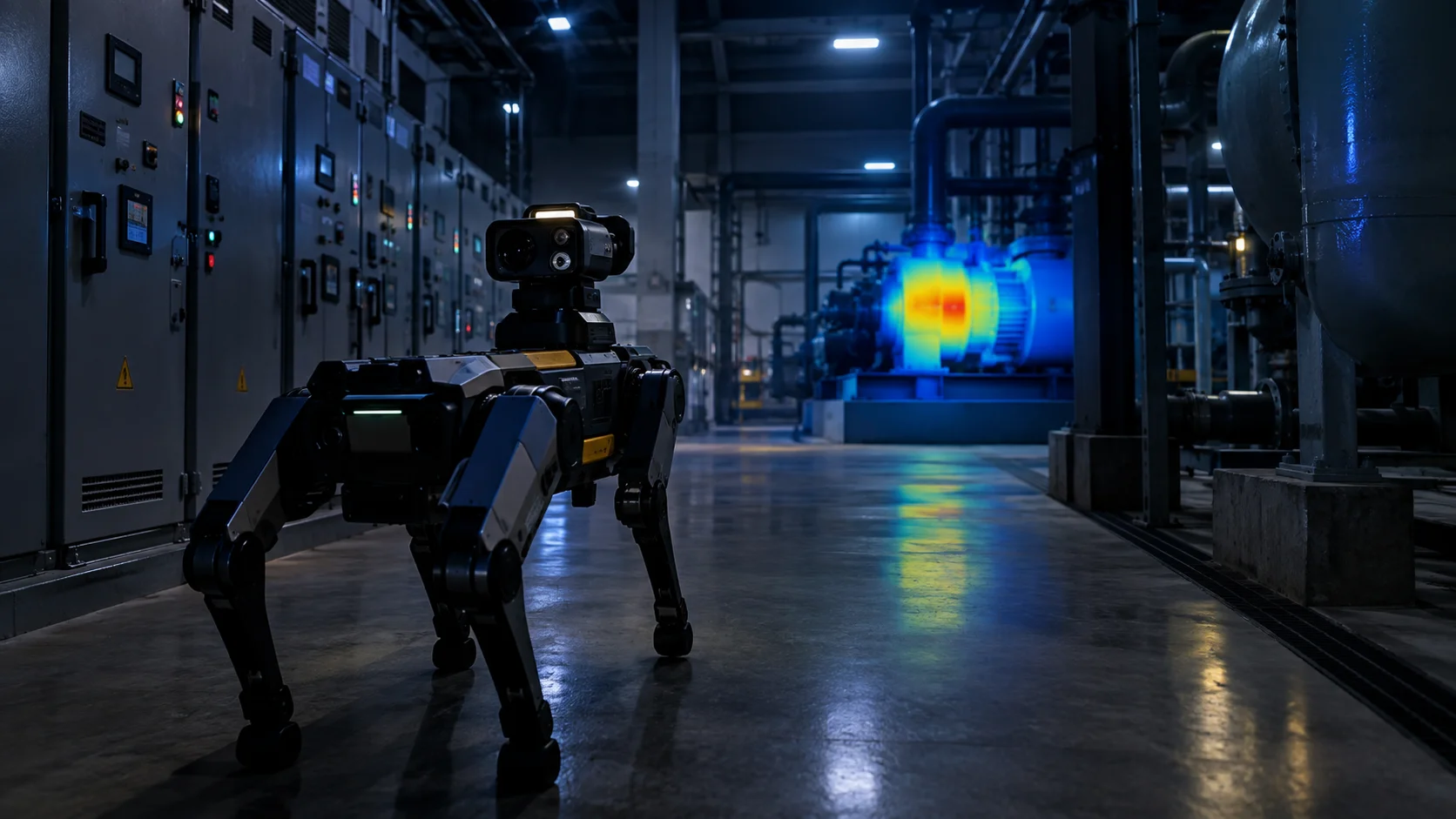
Quick Answer
Robotics in manufacturing splits into two economies: production arms that only pay back when you rebuild the line, and inspection and maintenance robots that pay the moment sending a person costs more than sending a machine. Here is where each earns its keep.
Most conversations about robotics in manufacturing stall on the wrong question. People argue about whether robots replace welders and assemblers, settled thirty years ago, and skip the one with money behind it: which robots pay back on a plant already built, already staffed and already running at capacity? Rarely another six-axis arm; more often the machine that walks the compressor house at 03:00 with a thermal camera and a microphone array, or the crawler that ultrasonically maps a tank floor without draining it.
The two halves of this field have different economics. Production robots buy throughput, and only make sense when you are changing what the plant builds or how fast. Inspection and maintenance robots buy information about assets you already own, and they pay the moment it costs more to put a person in front of an asset than to send a machine. On a live refinery, that crossover arrives quickly.
Production robots change what your plant makes. Inspection robots change what your plant knows. Only one of those is available without rebuilding the line.
How Is Robotics Used in Manufacturing Today?
Robotics in manufacturing is used in four broad ways: material handling and machine tending, process operations such as welding, painting and dispensing, assembly and fastening, and inspection or quality control. The International Federation of Robotics counted 542,076 industrial robots installed worldwide in 2024 in its World Robotics 2025 report, taking global operational stock to roughly 4.66 million units, up 9 percent year on year, with Asia absorbing 74 percent of new installations. Density reached 267 robots per 10,000 manufacturing employees in Western Europe, against 1,220 in the Republic of Korea.
Those figures cover the first group only: the IFR counts articulated arms, SCARA, delta and gantry machines inside production, not quadrupeds patrolling a gas plant, pipeline pigs or tank crawlers. For a straight answer to how is robotics used in manufacturing beyond the production line, look at the machines that never touch the product. That second population is where most brownfield plants in the Gulf, Russia and South Africa will spend over the next five years, because it does not require touching the process.
What Is the Difference Between a Cobot and an Industrial Robot?
A cobot is an industrial robot. The distinction is the application, not the machine: what changes is whether the risk assessment lets a person share the workspace while the robot moves.
ISO 10218-1:2025 and ISO 10218-2:2025 replaced the 2011 editions on 1 April 2025. Part 1 now splits industrial robots into Class I, very low hazard machines with reduced control requirements, and Class II, everything else. Part 2, which governs the integrator, roughly tripled in length, absorbed the collaborative-application content from ISO/TS 15066, and added cybersecurity requirements for the first time. The four recognized collaborative techniques survive: safety-rated monitored stop, hand guiding, speed and separation monitoring, power and force limiting.
The practical consequence: a cobot arm does not make an application collaborative. Put a 5 kg cobot on a deburring tool with a spinning carbide burr and you have an industrial robot application needing a guarded cell, whatever the datasheet says. The biomechanical contact limits in ISO 10218-2:2025 cover the robot and its payload, not the sharp or hot thing bolted to the end.
Robotics in Automotive Manufacturing
Robotics in automotive manufacturing remains the reference case because the duty cycle justifies almost anything: body-in-white welding, sealant dispensing, powertrain assembly and paint booths run high volumes of identical parts with cell geometry fixed for the model's life, and the IFR reported 13,700 units installed in the US car industry alone in 2024, up 10.7 percent. The sector's most interesting current work is not another spot-welding arm, though. It is vision-based inline gauging replacing offline CMM checks, and end-of-line leak and gap-and-flush inspection: measurement, not production.
Copying automotive's arm density into a batch chemical plant does not work; copying its insistence on measuring every part does. Good industrial automation design starts with what needs measuring, then what needs to move.
What Do Inspection Robots Actually Detect?
Inspection robots detect four physical signatures, with the AI layer acting as a classifier on each. What each can and cannot resolve separates a robot that raises work orders from one that fills a photo library nobody reads.
Thermal. A radiometric camera on a pan-tilt head captures the same asset from the same waypoint every patrol, and the model compares each image against a baseline. The ANYbotics ANYmal X, currently the only ATEX and IECEx Zone 1 IIB certified legged robot, carries a thermal camera reading -10 °C to +400 °C on a pan-tilt unit with ±90° vertical and ±165° horizontal travel, alongside a 20x zoom camera, microphone and lidar in an IP67 body. Thermal catches loose terminations, failing bearings, blocked coolers and passing steam traps. It fails on reflective surfaces: polished stainless, galvanized sheet and glass reflect infrared, and an apparent hotspot that moves with sun angle is a reflection, not heat. Emissivity must be pinned per asset and waypoint or the trend is worthless.
Acoustic and ultrasonic. A MEMS microphone array beamforms to localize a sound source and overlays it on the visible image. Teledyne FLIR's Si124 uses 124 microphones across 2 kHz to 65 kHz; the Fluke ii900 covers 2 kHz to 52 kHz beyond 50 m, and the ii910 reaches 100 kHz and up to 120 m, bringing partial discharge on insulators, switchgear and overhead lines into scope. US Department of Energy guidance holds that leaks take 20 to 30 percent of a compressed air system's output, against below 10 percent for a well-maintained one. Localizing leaks weekly rather than annually turns that gap into kilowatts.
Vibration. Robots are poor vibration platforms. A walking machine cannot hold an accelerometer against a bearing housing with repeatable pressure, and airborne acoustics do not substitute when you need bearing defect frequencies. Serious programs stay on installed sensors or route collection by an ISO 18436 certified analyst, structured against ISO 17359:2018 with data architecture per ISO 13374-1. A patrol robot screens; it does not replace that.
Gas. Optical gas imaging and point sensors for combustible and toxic gas are the standard optional payload. The ExRobotics ExR-2, a tracked Zone 1 certified platform, carries up to 30 kg of payload, runs 120 minutes per charge, covers a 2 km mission range and returns to an ATEX and IECEx Zone 1 certified dock. Fugitive methane detection dominates, the one application with a regulatory driver.
Where the AI Layer Falls Over
Anomaly detection against a baseline works for slow, monotonic degradation. It works badly for anything intermittent, anything appearing only under a load condition the patrol never coincides with, and anything the baseline already contains. If a pump was already running 12 °C hot when the baseline was captured, the model treats that as normal for the asset's life. Rebaselining after every overhaul is not optional, and almost nobody does it.
The second failure mode is alarm economics. A robot raising 40 anomalies a week for an engineer to triage manually costs more than it saves. The fix is unglamorous: tight per-asset thresholds, thermal findings cross-referenced against process data, and a hard rule that an anomaly generating no CMMS work order is not an anomaly. That work lands on the team owning PLC and SCADA integration, because the output only matters once it reaches the same historian as everything else.
Crawlers, Pigs and Drones: Robots That Go Where People Cannot
Patrol robots get the attention. The hardest financial case belongs to the robots that eliminate an entry permit or a shutdown.
Tank and vessel crawlers. Submersible crawlers pairing magnetic flux leakage arrays with ultrasonic thickness arrays inspect storage tank floors while the tank stays in service and full of product. MFL screens the full floor plate in almost any surface condition; the UT array then sizes what MFL found. The case is the avoided outage: draining, cleaning, gas-freeing and recommissioning a large product tank costs far more than the survey. The work still has to satisfy API 653 coverage requirements, and a robotic survey does not discharge every element of an out-of-service internal inspection, so map coverage against the code before deferring the outage.
In-line inspection tools. Pipeline pigs carrying MFL or UT sensor arrays are the oldest genuinely autonomous inspection robots in industry. API Standard 1163, In-line Inspection Systems Qualification, frames tool performance as probability of detection, probability of identification and sizing accuracy, each at a stated confidence level, typically 80 or 90 percent. A high-resolution MFL tool commonly specifies depth sizing near ±10 percent of wall thickness at 80 percent confidence. An ILI report without stated POD and sizing tolerance is a picture, not a result.
Confined space and subsea units. Vessel internals, sewers, water intakes and ballast tanks are where crawlers and small ROVs pull the highest-consequence work out of the permit system. The gain is not speed; it is that nobody signs an entry permit.
UAV inspection. Flare stacks, cooling towers, transmission line hardware and tank roofs are the natural drone targets, and the flare tip is clearest: inspecting it conventionally means a shutdown or rope access, while a drone with zoom and thermal payloads does it while the flare burns. ADNOC Gas, AIQ and Gecko Robotics announced a three-year program in November 2025 feeding robotic inspection data into an AI platform, projecting over USD 300 million in maintenance and inspection savings across five years. Savings at that scale come from deferred shutdowns, not labor substitution.
Fixed vision cells. The least glamorous category often has the shortest payback, because controlled lighting and a fixed working distance solve what mobile robots never fully solve: repeatable geometry and repeatable illumination. The constraint is training data, since the defect classes you most want to catch are the ones with fewest examples. That is the single place where generative AI in manufacturing has a defensible role: synthesizing realistic defect images to balance training sets for under-represented classes. Beyond it, treat generative AI in manufacturing claims skeptically. Summarizing inspection reports is a convenience; deciding whether a weld passes is a safety case needing validation evidence.
The Infrastructure Nobody Budgets For
Robotics in manufacturing fails at the infrastructure line more often than at the robot line.
Hazardous area certification. Any robot entering a classified area needs equipment protection appropriate to the zone, certified under IEC 60079. The base standard, IEC 60079-0, moved to Edition 8.0 in June 2026, superseding the 2017 seventh edition. Zone 2 units are comparatively straightforward; Zone 1 is a different engineering problem, which is why the Zone 1 certified fleet is small and expensive. Robot marking follows the same logic as any junction box, covered in our guide to Ex d versus Ex db equipment marking.
Certification regimes are not interchangeable, which catches international projects. An ATEX or IECEx certificate does not satisfy the Eurasian Economic Union: TR CU 012/2011 requires its own EAC Ex certificate, and IECEx or ATEX test reports cannot substitute for EAC testing even though the protection concepts are harmonized with IEC. In South Africa, selection follows SANS 10108 and type-tested Ex equipment needs an Inspection Authority certificate under ARP 0108, issued by an accredited laboratory and valid ten years. Budget certification time into delivery, not commissioning.
Charging, coverage and climate. A patrol robot is only autonomous if it docks and charges without a human, and in a classified area the dock must be certified to the same zone. Dock siting drives cable routing and usually a dedicated circuit from the nearest MCC: ordinary electrical engineering work nobody scopes until the robot lands on site. They also stream video and telemetry continuously and need handover between access points mid-mission, and steel structures and tank farms are hostile RF environments, so survey coverage before purchase. Gulf summer ambients above 50 °C push battery and electronics limits hard, derating runtime below datasheet figures, while fine sand attacks seals and leg joints. Ask for measured runtime at 50 °C.
| Robot class | Typical role | Key constraint | Payback driver |
|---|---|---|---|
| Articulated / SCARA / delta | Weld, handle, assemble | ISO 10218-2:2025 cell | Throughput, scrap |
| Cobot (power/force limited) | Low-payload assembly | Risk-assessed application | Changeover flexibility |
| Quadruped / wheeled patrol | Rounds, thermal, acoustic | Zone build, derating | Data frequency, fewer entries |
| Tank / vessel crawler | In-service floor MFL/UT | Submerged, spark-safe | Avoided outage cost |
| In-line inspection tool | Pipeline wall loss, cracking | Launcher, receiver, flow | API 1163 qualified data |
| UAV | Flare tips, stacks, lines | Wind, airspace approval | No shutdown |
| Fixed vision cell | Inline 100 percent check | Lighting, fixed geometry | Escape rate, rework |
A Real-World Scenario: The Compressor House Inspected Once a Year
The Setup
A urea plant in the Gulf ran a synthesis gas compressor house classified Zone 2, with four 6.6 kV motors between 1,200 and 3,500 kW driving compressor and pump trains. Operator rounds happened twice per shift but were visual and auditory only, through a doorway: getting close inside a 48 °C building was unpleasant and the rounds sheet did not require it. Thermography was contracted annually, so between surveys the plant saw its electrical system through relay events.
What Went Wrong
The non-drive-end bearing housing on one 3,500 kW motor began running hot after a lubrication schedule change during a turnaround. The rise was gradual: roughly 4 °C over eight weeks, then accelerating. The annual survey had been completed three weeks before that change, so the detection window closed behind it. The motor tripped on winding overtemperature fourteen weeks later, with bearing damage advanced enough that the rotor came out and the journal needed re-machining, costing six days of reduced-rate operation. A 4 °C rise is invisible to someone walking past and obvious in a weekly thermal trend.
The Fix
A Zone 2 certified wheeled patrol robot with thermal and acoustic payloads now runs four times a week through the compressor house and the adjacent MCC room, alongside fixed vibration monitoring on the two largest trains. Waypoints were defined per bearing housing and per switchgear cubicle with emissivity pinned per surface, and the baseline is rebuilt after every overhaul. Acoustic imaging found an instrument air leak on a valve positioner in the first fortnight.
What the robot did not do is worth stating plainly. It missed a stator winding insulation problem on a second motor, which surfaced later through routine offline testing. Surface thermal patrol cannot see inside a winding, and no amount of AI changes that; that failure mode belongs to the tests in our guide to motor testing methods. The robot raised the frequency of the measurements it could make. It did not expand the list.
A patrol robot changes inspection frequency from annual to weekly. It does not change what a thermal camera is physically able to see.
What Does a Maintenance Robot Cost to Run?
Publicly documented pricing for a Boston Dynamics Spot-class platform starts near USD 75,000 bare, and industrial deployments with a thermal payload, onboard compute, dock and first-year software and support land around USD 150,000 to 195,000 in year one. Zone 1 platforms sit above that. Robotics-as-a-service subscriptions for patrol units are commonly quoted at USD 1,500 to 8,000 per unit per month on 12 to 36 month terms.
The running cost that gets missed is not the robot. It is the half to one full-time equivalent needed to define waypoints, maintain baselines, triage anomalies and keep the fleet serviceable, plus annual licensing and Ex recertification after any repair. Budget for a robot operator or the fleet quietly stops being used inside a year.
Payback comes from three places, in descending order of reliability: avoided shutdowns and permit entries, extended inspection intervals justified by better data, and energy recovered from leaks and thermal faults caught early. Labor substitution is the weakest argument and the one vendors lead with. On a plant already running a structured electrical maintenance and reliability program, price one avoided unplanned outage of the largest critical machine and ask how many years of robot operating cost it covers.
Where Digital Twins and Generative AI Actually Fit
Digital twin predictive maintenance is real but frequently oversold. A twin that earns the name is a calibrated physics model of a specific machine, fed live sensor data, estimating internal states that are not directly measured and projecting remaining useful life from them. It needs instrumentation dense enough to constrain it and continuous recalibration. Digital twin predictive maintenance built on a 3D visualization with live tag values overlaid is a dashboard, and it will not predict anything.
The honest sequencing for smart automation manufacturing programs is unglamorous. Fix instrumentation and data quality first, because a model trained on drifting transmitters learns the drift. That means disciplined instrumentation and control practice, calibration records that exist, and a historian retaining raw data rather than compressed averages. Robots feed that chain well and substitute for it badly. Smart automation manufacturing initiatives fail at the data layer far more often than at the algorithm layer, and the robot is usually the last thing bought, not the first.
If you are scoping robotics in manufacturing for inspection duty, the first decision is not which robot. It is which assets are inspected at a frequency that does not match their failure rate, and what the electrical, network and hazardous-area infrastructure will cost to support a machine visiting them weekly. Techno Control Corp works both ends: the automation and instrumentation layer the data lands in, and the electrical design, area classification and reliability programs that decide whether a robot can be deployed at all. Get in touch with the asset list and the area classification drawing, and the conversation starts from what is installed, not from a vendor demo.
Frequently Asked Questions
How is robotics used in manufacturing today?
Robotics in manufacturing covers four broad uses: material handling, process operations such as welding and dispensing, assembly, and inspection. The IFR's World Robotics 2025 report counted over 542,000 new industrial robots installed globally in 2024, but that figure covers arms and gantries inside production only, not the quadrupeds and crawlers that inspect a plant without touching the process.
What is the difference between a cobot and an industrial robot?
A cobot is an industrial robot; the distinction is the application, not the machine. What changes is whether a documented risk assessment allows a person to share the workspace while it moves, under the collaborative techniques defined in ISO 10218-1 and -2.
What do inspection robots actually detect?
Four physical signatures: thermal anomalies against a stored baseline, acoustic and ultrasonic signatures that localise leaks and partial discharge, visual defects through machine vision, and gas concentrations. Vibration is the exception: a walking robot can't hold an accelerometer against a bearing with repeatable pressure, so that work still belongs to installed sensors.
What does a maintenance robot cost to run?
An industrial quadruped deployment with a thermal payload, dock and first-year support typically runs USD 150,000 to 195,000, or USD 1,500 to 8,000 a month on a robotics-as-a-service contract. The cost most budgets miss isn't the robot, it's the half to full-time person needed to maintain waypoints, baselines and triage the anomalies it reports.
Related products
Components from our catalogue relevant to this article — request a quote for availability, lead time and pricing.
/BAT53 Series Explosion Proof Led Flood Light 70W-1000W For Hazardous Areas.webp "ATEX BAT53 Series ATEX - Explosion Proof LED Flood Light 70W-1000W | Explosion-proof LED floodlight, 70W-1000W")
BAT53 Series ATEX - Explosion Proof LED Flood Light 70W-1000W
Explosion-proof LED floodlight, 70W-1000W
/BAT85 Series Explosion Proof Floodlights , ATEX Led Flood Light.webp "ATEX BAT85 Series ATEX - Explosion Proof Floodlight, LED Flood Light | ATEX-certified explosion-proof LED floodlight")
BAT85 Series ATEX - Explosion Proof Floodlight, LED Flood Light
ATEX-certified explosion-proof LED floodlight
/BnT81 Series Aluminium ATEX Floodlights , Hazardous Location ights with 400W~1000W.webp "ATEX BnT81 Series ATEX - Aluminium Floodlight, Hazardous Location Lighting 400W-1000W | Aluminium ATEX floodlight, 400W-1000W")
BnT81 Series ATEX - Aluminium Floodlight, Hazardous Location Lighting 400W-1000W
Aluminium ATEX floodlight, 400W-1000W
/HRD91-LED Series Explosion Proof LED Lighting 30W 50W 70W 100W For Hazardous Areas.webp "ATEX HRD91-LED Series ATEX - Explosion Proof LED Lighting 30W-100W | Explosion-proof LED light, 30W/50W/70W/100W")
HRD91-LED Series ATEX - Explosion Proof LED Lighting 30W-100W
Explosion-proof LED light, 30W/50W/70W/100W