
Ex d vs Ex db: Understanding the Marking Behind Explosion-Proof Equipment

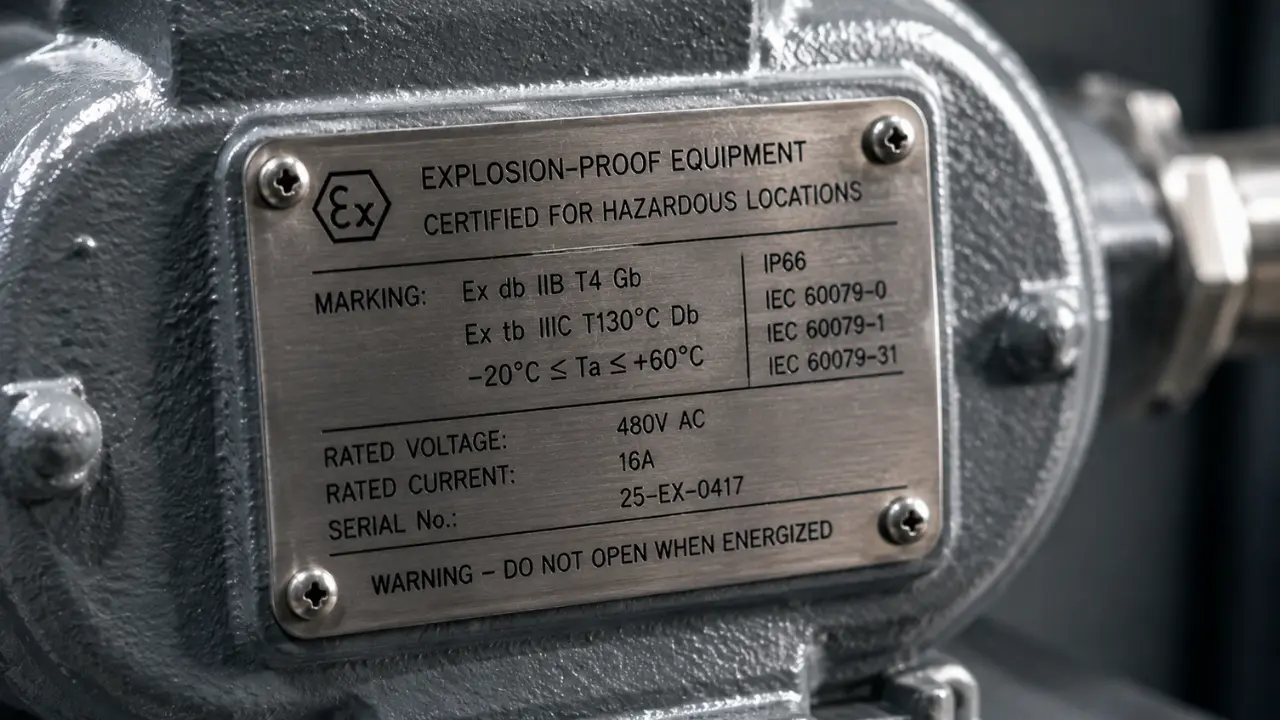
Quick Answer
Ex d vs Ex db is not old technology versus new: both describe the same flameproof protection concept from IEC 60079-1, but "Ex db" adds the Equipment Protection Level that states which zone the equipment is actually certified for. The risk is treating an older "Ex d" certificate as automatically equivalent without checking the EPL and standard edition.
A procurement engineer pulls the manufacturer's test certificate for a junction box destined for a Zone 1 process area and sees "Ex d IIB T4" stamped on it. The current project specification calls for "Ex db IIB T4 Gb." Are these the same product? The honest answer is: probably, but you cannot confirm that from the marking alone, and that gap is exactly where the Ex d vs Ex db question turns into a real procurement delay instead of a footnote. Both markings describe the same flameproof protection concept defined in IEC 60079-1: a rigid enclosure built to contain an internal explosion and cool the escaping combustion products below their ignition temperature before they can reach the surrounding atmosphere. What changed between the two markings is not the underlying engineering. It's whether the label tells you, explicitly, which Equipment Protection Level the device was actually certified against.
Ex d and Ex db describe the same flameproof engineering. Ex db just forces the certificate to say which zone that engineering is actually rated for.
What "Ex d" Actually Means: The Flameproof Concept
The flameproof protection concept, designated "d," does not try to keep an explosive atmosphere out of the enclosure and does not try to eliminate ignition sources inside it. It assumes an internal explosion can happen, inside the housing, around a switch contact or a terminal, and it is engineered to survive that event without letting flame or hot particles escape into the surrounding hazardous area.
Three things make that possible, and all three are governed by IEC 60079-1: the enclosure has to withstand the internal explosion pressure without deforming or rupturing, the joints where the enclosure opens (flanged covers, threaded entries, shaft seals) have to be machined to a specific gap and length so any escaping flame front cools below ignition temperature before it exits, and the surface temperature under fault conditions has to stay below the autoignition temperature of the gas or vapor present, which is where the T-class rating (T1 through T6) comes from. The joint gap tolerance is tied directly to the gas group, IIA, IIB, or IIC, ranked by how easily the specific gas transmits a flame through a narrow gap. Hydrogen and acetylene atmospheres, group IIC, require tighter joint tolerances than a propane or methane atmosphere in group IIA.
This is why a flameproof enclosure for a hazardous area is a mechanical design problem as much as an electrical one. Explosion proof lighting fixtures, junction boxes, and distribution boards built to this concept rely on precise machining and assembly, not a gasket and a good enclosure rating. Field-drilling a new cable entry into a flameproof housing, or substituting a gland that wasn't part of the original type test, invalidates the certification even if the box still looks intact from the outside. We stock and source this class of equipment through our products catalog specifically because substitutions on flameproof gear are rarely as harmless as they look on a drawing.
Why the Marking Changed: Enter the Equipment Protection Level
For years, "Ex d" on its own told you the protection method and, combined with the gas group and T-class, gave you most of what you needed. What it didn't do was state, in the marking itself, which zone or which fault-tolerance category the specific piece of equipment had been assessed against. That information existed, but you had to go find it in the ATEX category marking or the certificate schedule rather than read it off the label.
IEC 60079-0, the general requirements standard that sits underneath every protection concept in the 60079 series, formalized the Equipment Protection Level system to close that gap. Under the IECEx Equipment Protection Level scheme, gas atmosphere equipment is rated Ga (very high protection, safe with two independent faults), Gb (high protection, safe with one fault, the level required for Zone 1), or Gc (enhanced protection, intended for Zone 2 where an explosive atmosphere is unlikely and brief). Dust atmospheres use the parallel Da, Db, Dc scale. Flameproof enclosures are built and tested for Gb, marked "Ex db," or for the reduced-duty Zone 2 case, "Ex dc" with EPL Gc. For general-purpose flameproof equipment, lighting fixtures, junction boxes, distribution boards, the equipment this article is actually about, a flameproof enclosure is not recognized as sufficient for the very-high-protection Ga level that Zone 0 requires; that duty normally falls to concepts like intrinsic safety, which keep energy below the ignition threshold under multiple simultaneous faults instead of relying on containment. IEC 60079-1 does carve out a narrow "Ex da" flameproof marking that can achieve EPL Ga, but its recognized application is limited to catalytic sensor elements inside portable combustible gas detectors, not the enclosure classes covered here, so it's an exception worth knowing about rather than a loophole for Zone 0 lighting or panels.
Dust environments are worth flagging separately, because this is where the marking gets misread most often. Flameproof "d" is a gas-atmosphere protection concept. Dust hazardous areas use a different protection concept entirely, protection by enclosure "t," defined in IEC 60079-31, which produces the Ex tb (EPL Db) or Ex tc (EPL Dc) markings. An enclosure rated Ex db for a Zone 1 gas area does not automatically cover a combustible dust environment. If a spec calls for both, the nameplate needs to show both protection concepts assessed and certified, not one inferred from the other.
The EPL system is not a redesign of flameproof engineering. IEC 60079-1's core construction and test requirements for the "d" concept did not fundamentally change to create the "db" marking. What changed is that the harmonized IEC 60079-0 scheme now requires the protection-level suffix to appear on the equipment itself, so an inspector, an installer, or a procurement engineer standing in front of the nameplate can confirm the zone suitability without pulling the full certificate file. That single change closed a real gap in hazardous area classification paperwork that used to depend on someone correctly cross-referencing a separate category marking.
Ex d vs Ex db: Reading a Modern Nameplate Correctly
A current nameplate on flameproof equipment typically reads something like: II 2 G Ex db IIB T4 Gb. Every segment carries a specific meaning, and every segment should trace back to something printed on the actual certificate, not just the datasheet summary a sales rep sends over.
| Marking Element | What It Tells You | Where to Verify It |
|---|---|---|
| Equipment Group (I, II, III) | I is underground mining; II is surface industry gas atmospheres; III is surface industry dust atmospheres | IECEx Certificate of Conformity or ATEX certificate header |
| Category / EPL (2G, Gb) | Which zone the device is rated for: Category 2G / Gb suits Zone 1, Category 3G / Gc suits Zone 2 | Certificate schedule, cross-checked against the hazardous area classification drawing |
| Protection concept (db, dc, tb, tc) | The specific method used and the fault-tolerance level tested for that method | Type Examination Certificate, referencing the relevant part of IEC 60079 |
| Gas or dust group (IIA, IIB, IIC / IIIA, IIIB, IIIC) | Which specific gases or dusts the flame-path or enclosure rating actually covers | Certificate schedule and MESG data referenced in the test report |
| Temperature class (T1–T6) or surface temperature | Maximum surface temperature versus the autoignition temperature of the process gas | Nameplate, cross-checked against process gas data |
| Ambient temperature range (Ta) | The operating envelope the certificate is valid for; many boxes are Ta -20°C to +60°C unless stated otherwise | Certificate schedule |
| Certificate number and ExCB / Notified Body | Who tested it, when, and to which edition of the standard | IECEx Online Certificate System or the relevant EU Notified Body database |
That last row is the one procurement teams skip most often, and it's the one that actually resolves the Ex d vs Ex db question on a specific piece of equipment. The certificate states which edition of IEC 60079-0 and IEC 60079-1 the assessment was performed against. A certificate issued against superseded editions can still be valid, but you need to know that, not assume it, before you accept it against a spec written around the current harmonized marking. That check has more teeth right now than it did a year ago: IEC 60079-0 moved to its 8th edition, IEC 60079-0:2026, published in mid-2026, superseding the 2017 edition that most equipment currently in service was still certified against. A certificate that cites IEC 60079-0:2017 isn't automatically wrong, IECEx and ATEX both run a transition period before a full reassessment against a new edition becomes mandatory, but "2017" stops being a safe default for "current" the moment a newer edition is on the books, and confirming where a given certificate sits in that transition window belongs on the same checklist as the EPL and category fields.
The Procurement Trap: Old Documentation Meeting a New Spec
Here is where the Ex d vs Ex db distinction stops being academic. A specification written today, for a Zone 1 area, will typically call out "Ex db" explicitly, sometimes with the EPL stated, sometimes just implied by the zone. A vendor quoting against that spec pulls documentation for a product line that hasn't been resubmitted for a fresh certificate in years, and that documentation says "Ex d IIB T4," with no EPL and no category listed on the page the sales team forwards.
The trap is treating those two labels as interchangeable because they share the letter "d." Three things can go wrong when that assumption isn't checked. First, the equipment may genuinely be fine, tested to a current standard edition, assigned Category 2G / EPL Gb, and simply marketed under an old datasheet template that predates the harmonized marking, in which case a current certificate resolves it in five minutes. Second, the equipment might have last been formally assessed under an earlier edition of IEC 60079-1, with flame-path gap tables or test methods that have since been revised, and nobody has confirmed whether the design still meets the current construction requirements. Third, and this is the expensive one, the original certificate might only ever have supported Category 3G, suitable for Zone 2, and the "Ex d" shorthand on an old cut sheet simply never made that distinction clear. Installing that box in a Zone 1 tank farm on the strength of a keyword match is a hazardous area classification violation that won't surface until an auditor or an insurer's inspector asks for the certificate.
A Real-World Scenario
An EPC contractor sourcing distribution boards for a Zone 1 tank farm revamp receives quotes from two suppliers for functionally similar panels. One ships a datasheet stamped "Ex d IIB T4," referencing a type test performed years earlier. The other ships "Ex db IIB T4 Gb," backed by an IECEx Certificate of Conformity that references IEC 60079-1:2014, still the current edition of Part 1, and IEC 60079-0:2017, an edition now superseded by IEC 60079-0:2026 but still inside the transition window where a certificate issued against it remains valid. To a purchasing agent working from a spec sheet keyword match, the two look interchangeable. Engineering flags it during technical bid evaluation: the older certificate has no EPL stated, the category field on the scanned document is blank, and site QA can't confirm the flame-path joint dimensions were verified against the current gas group tables the design was originally tested under. Getting an updated assessment, or securing a current IECEx Certificate of Conformity for the same enclosure family, adds real weeks to the order before the boards can be released for fabrication sign-off.
An "Ex d" stamp on a decade-old datasheet is proof that the enclosure once passed a flameproof test. It is not proof of which zone, which standard edition, or which fault-tolerance level that test actually covered.
The fix isn't disqualifying the supplier with older paperwork. It's making a current IECEx Certificate of Conformity or ATEX EU-Type Examination Certificate, with an explicit EPL, a non-negotiable submittal for every flameproof component going into a Zone 1 bill of materials, regardless of how long the manufacturer has been building that product line. Our electrical engineering team runs this verification as a standard step in technical bid evaluation, because catching a missing EPL during procurement costs an email. Catching it during commissioning costs a schedule slip.
North American Class/Division Labeling Is Not the Same System
North America adds a second layer to this comparison. The NEC (NFPA 70) historically classifies hazardous locations by Class I, II, or III and Division 1 or 2, with equipment listed by an NRTL such as UL or CSA against standards like UL 1203, producing the familiar cast-metal "Explosionproof" enclosure for Class I, Division 1 service. The underlying physics is the same idea as flameproof "d": a rigid housing that contains an internal explosion and quenches the flame path before it reaches the surrounding atmosphere. But a UL or CSA Division 1 explosionproof listing is not automatically interchangeable with an Ex d or Ex db certificate from IECEx or a European Notified Body. The testing bodies differ, some construction details and joint tolerance tables differ in the fine print, and the marking conventions are built around entirely different classification logic, Division by likelihood of occurrence versus Zone by frequency and duration.
The NEC has since adopted its own Zone-based option under Article 505, which brings US installations much closer to the IEC system. Equipment evaluated to the harmonized UL/CSA 60079 series and installed under that article is marked with an "AEx" prefix, for example "Class I, Zone 1, AEx db IIB T4," which is functionally the same protection concept and EPL logic as its IECEx or ATEX counterpart, just labeled for the North American Zone system. That still doesn't make a European "Ex db" nameplate a valid substitute on a project governed by an NEC Division-based area classification drawing without a proper NRTL listing behind it.
The practical takeaway for anyone sourcing across regions: check which classification system the site's hazardous area classification study was actually built on, Division or Zone, before assuming a marking from one system satisfies a spec written for the other. Our team handles this cross-check regularly on projects moving equipment between Gulf, South Asian, and European supply chains, where a single bill of materials can end up with IECEx, ATEX, and NEC-listed components side by side. It's routine work for the multi-region engineering group described on our about us page, coordinated out of our Lahore and Torino offices rather than treated as a one-off specialty request.
What This Means for Explosion Proof Lighting and Panel Sourcing
Most of the flameproof equipment moving through hazardous area projects today, explosion proof lighting fixtures, junction boxes, and local distribution boards mounted at grade in tank farms, compressor stations, and process units, ships as Ex db, sometimes combined with increased safety terminal compartments as "Ex db eb." When a technical file or a supplier's catalog page still shows bare "Ex d" without a stated EPL, that's the cue to request the current certificate before it goes on the approved vendor list, not after the equipment shows up on site. How that class of hazardous-area rated gear actually differs from standard electrical fixtures, down to how junction boxes and distribution boards get specified and installed on site, is a broader question than nameplate reading alone, and it's one we go into in more depth elsewhere on the blog for anyone assembling a full hazardous area procurement package.
The same discipline applies to panels and enclosures feeding those fixtures. If you're evaluating how a hazardous-area distribution board fits into a larger power distribution scheme, our breakdown of what's inside a containerized MCC panel covers the adjacent question of matching enclosure ratings and documentation to actual site conditions, a habit that carries over directly to flameproof equipment sourcing.
Verifying What You're Actually Buying
None of this requires a standards library to get right, just a short checklist applied consistently before equipment gets approved for a hazardous area:
- Confirm the nameplate states an EPL under the IECEx Equipment Protection Level system (Gb, Gc, Db, or Dc), not just a bare protection letter.
- Match that EPL against the zone on the site's hazardous area classification drawing, not against the zone the last project happened to use.
- Pull the actual IECEx Certificate of Conformity or ATEX EU-Type Examination Certificate, and check which edition of IEC 60079-0 and IEC 60079-1 it references.
- Verify the ExCB or Notified Body number against the official IECEx or EU database rather than trusting a certificate PDF forwarded by a sales contact.
- If the project sits in a jurisdiction governed by NEC Class/Division rules, confirm a separate NRTL listing exists rather than relying on an IECEx or ATEX mark alone.
- Treat any field modification, an added gland, a re-drilled entry, a swapped fastener, as grounds to re-verify the certification, since flameproof integrity is a machining tolerance, not a paint job.
Most of the time, resolving Ex d vs Ex db on a specific product is a documentation exercise, not an engineering redesign, but it has to happen before purchase order approval, not after the equipment lands on site. Techno Control Corp supports this kind of certificate verification as part of the broader services we run for clients specifying hazardous-area equipment, from EPC bid packages to plant expansions. If you're not sure whether a shortlisted enclosure, fixture, or panel actually clears the EPL your site classification requires, contact us with the datasheet and we'll walk the certificate with you before it becomes a fabrication problem.
Related products
Components from our catalogue relevant to this article — request a quote for availability, lead time and pricing.
/BAT53 Series Explosion Proof Led Flood Light 70W-1000W For Hazardous Areas.webp "ATEX BAT53 Series ATEX - Explosion Proof LED Flood Light 70W-1000W | Explosion-proof LED floodlight, 70W-1000W")
BAT53 Series ATEX - Explosion Proof LED Flood Light 70W-1000W
Explosion-proof LED floodlight, 70W-1000W
/BAT85 Series Explosion Proof Floodlights , ATEX Led Flood Light.webp "ATEX BAT85 Series ATEX - Explosion Proof Floodlight, LED Flood Light | ATEX-certified explosion-proof LED floodlight")
BAT85 Series ATEX - Explosion Proof Floodlight, LED Flood Light
ATEX-certified explosion-proof LED floodlight
/BnT81 Series Aluminium ATEX Floodlights , Hazardous Location ights with 400W~1000W.webp "ATEX BnT81 Series ATEX - Aluminium Floodlight, Hazardous Location Lighting 400W-1000W | Aluminium ATEX floodlight, 400W-1000W")
BnT81 Series ATEX - Aluminium Floodlight, Hazardous Location Lighting 400W-1000W
Aluminium ATEX floodlight, 400W-1000W
/HRD91-LED Series Explosion Proof LED Lighting 30W 50W 70W 100W For Hazardous Areas.webp "ATEX HRD91-LED Series ATEX - Explosion Proof LED Lighting 30W-100W | Explosion-proof LED light, 30W/50W/70W/100W")
HRD91-LED Series ATEX - Explosion Proof LED Lighting 30W-100W
Explosion-proof LED light, 30W/50W/70W/100W