
What's Inside a Containerized MCC Panel?

Quick Answer
A containerized MCC panel arrives largely pre-wired and factory-tested, but what's actually inside, from bus bars and VFD buckets to grounding and arc flash design, has to match the load list and site conditions before it's ever energized. This field guide walks through every section of the panel and what to verify before signing off.
A containerized MCC panel shows up on a flatbed, gets set on a concrete pad, and someone on site assumes it's ready to energize. It rarely is. Knowing what is inside a containerized MCC panel before it arrives is the difference between a clean startup and a week of schedule slip chasing missing components.
This matters most on projects where the container is doing double duty, housing the motor control center and acting as the electrical room. Once it lands, there is no easy do-over. Every bucket, breaker, and cable gland inside needs to match the load list, the site conditions, and the control philosophy the plant is already running.
Remote well sites, temporary process facilities, mining operations, and plant expansions that can't wait for a building addition all lean on containerized MCCs for the same reason: they arrive largely pre-wired and factory-tested, cutting field labor and site schedule risk compared to building an electrical room from scratch. That advantage only holds if what's inside the box actually matches what the process needs.
The Container Shell Itself
Before any electrical component gets discussed, the shell has to fit the environment. Containerized MCC panels use a modified ISO or custom steel enclosure rated for outdoor exposure, corrosion resistance, and in many cases hazardous location proximity.
Enclosure Rating and Material
Most containerized units carry a NEMA 3R or NEMA 4 rating at minimum, with NEMA 4X specified for coastal sites, wastewater plants, or anywhere chemical washdown is routine. IP ratings show up on projects sourced through European or Asian OEMs, and the two rating systems do not map one to one, so cross-checking the datasheet against the actual site conditions matters more than trusting a spec sheet summary.
Wall construction is typically galvanized or stainless steel over a structural steel frame, with gasketed doors and a raised floor for cable entry. Insulation thickness gets skipped over in early quoting conversations, then becomes a real problem once the HVAC load calculation comes back short.
Cable Entry and Gland Plates
Bottom entry through removable gland plates is standard for containerized builds, since top entry invites water intrusion on units that sit outdoors year round. Gland plate layout should be confirmed against the actual cable schedule before fabrication, not after the container ships, because field-drilling a gland plate on a NEMA 4X rated shell voids the rating at that penetration.
The Incoming Section
Every containerized MCC starts with an incoming section that steps utility or generator power down into something the bus can distribute safely.
Main Breaker and Bus Bars
The main breaker, typically a molded case or insulated case breaker sized to the transformer or generator feeding the unit, sits ahead of the horizontal bus. Bus bar material is almost always copper, sized per NEC or IEC ampacity tables depending on which code jurisdiction the project falls under.
Vertical bus drops feed each MCC bucket section, and short circuit current rating on the bus assembly needs to match or exceed the available fault current at the point of connection. This number gets requested late in procurement more often than it should, and a mismatch here is a redesign, not a punch list item.
Metering and Protection
Digital power meters, typically Modbus or Ethernet/IP capable, sit in the incoming section to give the control system visibility into voltage, current, and power factor at the panel level. Ground fault protection is standard on incoming breakers above a certain amperage threshold, and arc flash mitigation devices, including light-sensing relays, show up on newer builds where the utility or insurance carrier requires a reduced arc flash boundary.
MCC Buckets, the Core of the Panel
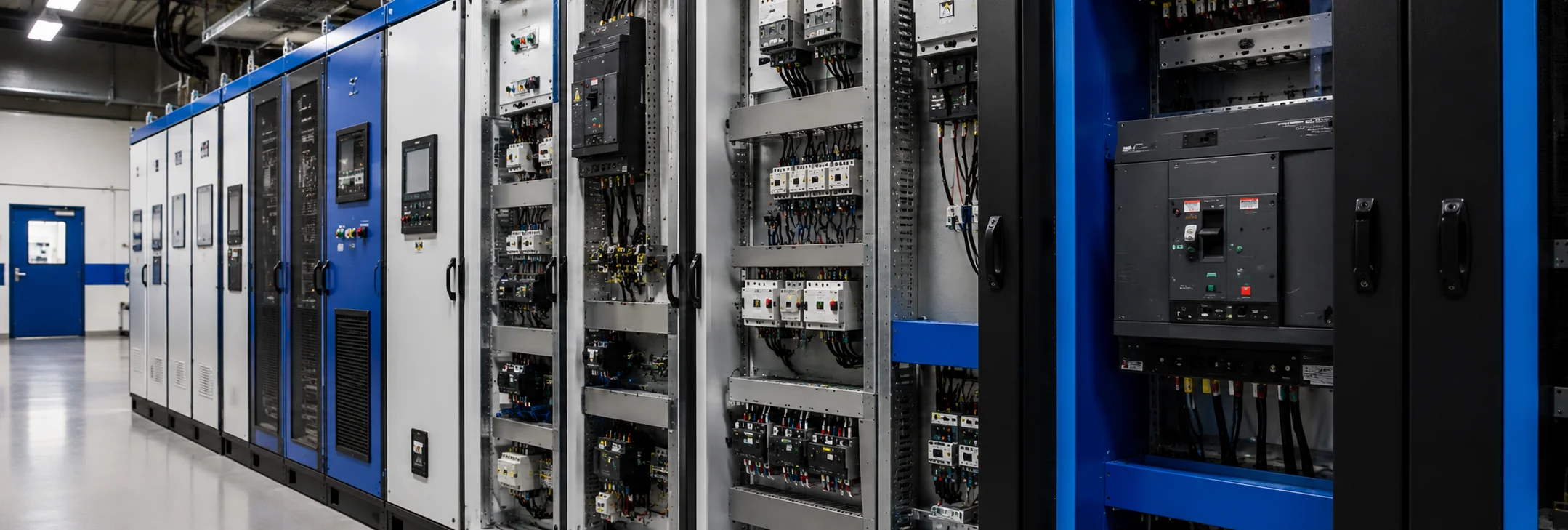
The buckets are what most people mean when they ask what is inside a containerized MCC panel. Each bucket is a self-contained compartment holding the components for one motor or load, and it plugs into the vertical bus through a stab connection.
Motor Starters and Contactors
Full voltage non-reversing starters cover the majority of pump and fan applications. Reversing starters, two-speed starters, and reduced voltage starters appear where the process demands it, and each configuration changes the bucket's internal wiring and the contactor count inside.
Contactors are sized by NEMA size or IEC rating against the motor's full load amperage, with enough margin for inrush current on across-the-line starts. Undersized contactors are a common field failure point on retrofits where a motor got upsized without the bucket being re-evaluated.
VFDs Inside MCC Buckets
Variable frequency drives get mounted directly in dedicated bucket sections on modern containerized builds, replacing the starter and contactor entirely for that load. This is where energy efficiency gains show up most, since a VFD running a centrifugal pump or fan at reduced speed cuts energy consumption faster than throttling a valve or damper ever could.
VFD buckets need ventilation or dedicated cooling separate from the general container HVAC, since drives reject heat directly into the compartment they sit in. Harmonics mitigation, whether through line reactors or active filters, also needs to be specified at this stage, not added later, because retrofitting a filter into a sealed bucket is a rebuild, not an add-on.
Overload and Protection Relays
Thermal overload relays or solid state overload protection sit downstream of every starter, sized to the motor nameplate and protecting against sustained overcurrent without nuisance tripping during normal starting transients. Solid state relays are increasingly standard because they hold diagnostic data, including trip history and thermal capacity used, which is useful during a troubleshooting call when a motor won't restart and nobody remembers the last three trips.
You don't find out a bucket was wired wrong until the motor doesn't turn and the schedule is already committed.
The Control and Automation Layer
A containerized MCC panel is rarely just power distribution. Most builds fold in the industrial automation and control logic that decides when each load runs.
PLCs and I/O Architecture
A PLC, commonly an Allen-Bradley CompactLogix, Siemens S7-1200, or comparable platform, sits in a dedicated control section or a separate control cubicle within the container. I/O architecture matters here: remote I/O racks distributed near the buckets they serve cut wiring runs dramatically compared to a single centralized rack pulling wire back from every starter.
Discrete I/O handles start and stop commands, run status, and fault feedback from each bucket. Analog I/O carries VFD speed references, process variable feedback, and metering data where a hardwired signal is more reliable than a network connection for a critical loop.
Spare I/O capacity gets debated during design review more than almost anything else in the control section. Twenty percent spare on both discrete and analog points is a reasonable baseline for a containerized MCC, since adding a bucket after the fact is far easier when the I/O rack already has open terminals waiting for it.
HMI and Local Control Stations
A local HMI mounted on or near the container gives operators start, stop, and status visibility without needing to walk back to a central control room. Hand off auto selector switches on individual buckets let maintenance take a single motor offline for service without shutting down the whole MCC, which matters during partial outages when the rest of the process still needs to run.
SCADA and Communication Protocols
Most containerized MCCs tie into plant SCADA through Ethernet/IP, Modbus TCP, or Profinet, depending on which platform the plant standardized on. Communication protocol choice made in isolation from the plant's existing network architecture is one of the more expensive mistakes on a project, since it usually surfaces during commissioning rather than during design review.
Managed switches inside the container, with VLAN segmentation between control traffic and metering or diagnostic traffic, keep a single noisy device from flooding the network the PLC depends on for real-time control. Fiber uplink between a remote containerized MCC and the main control room is worth the added cost anywhere the run exceeds standard copper distance limits or crosses an area with heavy electromagnetic interference from adjacent drives or transformers.
Grounding and Bonding Inside a Steel Enclosure
A containerized MCC sits on isolated footings or skids more often than a poured foundation tied into a building's grounding grid, which means the grounding electrode system has to be engineered specifically for that container, not assumed from a generic electrical room design.
Bus bar grounding, equipment bonding jumpers between the container shell and internal steel, and a dedicated ground grid connection all need verification during commissioning. A floating ground reference on a containerized unit shows up later as nuisance ground fault trips or, worse, as a shock hazard nobody caught until an incident report got filed.
Safety Systems and Arc Flash Considerations
Arc flash incident energy calculations change once equipment moves into a compact steel enclosure, since available fault current and clearing times interact differently with a shorter bus run and a tighter compartment. Labeling requirements under NFPA 70E apply the same way they would in a building, but the calculation inputs need to reflect the containerized unit's actual short circuit study, not a copy-paste from a similar building-based MCC.
Remote racking mechanisms, infrared viewing windows, and arc-resistant construction options are worth specifying on any containerized MCC where a technician would otherwise need to open a bucket door while the bus is energized. These options add cost during fabrication and remove risk during every maintenance interaction for the life of the panel.
Environmental Control Inside the Container
Electronics inside a sealed steel box in direct sun load differently than the same electronics in a climate controlled electrical room. Containerized MCCs need HVAC sized against actual internal heat load, not a generic square footage estimate, since VFDs, transformers, and densely packed buckets generate real heat.
Positive pressurization with filtered intake air keeps dust and corrosive vapors out in industrial and mining environments, which extends contactor and relay life significantly compared to an unpressurized enclosure in the same location.
A Field Constraint Worth Planning Around
A wastewater treatment plant replacing an aging blower system decided on a containerized MCC to avoid a building addition. The VFD buckets were specified without confirming the container's HVAC capacity against the drive manufacturer's heat rejection data. During summer commissioning, ambient temperature inside the container climbed past the drive's derating threshold, and the units began thermal throttling under full load.
The fix required adding supplemental cooling after the container was already on site, which meant cutting a new opening in a NEMA-rated wall and re-certifying that section. A heat load calculation done during the design phase, cross-referenced against the specific VFD models chosen, would have caught this before fabrication.
Supplier Verification Before You Sign Off
Counterfeit or gray market contactors, breakers, and PLCs circulate more than most procurement teams expect, particularly on fast-tracked projects where sourcing pressure pushes buyers toward the first available inventory. Cross-referencing datasheets and part numbers against the manufacturer's authorized distributor list before accepting a containerized MCC is a five minute check that avoids a warranty dispute later.
Lead time planning matters just as much. VFDs and PLCs with embedded chipsets have seen extended lead times industry wide, and a containerized MCC panel is only as fast to deliver as its slowest component. Confirming actual component availability before committing to a delivery date protects the schedule more than any amount of expediting after the fact.
Datasheet cross-referencing goes beyond checking a part number against a catalog. Firmware revision on a VFD or PLC can change I/O behavior or communication protocol support between two units carrying the same base model number, and a panel builder who confirms firmware revision alongside part number avoids a surprise during PLC program upload.
Fixed, Drawout, or Containerized: What Actually Changes
| Configuration | Maintenance Access | Typical Footprint | Best Fit |
|---|---|---|---|
| Fixed-mount MCC | Requires full shutdown to service a bucket | Indoor electrical room | Retrofits with tight budgets and stable loads |
| Drawout MCC | Bucket withdraws for service without deenergizing the bus | Indoor electrical room | Facilities needing frequent motor swaps |
| Containerized MCC | Drawout or fixed buckets inside a portable enclosure | Outdoor or remote sites | New builds, temporary facilities, remote or modular plants |
Documentation That Should Ship With the Panel
A containerized MCC without a complete documentation package is a maintenance problem waiting to happen. One-line diagrams, bucket-by-bucket wiring schematics, PLC program backups, and a bill of materials with manufacturer part numbers should arrive with the unit, not get requested after a component fails and nobody can identify what's actually installed.
As-Built Drawings vs Fabrication Drawings
Fabrication drawings represent design intent. Field changes made during assembly or commissioning, including any last-minute bucket swaps or wiring corrections, need to be reflected in as-built drawings before final handover. A panel builder who hands over fabrication drawings and calls them as-builts is setting up the next technician for a bad troubleshooting call.
Digital copies stored in a format the plant's document control system can actually open matter more than a printed binder. A PDF set with searchable text saves real time during an outage when someone needs to find a specific bucket's wiring in under five minutes.
Commissioning and Lead Time Considerations
Factory acceptance testing on a containerized MCC should verify bus torque values, insulation resistance, control sequence logic, and communication between the PLC and any remote I/O before the unit ever leaves the shop.
Catching a miswired bucket on the factory floor costs an afternoon. Catching it after the container is set and energized costs a production shift.
Site commissioning adds environmental verification: confirming the HVAC or pressurization system holds internal temperature and humidity within spec once the container sits in its actual outdoor location, not the shop floor it was tested on.
Reliability and Maintenance Planning
MTBF data on contactors, overload relays, and VFDs should inform spare parts stocking and preventive maintenance planning before startup, not after the first failure. A spare bucket or a spare set of contactors sitting on a shelf costs far less than an unplanned outage waiting on a part with a six week lead time.
Predictive maintenance indicators, including thermal imaging ports built into bucket doors and VFD diagnostic data pulled over the network, give maintenance teams a way to catch a failing component before it takes the load down. Redundancy planning, where a spare bucket position sits pre-wired and ready, is worth the upfront cost on any load where downtime carries a real production cost.
Acceptable downtime thresholds should be set at the design stage, based on what the process can actually tolerate, not decided reactively after the first outage. A blower feeding a single-train wastewater process has a very different downtime tolerance than a redundant pumping station, and that difference should drive whether the containerized MCC gets N+1 bucket redundancy or a lean single-string design.
Cycle time and process optimization data from the plant's historian, when tied back into the MCC's control logic, can surface motor loading patterns that inform future VFD sizing decisions on the next expansion. A containerized MCC built with that feedback loop in mind pays for itself well beyond the initial commissioning.
If you are specifying a containerized MCC panel for a new build or a plant expansion, getting the bucket layout, VFD selection, and control architecture right before fabrication saves real time on site. Techno Control Corp works through load lists, component sourcing, and panel design with engineering teams who need a panel that matches their actual site conditions, not a generic spec sheet. Reach out to our team to walk through your load list and get a sourcing timeline that holds up.
Related products
Components from our catalogue relevant to this article — request a quote for availability, lead time and pricing.
/010005 Eaton - DILEM-10(24V50HZ).webp "Eaton 010005 Eaton - DILEM-10(24V50HZ) | Eaton DILEM contactor")
010005 Eaton - DILEM-10(24V50HZ)
Eaton DILEM contactor
/TC625 AF100 ABB - Coaxial Modem 3BSE002224R1.png "ABB TC625 AF100 ABB - Coaxial Modem 3BSE002224R1 | Coaxial modem TC625 AF100")
TC625 AF100 ABB - Coaxial Modem 3BSE002224R1
Coaxial modem TC625 AF100
/SB512 ABB - Power Supply 3BSE002098R1.png "ABB SB512 ABB - Power Supply 3BSE002098R1 | SB512 power supply module")
SB512 ABB - Power Supply 3BSE002098R1
SB512 power supply module
/DSSS 171 ABB - Voting Unit 3BSE005003R1.png "ABB DSSS 171 ABB - Voting Unit 3BSE005003R1 | DSSS 171 voting unit for safety systems")
DSSS 171 ABB - Voting Unit 3BSE005003R1
DSSS 171 voting unit for safety systems