
Oil-Type vs Dry-Type Transformer: How to Choose the Right One

Quick Answer
A dry type transformer is the right call anywhere fire code, indoor occupancy, or environmental permitting rule out liquid insulation, while an oil type transformer wins on efficiency, overload headroom, and footprint everywhere else. The decision comes down to matching the insulation and cooling method to the site's fire rating, ambient conditions, and loading profile, not to catalog price.
If you're specifying a new transformer and the site conditions aren't obvious, the oil-type vs dry-type transformer decision usually gets made for the wrong reason: whichever unit was cheaper on the quote, or whichever one the last project used. That's a bad way to spec a piece of equipment that's supposed to sit in service for 25 to 40 years. The right call comes down to how the winding insulation handles heat and how the site's occupancy, fire code, and environment interact with that insulation method. Get that wrong and you're not looking at a minor inefficiency, you're looking at a rejected permit, a vault redesign, or a transformer that can't carry the load it was sized for.
A dry type transformer and an oil-filled unit both do the same fundamental job: step voltage up or down through electromagnetic induction. Everything else, how they cool, how they're protected, where code allows them, how they age, diverges from that point forward. This piece works through the real differences so the choice gets made on engineering grounds, not habit.
None of that comes down to which technology is better in some general sense. It comes down to which one your building code, your ambient environment, and your loading profile will actually let you install and keep running.
The Core Difference: How Each Type Insulates and Cools
Oil-Type (Oil-Filled, Oil-Immersed) Transformers
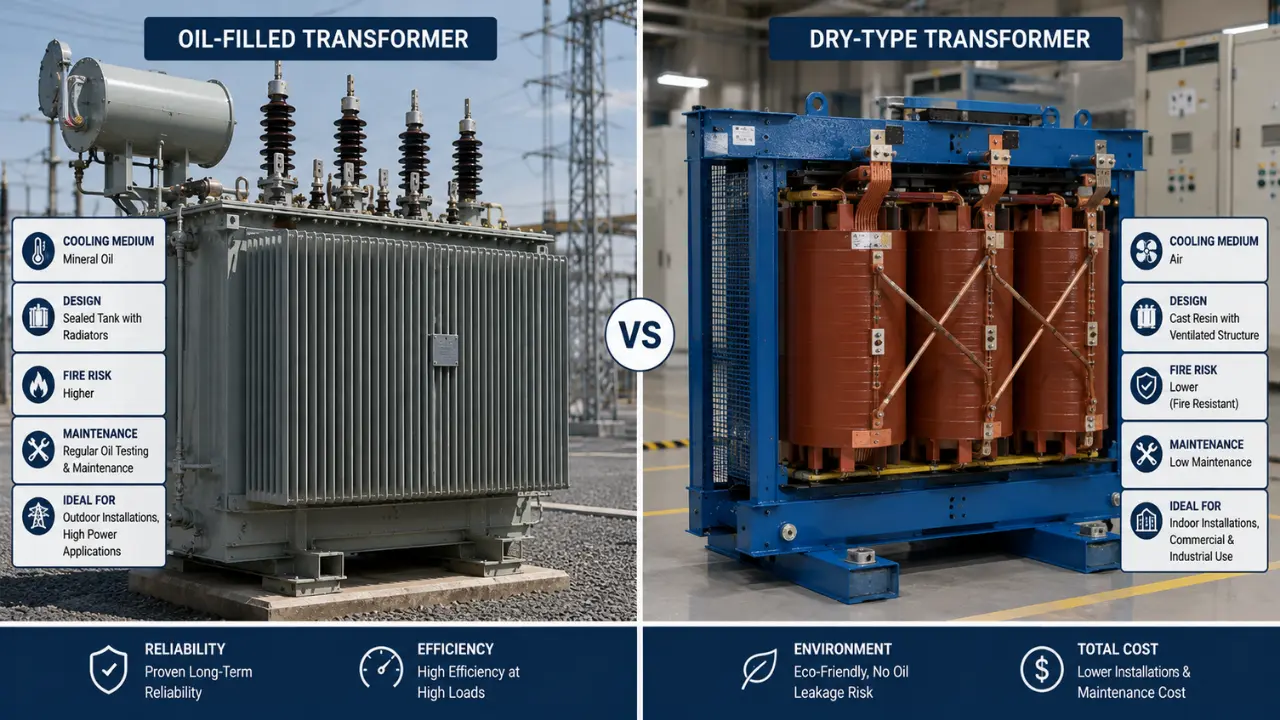
An oil filled transformer submerges the core and windings in a dielectric fluid, most commonly mineral oil, inside a sealed steel tank. That transformer oil does two jobs simultaneously: it's the primary electrical insulation between windings and ground, and it's the cooling medium, circulating by natural convection (ONAN) or forced circulation (ONAF, OFAF) to carry heat to external radiators.
Oil's thermal conductivity is roughly five times that of air, which is why an oil immersed transformer can pack more kVA into a given tank size than an equivalent dry-type unit in an equivalent enclosure. Some installations use less-flammable synthetic or natural ester fluids (FR3 and similar products) instead of mineral oil, trading a bit of dielectric performance for a much higher fire point that changes where code allows the unit to sit. IEEE Std C57.12.00-2021 sets the general requirements for liquid-immersed distribution, power, and regulating transformers, and it's the reference standard most North American specs point back to.
Dry-Type Transformers
A dry type transformer insulates the windings with air, or with a solid cast material, instead of liquid. Ventilated dry-type units rely on convective airflow through the coil for cooling. Cast-coil and vacuum-pressure-impregnated (VPI) designs encapsulate the windings in epoxy resin or varnish, which improves resistance to moisture, dust, and corrosive atmospheres compared to open ventilated construction. Cast-resin units, the kind sold under names like ABB RESIBLOC or Siemens GEAFOL, are the standard choice where an open-wound dry-type transformer would collect contamination.
There's no liquid reservoir, no tank, and no oil to sample. IEEE Std C57.12.01-2020 covers general requirements for dry-type distribution and power transformers, and it's worth reading alongside our broader high voltage transformers guide if you're specifying beyond this single decision point.
Fire Safety: Why the Insulation Medium Decides Where You Can Install It
This is the factor that actually drives most oil-type vs dry-type transformer decisions on commercial and institutional projects, more than efficiency or cost.
Mineral transformer oil has a flash point around 150°C and a fire point around 165°C, per ASTM D3487 test data commonly cited by fluid manufacturers. That's low enough that NEC Article 450 (part of NFPA 70) treats indoor oil-insulated transformers as a real fire load. Section 450.26 requires them installed indoors to sit inside a vault built to Part III of Article 450, generally 3-hour fire-rated construction with liquid containment and dedicated ventilation, with narrow exceptions below 112.5 kVA. Building that vault is not a line item anyone budgets for until a plan reviewer flags it.
Less-flammable liquids change that math. NEC 450.23 permits transformers insulated with a listed less-flammable liquid carrying a fire point of at least 300°C to be installed indoors in Type I or Type II construction without a full vault, subject to voltage limits and a liquid confinement area. Natural ester fluid like FR3 has a flash point around 330°C and a fire point around 360°C, which is why a retrofit from mineral oil to ester fluid is sometimes the fix when a vault isn't in the budget.
A dry-type transformer has no liquid reservoir to feed a sustained fire, which is why NEC 450.21 treats it far more leniently: units at 112.5 kVA or below just need 300 mm (12 in.) clearance from combustible material, and larger units need a one-hour fire-resistant room instead of a full vault. That's why dry-type belongs indoors, in occupied buildings, near people, and why data centers, hospitals, high-rises, and commercial basements default to it almost without exception. A dry-type transformer isn't inherently safer in some general sense; it simply removes the ignitable liquid from the equation, and that's what let NEC 450 relax the construction requirements around it.
Efficiency and Losses at Typical Loading
An oil type transformer generally runs more efficient than a dry type transformer at the same kVA rating, largely because oil's superior heat transfer lets the core and windings run cooler for a given loss level, and because the design margins built into dry-type units for thermal safety add a bit of no-load loss. Typical full-load efficiency for oil-immersed distribution transformers runs in the high 98% to upper 99% range, while dry-type units, depending on winding rise class and loading, typically land in the mid-96% to upper 98% range. The gap narrows at smaller kVA ratings and widens as units get larger, since oil's cooling advantage compounds with size.
The loss profile also splits differently between the two designs. Dry-type units tend to run higher no-load (core) losses but can show comparable or lower load losses at partial loading, while oil-filled units typically show lower no-load losses and take on more load loss as current rises. On a transformer running near full load continuously, like one feeding a production line around the clock, that no-load loss difference compounds over a 25 to 30 year service life into a measurable energy cost delta. DOE efficiency standards under 10 CFR 431 Subpart K, effective since January 2016, set minimum efficiency levels separately for low-voltage dry-type, medium-voltage dry-type, and liquid-immersed distribution transformers between 10 and 2,500 kVA, because the two technologies don't perform identically at the same rating.
Maintenance Profile: Oil Sampling vs Simpler, Not Zero, Dry-Type Care
An oil filled transformer carries a maintenance program that a dry-type unit doesn't need. Dissolved gas analysis, or DGA, is the core of it: oil samples get tested for hydrogen, methane, ethylene, acetylene, and other trace gases that indicate arcing, overheating, or insulation breakdown before it shows up externally. We cover the mechanics of that testing, including when to run DGA testing online versus offline, in detail elsewhere on this site, and it's worth reading before you commit to an oil-immersed unit on a critical circuit. Beyond DGA, oil-filled transformers need periodic dielectric strength testing, moisture content checks, and acidity testing, since degraded transformer oil accelerates paper insulation aging.
Dry-type transformers skip all of that. There's no oil to sample, no tank integrity to monitor, no risk of a leaking gasket contaminating a containment pad. But "lower maintenance" doesn't mean "no maintenance." Dry-type units still need periodic insulation resistance testing, winding temperature monitoring through embedded RTDs, and visual inspection for tracking and dust buildup, particularly on open ventilated designs in dusty or humid environments. Our field guide on insulation resistance, winding resistance, TTR, C&DF, and DGA testing covers how these tests apply across both types as part of a full asset history. Either way, testing and maintenance support belongs in the commissioning budget from day one, not as an afterthought later.
Overload Capability
Oil's thermal mass and circulation give an oil-immersed transformer real short-term overload headroom. IEEE Std C57.91 (the loading guide for mineral-oil-immersed transformers and step-voltage regulators) provides documented methodology for planned and emergency loading above nameplate, based on hot-spot temperature and expected loss of insulation life, because the oil bath buffers thermal transients and gives the winding time to heat gradually.
A dry type transformer has less thermal mass and a lower margin for sustained overload before hot-spot temperatures approach the insulation system's rated limit. IEEE Std C57.96 is the equivalent loading guide for dry-type distribution and power transformers, covering 80°C, 115°C, and 150°C average winding rise classes with maximum hottest-spot limits up to 220°C. Dry-type units can still handle planned overloads, but the margin for error is tighter, and sustained operation near the top of the insulation class shortens service life faster than on an oil-filled unit. If a load profile includes regular short-duration spikes, motor starting inrush on a large compressor or crane feed, that belongs in the sizing conversation, not just the base kVA number. A transformer testing and maintenance program started at commissioning gives you the baseline data later overload decisions get measured against, on either type.
Upfront Cost, Lifecycle Cost, and Footprint
Catalog price on a dry type transformer typically runs higher than an equivalent oil type transformer at the same kVA rating, sometimes substantially so at larger ratings, since cast-resin construction and the materials involved cost more to manufacture than a steel tank and mineral oil. That's the number that shows up on a first-pass budget comparison, and it's the number that leads some projects toward oil-filled units by default.
It's the wrong number to anchor on by itself. Lifecycle cost includes the vault or fire-rated room construction an oil-filled unit may need indoors, containment infrastructure, the DGA and oil testing program over 25-plus years, and the higher efficiency loss cost if the unit runs near full load continuously. An oil-immersed unit also needs more physical clearance for the tank, radiators, and containment berm, while a dry-type unit in a NEMA enclosure can often sit closer to a wall. On a footprint-constrained site, indoor mechanical room, rooftop penthouse, or a tight urban lot, that space difference can decide the question before cost even enters it. That comparison belongs before the budget line gets fixed, and it's the kind of review our engineering services team runs alongside sourcing.
Environmental and Spill Containment Requirements
This is a category dry-type transformers simply don't carry. Under 40 CFR 112, the EPA's Spill Prevention, Control, and Countermeasure rule, any oil filled transformer or other oil-filled container of 55 gallons or more counts toward a facility's above-ground oil total, a per-container counting threshold, not a standalone trigger. The SPCC plan requirement kicks in once that facility-wide aggregate, not any single oil immersed transformer, exceeds 1,320 gallons; a lone 200-gallon unit at a site with nothing else on oil doesn't trip the rule alone. Past that line, the site needs a full SPCC plan and documented response procedure, and standard practice sizes secondary containment to hold 100% of the largest transformer's fluid volume plus roughly 10% for precipitation, enough to satisfy the CFR's freeboard requirement, though that 10% figure is industry convention rather than rule text. A leaking gasket or cracked bushing at that point isn't just a maintenance ticket, it's a potential reportable release depending on volume and proximity to stormwater or groundwater.
None of that containment, inspection, or reporting burden applies to a dry-type transformer. For sites near waterways, in wellhead protection areas, or anywhere environmental permitting is already a friction point, that difference alone can settle the oil-type vs dry-type transformer decision.
Altitude and Ambient Derating
Both transformer types lose cooling capacity as altitude increases, since thinner air reduces convective heat transfer, but the standards treat the derating differently. IEEE C57.91 addresses loading for oil-immersed units above 1,000 m (3,300 ft), reducing permissible load as elevation climbs since radiator convection becomes less effective. IEEE C57.96 covers the equivalent derating for dry-type units, which also lose cooling capacity at altitude, though the correction factors differ between the two guides since the cooling mechanisms aren't the same. Any site above roughly 1,000 m needs an altitude-corrected kVA rating from the applicable guide, not the sea-level nameplate figure, and sustained high ambient temperature needs the same scrutiny, since both factors stack.
Comparison Table
| Factor | Oil-Type (Oil-Filled/Immersed) | Dry-Type |
|---|---|---|
| Insulation/cooling medium | Mineral oil or ester fluid | Air, cast resin, or VPI varnish |
| Flash / fire point | ~150°C / ~165°C (mineral oil); ester fluids ≥300°C | Not applicable, no liquid to burn |
| Indoor fire code (NEC/NFPA 70) | Vault required per 450.26 (exceptions apply) | Clearance or fire-rated room per 450.21 |
| Typical full-load efficiency | High 98% to upper 99% | Mid-96% to upper 98% |
| Overload guidance | IEEE C57.91 | IEEE C57.96 |
| Routine condition test | DGA, dielectric strength, moisture/acidity | Insulation resistance, RTD monitoring |
| Environmental/spill rules | SPCC (40 CFR 112) above 1,320 gal facility aggregate | None |
| Typical footprint | Larger, needs containment clearance | Smaller, closer wall clearance possible |
| Upfront cost | Lower at equivalent kVA | Higher at equivalent kVA |
| Best environment | Outdoor, utility, heavy industrial | Indoor, occupied, altitude/space constrained |
Decision Framework by Application
Whether an oil type transformer or a dry type transformer is the right call depends on where the unit sits and what surrounds it, not just what it costs on paper.
Indoor Commercial, High-Rise, and Data Center Loads
Default to a dry type transformer for anything indoors and occupied. Data centers avoid oil-filled units almost universally because a vault big enough for N+1 redundancy eats floor space worth far more racked with compute. Hospitals, office towers, and mixed-use high-rises face the same math: fire code compliance, insurance underwriting, and space efficiency all point the same direction. Cast-resin dry-type units handle the humidity and dust variation typical of mechanical rooms without the tracking issues open-ventilated designs develop over time.
Outdoor Utility, Substation, and Heavy Industrial Loads
Oil-immersed transformers remain the standard for outdoor pad-mount distribution, substation power transformers, and heavy industrial services where kVA ratings climb into the multi-megavolt-ampere range. Oil's cooling capacity lets these units carry serious continuous load in a compact footprint, containment is manageable on an outdoor pad with a properly designed berm, and there's no occupied space nearby to worry about. Mining sites, steel plants, and process industries running large motor loads default to oil-filled units for this reason, reserving dry-type for indoor control rooms and MCC feeds within the same facility.
The Middle Ground
Parking structures, rooftop mechanical penthouses, and below-grade electrical rooms in mixed-use buildings sit in the grey area. These sites often start with an oil-filled unit on the budget for its lower catalog price, then run into the vault construction cost once the fire code review happens. Running the full lifecycle comparison, vault or room cost, containment, footprint, and testing program, against a dry-type unit's higher upfront cost before the design locks avoids the redesign described below. It's the same comparison our engineers run on mixed-use and retrofit projects before a single-line gets finalized.
A Real-World Scenario: Choosing Wrong for the Site
A general contractor building a mixed-use tower priced out electrical service for the below-grade mechanical level, including a transformer room feeding the building's 480V distribution. The engineer of record's initial single-line specified a 500 kVA pad-style oil-filled transformer, largely because it was the lowest-cost unit on the vendor's quote and matched what the firm had used on a previous suburban project with an outdoor pad.
The problem surfaced during permit review. The electrical room was below grade, inside occupied building envelope, with no exterior wall for ventilation and ductwork already routed above the ceiling. NEC 450.26 required a full vault: 3-hour fire-rated construction, dedicated exterior ventilation, and liquid containment sized to the transformer's oil volume. None of that was in the original design, and retrofitting the vault meant re-engineering fire-rated wall assemblies around ductwork already coordinated and partially installed.
The transformer itself was never the expensive part. The vault the transformer forced into the design was.
The fix was switching to a cast-resin dry-type transformer at the same 500 kVA rating. Under NEC 450.21, the unit needed a one-hour fire-resistant room instead of a full vault, which the existing space could support with a wall assembly upgrade, not a structural redesign. The catalog price ran higher than the oil-filled unit it replaced, but that delta was a rounding error against the vault redesign, the schedule slip, and the coordination rework the original spec created. The lesson wasn't that oil-filled transformers are wrong for buildings. It's that the fire code implications of the insulation medium need checking against the actual room, not assumed from the last project. Projects working through a similar swap can check current transformer and switchgear inventory against the ratings a retrofit like this needs.
Getting the Spec Right the First Time
The oil-type vs dry-type transformer decision holds up when it's driven by the room, the code jurisdiction, the loading profile, and the environmental exposure the unit will actually face, not by whichever quote came in lower on a budget spreadsheet. Run the fire code check against the actual space before the single-line gets locked, size for overload against the real load profile using the applicable IEEE loading guide, and factor the full maintenance and containment picture in, not just nameplate kVA and price.
If you're specifying a transformer for a new build, a retrofit, or a capacity upgrade and need help working through that comparison against your actual site conditions, Techno Control Corp's technical team can walk through sourcing, sizing, and maintenance planning for both oil-type and dry-type units. Reach out to our team to talk through your load list, your room constraints, and a sourcing timeline that holds up against your project schedule.
Related products
Components from our catalogue relevant to this article — request a quote for availability, lead time and pricing.
/TC625 AF100 ABB - Coaxial Modem 3BSE002224R1.png "ABB TC625 AF100 ABB - Coaxial Modem 3BSE002224R1 | Coaxial modem TC625 AF100")
TC625 AF100 ABB - Coaxial Modem 3BSE002224R1
Coaxial modem TC625 AF100
/SB512 ABB - Power Supply 3BSE002098R1.png "ABB SB512 ABB - Power Supply 3BSE002098R1 | SB512 power supply module")
SB512 ABB - Power Supply 3BSE002098R1
SB512 power supply module
/DSSS 171 ABB - Voting Unit 3BSE005003R1.png "ABB DSSS 171 ABB - Voting Unit 3BSE005003R1 | DSSS 171 voting unit for safety systems")
DSSS 171 ABB - Voting Unit 3BSE005003R1
DSSS 171 voting unit for safety systems
/4NWP100174R0001 ABB - UPS PowerValue 11LI Up 2000 VA.webp "ABB 4NWP100174R0001 ABB - UPS PowerValue 11LI Up 2000 VA | UPS PowerValue 11LI Up 2000 VA")
4NWP100174R0001 ABB - UPS PowerValue 11LI Up 2000 VA
UPS PowerValue 11LI Up 2000 VA