
Magnetic Separators for Coal Handling: How Electromagnetic Units Protect Crushers and Conveyors from Tramp Iron

Quick Answer
A magnetic separator pulls tramp iron off a coal conveyor before it reaches the crusher. This guide explains how electromagnetic units work, when they beat permanent magnets, and how TCC supplied one for a coal mining plant.
A single steel bolt on a coal conveyor is a small thing until it reaches the crusher. The belt carries it in with a few hundred tonnes of coal, the crusher closes on it, and the machine either stalls, breaks a tooth or rotor, or throws the bolt through the next piece of equipment. A short stop for a jam is the good outcome. The expensive one is a damaged crusher shell, a slit conveyor belt, and a production line down for days while spares are found. Most of that cost is avoidable with a magnetic separator installed ahead of the crusher.
A magnetic separator removes ferrous metal from a stream of bulk material, so the metal never reaches the machines downstream. In coal handling, the usual form is a suspended magnet hung over the conveyor, and at high burden depths and long working distances an electromagnetic separator does the job a permanent magnet cannot. This guide explains how the separator works, compares the overband magnet with the cross belt magnetic separator and other forms, sets out the permanent magnet vs electromagnet decision, and ends with sizing, commissioning and maintenance, including how TCC supplied an electromagnet to a coal mining plant.
What Tramp Iron Does to a Coal Plant
Tramp iron is any unwanted ferrous object in the material stream. In coal it arrives from many sources: roof bolts and rock bolts from underground or pit workings, bolts and nuts shaken loose from machinery, drill steel and bit fragments, chain links, wire rope strands, and wear parts such as shovel teeth that break off in the pit. Some pieces are small enough to pass through a crusher and lodge in a screen or a mill. Others are large enough to jam it.
The damage falls into four groups. Crushers stall or break when an uncrushable object lodges between the hammers, rolls or jaws. Conveyor belts are cut when a sharp piece pierces the cover at a transfer point, and a belt slit of any length means a long repair and a long stoppage. Downstream equipment, including screens, feeders and pulverizers, takes abrasion and impact damage from objects that should have been removed. And product quality suffers when metal contaminates the coal sent to a power plant or a process customer.
Each event is rare, and each is expensive. A crusher jam that costs a few hours of production, once or twice a year, already justifies a magnet for most plants. A belt slit that stops a main conveyor for a day justifies a larger one. The magnet is cheap insurance compared with the cost of the machinery it protects.
How a Magnetic Separator Works
A magnetic separator creates a strong magnetic field over the conveyor, and the field pulls iron out of the burden. The force on a piece of iron depends on both the field strength and how quickly the field changes with distance, which engineers call the gradient. A field that is strong at the magnet face and falls away steeply pulls hard on objects near it and barely at all on objects far away. That is why the working distance, the gap between the magnet and the material on the belt, is the first number in any sizing.
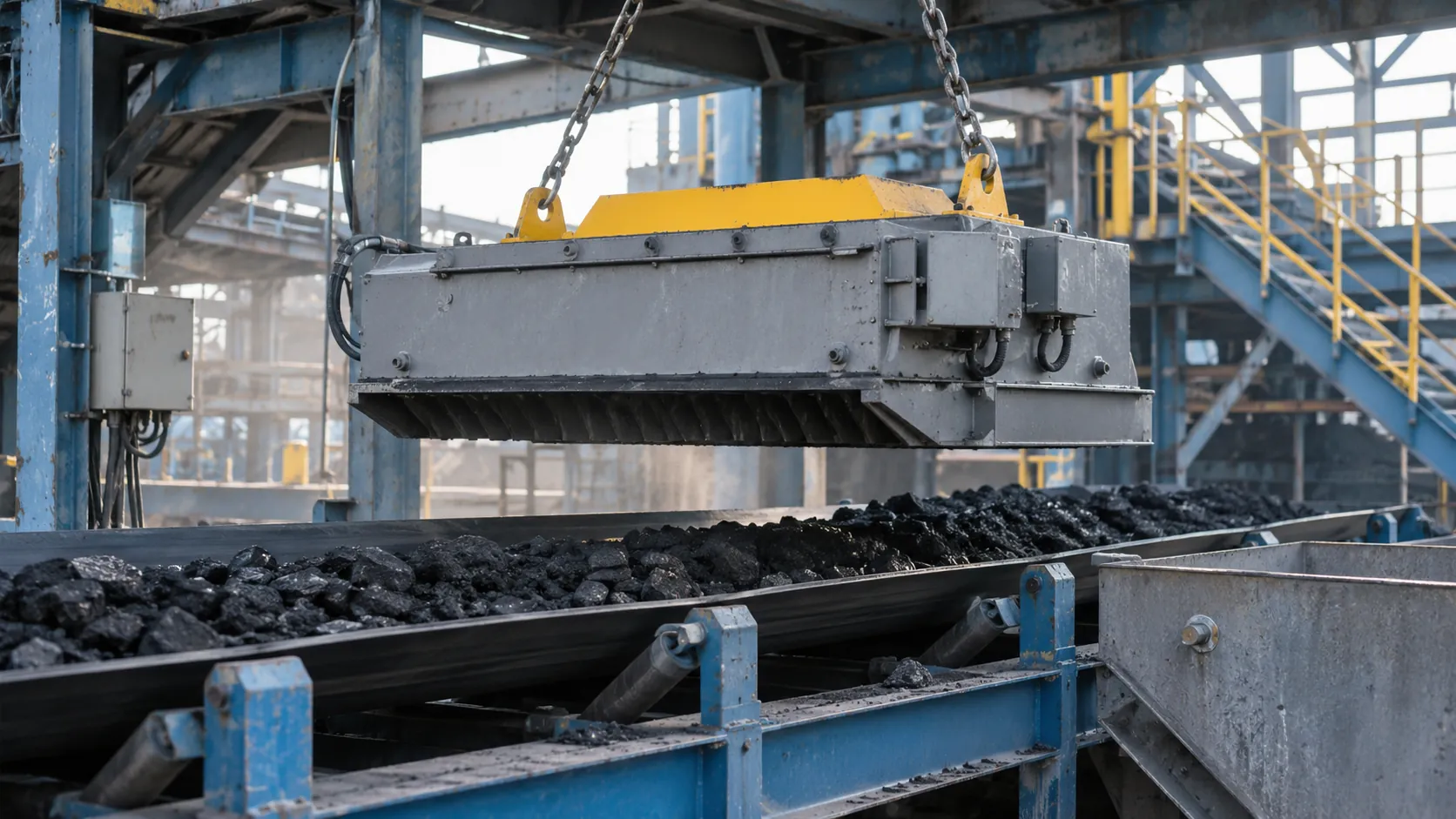
The suspended magnet hangs over the belt, usually at the discharge end where the material is thinnest and moving fastest across the head pulley. A tramp iron piece jumps up to the magnet face as it passes below. In a self-cleaning unit, a continuous rubber belt with cleats runs around the magnet face and carries the captured metal sideways out of the field, where it drops into a reject bin. In a non-self-cleaning unit, the metal stays on the face until someone removes it, which is fine for low contamination but leaves the magnet full after a few events.
The poles are arranged so the field is strong in the zone the material passes through, and the whole assembly is mounted at right angles to the belt direction on a frame with chains or rods. The separator does not touch the coal. It reaches into the stream with a field, takes out the iron, and leaves the coal untouched.
Overband, Cross Belt, Drum and Pulley: The Main Types
Several formats serve different layouts. The table lists the main types and where each is used.
| Type | How it is mounted | Best for | Limit |
|---|---|---|---|
| Overband magnet (inline) | Over the belt, in line with belt direction, at the discharge end | Most conveyors where material is on the belt | Needs headroom and a clear discharge path |
| Cross belt magnetic separator | Over the belt, at 90 degrees to belt direction, with its own cleaning belt | Layouts with limited space at the head pulley, or deep burdens | Larger footprint and drive, higher mounting height |
| Magnetic head pulley | The conveyor's head pulley is itself a magnet | Fine material, thin layers | Weak field at depth, only for shallow burden |
| Magnetic drum separator | A rotating drum in a chute or feed | Free-falling or sliding material in a chute | Needs a controlled feed, not a belt |
| Magnetic plate or grate | Fixed magnet in a chute or hopper | Dry free-flowing small material | Manual cleaning, shallow reach |
An overband magnet is the common first choice for a coal conveyor, because it works at the discharge where the burden is thinnest and it cleans itself. The cross belt magnetic separator takes over when the head pulley area is crowded or when the burden is deep, because it hangs transverse to the belt and removes iron across the whole width of the belt. The more difficult the installation, the more likely the project needs an electromagnetic version of either one.
Permanent Magnet vs Electromagnet
The choice between a permanent magnet and an electromagnet is the central decision, and it rests on working distance, burden, duty and running cost. A permanent magnet uses blocks of ferrite or rare-earth material and needs no power. An electromagnet uses a coil of copper or aluminum wire wound in a steel housing and energized from a DC supply, and its field can be switched off.
| Feature | Permanent magnet | Electromagnet |
|---|---|---|
| Typical working distance | Up to about 300 to 400 mm | Up to about 800 mm oil-cooled, up to about 1000 mm air-cooled |
| Field penetration | Moderate | Deep |
| Power needed | None | DC supply, continuous |
| Running cost | Zero | Electricity every hour it runs |
| Behavior on power failure | Keeps holding | Drops everything it holds |
| Release of captured iron | Needs a belt or manual removal | Can be switched off to release |
| Weight at equal reach | Heavy, especially rare-earth | Lighter for the same reach at depth |
| Maintenance | Belt, bearings | Coil, cooling, rectifier, belt, bearings |
| Cost | Higher purchase for large units, no energy cost | Lower purchase for deep reach, energy cost over life |
The distance figures come from manufacturer ranges, such as those published by Bunting, and trade guidance puts the crossover near 250 mm: below it, a permanent magnet usually does the job, and above it an electromagnet is generally the better choice. Real performance depends on belt width, burden, belt speed and the size of the iron pieces, so the numbers are a first filter and not a design.
A permanent magnet is the quiet choice when the working distance is short. An electromagnet earns its power bill when the burden is deep and the iron is small or heavy.
The power failure row deserves attention. A permanent magnet holds whatever it caught, and a loss of supply changes nothing. An electromagnet releases its load when the supply fails, and a conveyor stopping with the magnet full of iron is a harmless event, but a magnet that loses power while the belt keeps moving can send a captured load into the crusher. Interlock the magnet's supply with the conveyor so the belt cannot run without a live magnet.
The Electromagnetic Separator: Coil, Cooling and Power Supply
An electromagnetic separator consists of a coil, a cooling system, a rectifier or controller, and the housing and belt around them. Each part has a limit.
The coil carries direct current, typically 110 or 220 V DC from a rectifier fed by the plant's three-phase supply. Current through the coil heats it. Copper winding resistance rises about 0.4 percent for each degree Celsius, so a coil that warms by 60 °C has about 24 percent more resistance, and at constant voltage the current and the magnetic field fall by roughly 20 percent between cold and hot. A good controller regulates for that, and the specification should state the field strength at operating temperature, not cold.
Cooling decides how hard the magnet can work. An air-cooled unit has fins or an open frame and suits moderate duty. An oil-cooled unit sits the coil in an oil bath that carries heat to the housing, which allows higher current and a stronger field in the same size, and some manufacturers rate their oil-cooled models for deeper burdens than their air-cooled ones. Oil needs a level check and a leak check. Both types run at 100 percent duty on a conveyor, so the thermal design must allow continuous operation in the site's ambient temperature, which in hot regions is a real constraint.
The electrical protection belongs to the same discussion. A thermal switch in the coil trips the supply if the temperature goes past its limit. A DC ammeter or current monitor shows the operator whether the magnet is drawing its rated current. The coil insulation is tested by an insulation resistance measurement, in the same way as a motor winding; the principles are covered in our guide to insulation resistance and winding resistance testing. And in a coal dust atmosphere, where a classified area may apply, the coil housing and terminal box may need dust-ignition protection, so confirm the area classification and certification with the plant, using the approach in our post on ATEX versus IECEx.
What a Magnet Cannot Catch
A magnetic separator takes out ferrous metal that is magnetic, and several things in a coal stream are not. Manganese steel, also called Hadfield steel, is the material of many crusher teeth, liners and shovel wear parts, and in its normal condition it is non-magnetic. Austenitic stainless steels are similarly weakly magnetic or non-magnetic. Aluminum, copper, brass and other non-ferrous metals ignore a magnet entirely.
A tooth that breaks off a manganese steel bucket therefore passes under a magnet and arrives at the crusher. Plants that have this risk add a metal detector over the belt, which senses any conductive metal and stops the belt or diverts the load to a reject gate. The magnet and the detector complement each other: the magnet removes iron automatically, and the detector catches what the magnet cannot.
For non-ferrous metals in recycling and some mineral streams, an eddy current separator uses a rapidly rotating magnetic rotor to induce currents in conductive pieces and throw them off the belt. It is not used in coal handling, where non-ferrous contamination is rare, but a plant that processes mixed waste or slag meets it as the next stage after the magnet. The two machines solve different problems and appear in series: magnet first for ferrous metal, then an eddy current separator for the non-ferrous remainder.
A metal detector and a magnet also sit together on some belts in a defined order. The magnet goes first, because it removes the bulk of the iron and keeps the detector from tripping on every bolt. The detector goes second, close enough to the crusher that it can stop the belt before the object arrives, and far enough upstream that the belt has time to stop. Plants set that distance from the belt speed and the stopping time, with margin for a loaded belt, because a belt carrying a full load takes longer to stop than an empty one.
Sizing and Positioning
Sizing starts with the conveyor data. The belt width and speed, the burden depth, the material and its bulk density, the smallest and the heaviest iron piece to be caught, and the working distance from the magnet face to the top of the burden all feed the supplier's selection. A magnet should be at least as wide as the belt, since iron near the edges needs the same pull as iron in the center.
Position is as important as size. Mount the separator ahead of the crusher with enough conveyor length between them for the reject bin and chute, and hang it where the burden is thin and the belt is running straight. A position over the discharge pulley, where the material is thrown outward, helps the iron to jump free. Leave headroom for the cleaning belt and for removing the unit for service. Hang it with chains or rods that are rated for several times its weight, with a second support as a precaution, and check that the suspension keeps the magnet level.
The electrical design completes the layout. The rectifier cabinet needs a clean, ventilated location, the DC cable needs correct sizing for the current and the run, and the supply needs an interlock with the conveyor. A local isolator at the magnet allows safe maintenance, and a stray-field warning sign at the installation protects people with pacemakers, since the field outside the casing can still be strong near the face.
Real-World Scenario: An Electromagnet for a Coal Mining Plant
TCC supplied the electromagnet for the magnetic separator at the Sindh Engro Coal Mining Company plant. The description below covers the checks TCC applies on a supply of this kind, and the figures are illustrative sizing, not the plant's data.
The starting point is the conveyor data. Take a belt 1400 mm wide carrying coal at a burden depth of 300 mm, with the suspended unit hanging 500 mm above the burden surface. That working distance is beyond the comfortable range of a permanent magnet, which is the reason a plant chooses an electromagnet. The supplier sizes the coil and cooling for the distance and the heaviest bolts expected, and the unit is delivered with its rectifier and thermal protection.
On site, the sequence is mechanical, then electrical, then functional. The magnet is lifted into position on chains, leveled, and secured with a secondary safety support. The DC cable is run and terminated, the supply is interlocked with the conveyor, and the coil insulation resistance is measured before the first energization. After energizing, the DC current is checked against the nameplate, and the coil temperature is logged as it rises toward its operating level. The functional test follows: steel test pieces, such as a bolt and a plate of known weight, are placed on the belt and the unit is checked for pickup and for clean discharge into the reject bin.
The plant keeps a log of what the magnet recovers. A record of bolts, rock bolts and wear parts, and the point on the belt where they appear, tells the mine where its tramp iron comes from and often leads to a fix at the source.
Commissioning, Maintenance and Safety
A separator needs routine attention more than repair. Check the coil temperature and the DC current each shift, since a falling current signals a failing rectifier or a heating coil, and a rising temperature signals blocked fins or low oil. Keep the cooling surfaces clean of coal dust, which acts as thermal insulation. Inspect the cleaning belt for wear, the pulleys for bearing noise and the discharge area for build-up. Test the insulation resistance of the coil every year and trend it.
Safety work covers three areas. The suspended unit weighs hundreds of kilograms or more, so the chains, shackles and secondary support need inspection and a load rating. The electrical supply is a high-energy DC circuit that stays live after switching off for a short time because the coil stores energy, so lock out and wait before opening a terminal box. And the magnetic field affects pacemakers and loose steel tools within a meter or more of the face, so signs and exclusion zones apply.
TCC supplies electromagnets and the associated controls, installs and commissions them, and carries the work into the plant electrical system through its electrical engineering and industrial automation services. The electrical maintenance and reliability team then covers insulation testing, thermal checks and the supply cabinet. For the rectifier and control cubicle, the post on what is inside a containerized MCC panel shows how such equipment is housed on a mining site.
Frequently Asked Questions
What does a magnetic separator do?
A magnetic separator pulls ferrous metal out of bulk material, such as coal on a conveyor, before the material reaches a crusher or mill. It protects machinery from tramp iron such as bolts, rock bolts and tool fragments. In coal handling, the usual form is a suspended magnet over the belt that cleans itself with a continuous rubber belt.
What is the difference between a permanent magnet and an electromagnet separator?
A permanent magnet needs no power and holds its load when the supply fails, but its working distance is limited to roughly 300 to 400 mm. An electromagnet uses a DC coil, reaches much deeper, up to roughly 800 to 1000 mm depending on cooling, and can be switched off to release the iron, but it costs electricity and drops its load if the supply fails.
Where should an overband magnet be installed?
Install it over the conveyor ahead of the crusher, usually at the discharge end where the material is thinnest and moving fastest. Leave room for the cleaning belt and the reject bin, make the magnet at least as wide as the belt, and set the working distance to the manufacturer's recommendation for the burden depth and the size of iron to be removed.
Can a magnetic separator remove all metal from coal?
No. It removes magnetic ferrous metal. Manganese steel crusher teeth and austenitic stainless steel are non-magnetic or only weakly magnetic, and non-ferrous metals such as aluminum and copper are not attracted at all. Plants with that risk add a metal detector over the belt, and mixed waste streams add an eddy current separator for non-ferrous pieces.
Related products
Components from our catalogue relevant to this article — request a quote for availability, lead time and pricing.
/GHB3030-GR1 Eaton.webp "Eaton GHB3030-GR1 Eaton | Eaton GHB Circuit Breaker")
GHB3030-GR1 Eaton
Eaton GHB Circuit Breaker
/009737 Eaton - ZW7-240.webp "Eaton 009737 Eaton - ZW7-240 | Eaton Overload Relay")
009737 Eaton - ZW7-240
Eaton Overload Relay
/004991 Eaton - ZW7-125.webp "Eaton 004991 Eaton - ZW7-125 | Eaton ZW7 Overload Relay")
004991 Eaton - ZW7-125
Eaton ZW7 Overload Relay
/33AT08-AD1AA11A21A Endress + Hauser.webp "Endress+Hauser Endress+Hauser Promag 33 Electromagnetic Flow Measuring System | Electromagnetic flowmeter, configurable current/pulse/frequency/relay outputs")
Endress+Hauser Promag 33 Electromagnetic Flow Measuring System
Electromagnetic flowmeter, configurable current/pulse/frequency/relay outputs