
ATEX vs IECEx: What the Certification Difference Actually Means

Quick Answer
ATEX vs IECEx comes down to legal weight: ATEX is European law that makes CE and Ex marking mandatory for the EU market, while IECEx is a voluntary international scheme regulators elsewhere choose to accept. Knowing which one a given destination actually requires keeps a shipment out of customs limbo.
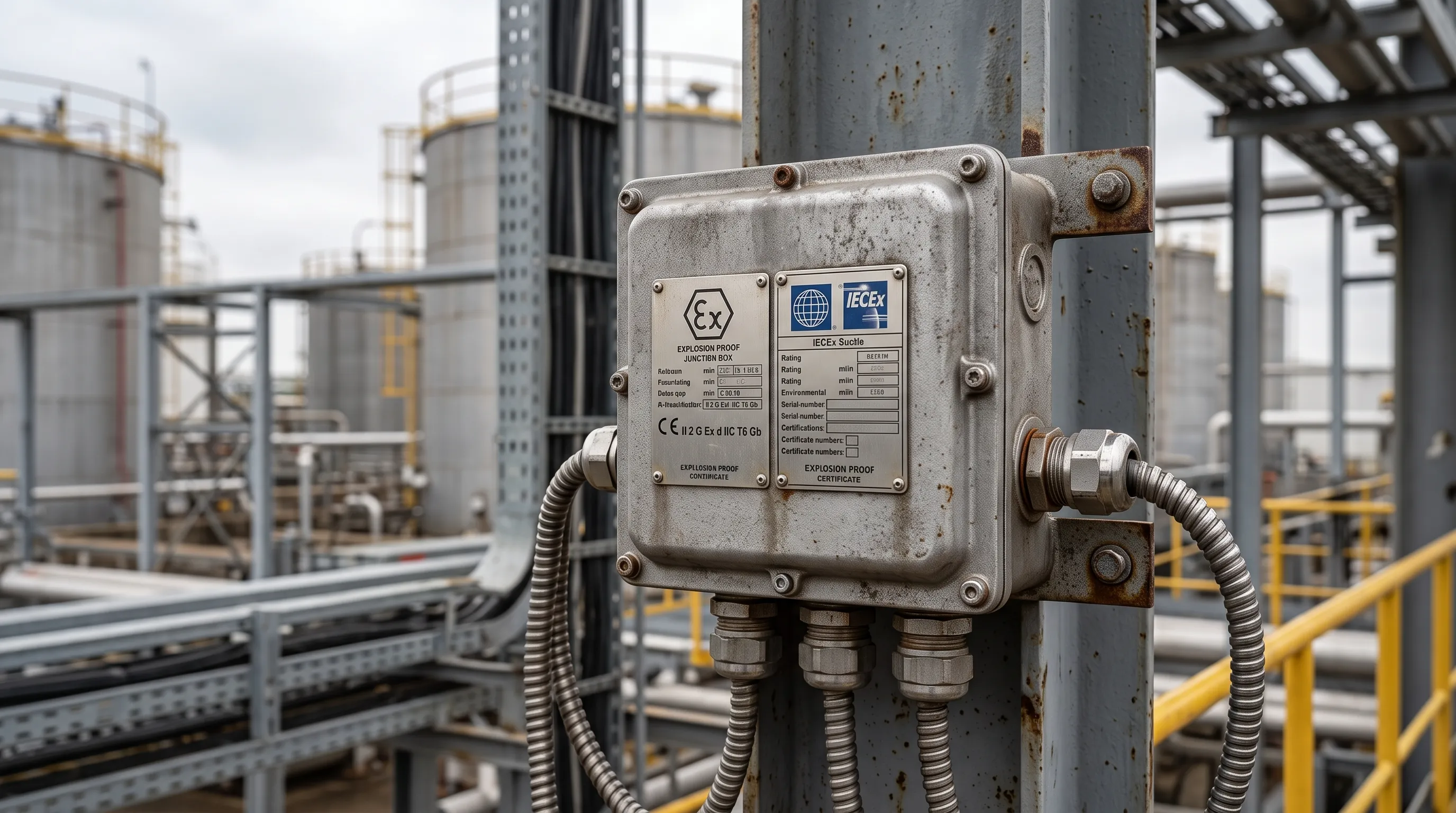
A hazardous-area junction box lands on site with two certificates stapled to the crate: an ATEX EU-type examination certificate and an IECEx Certificate of Conformity, both referencing the same model number. Procurement assumes redundancy; maybe the vendor paid for two stamps to look thorough. That assumption causes real delays on the next order, because ATEX and IECEx are not two versions of the same approval. One is European law. The other is a voluntary international scheme many regulators outside the EU rely on instead of writing their own rules. Get the ATEX vs IECEx distinction wrong on a bid package headed to Dammam, Doha, or Durban, and equipment that cleared one scheme can sit in a bonded warehouse waiting on paperwork for the other.
The difference between ATEX and IECEx is not a technical rivalry between two competing test methods. In any Ex certification standards comparison, both schemes lean on the same IEC 60079 series for the actual engineering, flameproof joints, intrinsic safety barriers, increased-safety terminals, so a device built to pass one usually passes the other without a redesign. The real ATEX IECEx certification difference is legal weight: ATEX is a European Union directive with real legal force, and IECEx is a conformity assessment scheme run by the International Electrotechnical Commission with no legal force of its own. Confusing the two is how a shipment clears one country's customs desk and gets held at the next.
ATEX tells you a product is legal to sell inside the EU. IECEx tells you a product has been independently tested to an international standard. Neither statement answers the other question.
What ATEX Actually Requires
ATEX directive explained properly begins with a correction: ATEX is not one directive. It is two, and buyers who only know the equipment-marking side miss half of what the name covers.
The equipment directive, 2014/34/EU, sets the ATEX certification requirements that actually matter to a supplier: any equipment or protective system intended for use in a potentially explosive atmosphere has to carry a CE mark plus the Ex symbol before it can be placed on the EU market, and that marking is a legal precondition for sale, not a voluntary quality signal. The directive sorts equipment into Group I (mining) and Group II (surface industries), then into Categories 1, 2, or 3 by how severe and how frequent the explosive atmosphere is expected to be. Category 1 and most Category 2 equipment needs third-party assessment from a Notified Body: an EU-type examination under Module B, followed by ongoing production oversight under a quality-assurance module such as Module D or Module E. Category 3 equipment, intended for zones where an explosive atmosphere is unlikely and brief, can be self-certified with no Notified Body involved. Notified Bodies are not EU institutions; they are commercial test houses that member states designate and report to the European Commission, and are normally accredited to EN ISO/IEC 17065 before a government designates them. Confirm any Notified Body's live designation on the European Commission's NANDO database rather than taking a certificate's letterhead on faith.
The second directive, 1999/92/EC, has nothing to do with equipment marking and everything to do with what an employer has to do once that equipment is installed. It is commonly called ATEX 137, after the article of the EC Treaty that was its original legal basis, though it is also cited as ATEX 153 after the EU's later renumbering of that article. ATEX 137 requires employers to run a documented explosion risk assessment, classify hazardous areas into zones, prepare an explosion protection document, and select equipment appropriate to that zone. A plant can hold flawless ATEX zone certification on its equipment and still fail ATEX 137 if the zoning study behind that selection was never done or never updated after a process change.
What IECEx Actually Is
IECEx is the IEC's international Ex equipment certification scheme for explosive atmospheres, and the distinction worth holding onto is that it is a scheme, not a statute. No country is bound by treaty to accept an IECEx certificate, and the IEC cannot prohibit a device from being sold anywhere. What it offers instead is a single, harmonized assessment path built on the IEC 60079 series, so a manufacturer tests once rather than repeating a near-identical program for every market running its own national scheme.
Here is the IECEx scheme explained in mechanical terms: it runs through two bodies working together rather than one. An IECEx Ex Testing and Assessment Laboratory (ExTL) performs the physical type test against the relevant part of IEC 60079 and produces a test report. An IECEx Ex Certification Body (ExCB) separately audits the manufacturer's production facility and quality system, producing a Quality Assessment Report (QAR), often built on the same quality-system criteria set out in ISO 80079-34. Once the ExCB confirms the test report and the QAR align, it issues the IECEx Certificate of Conformity, published on IECEx's own online certificate database so a buyer anywhere can verify it directly against the register rather than trusting a forwarded PDF. Both ExTLs and ExCBs only participate after passing an IECEx peer assessment, with ongoing surveillance and reassessment roughly every five years, which keeps the scheme's data trustworthy across dozens of countries without a single government enforcing it.
How a Manufacturer Actually Gets Each One
ATEX certificate vs IECEx certificate: both end in a signed document, but who signs it and what they check first are not the same process.
Under ATEX, a manufacturer selling Category 1 or 2 equipment into the EU submits a sample to a Notified Body for EU-type examination. The Notified Body tests against the applicable harmonized standards, issues an EU-Type Examination Certificate if the sample passes, then audits ongoing production under whichever quality-assurance module the manufacturer selected. The manufacturer, not the Notified Body, draws up the EU Declaration of Conformity and applies the CE and Ex marks. Category 3 equipment skips the Notified Body step entirely: the manufacturer self-assesses and takes on full legal liability for that declaration. That split is how the ATEX certification requirements get met in practice.
Under IECEx, there is no self-certification tier in the same sense. Every IECEx Certificate of Conformity under the Certified Equipment Scheme requires both the ExTL type test and the ExCB factory audit, so IECEx zone certification stays third-party however low-consequence the zone is. That is a structural difference, not a stylistic one: ATEX lets some equipment skip third-party involvement, and IECEx offers no shortcut for the scheme most industrial buyers encounter.
ATEX vs IECEx at a Glance
The table sets out the ATEX vs IECEx marking and certification differences.
| Aspect | ATEX | IECEx |
|---|---|---|
| Legal status | EU directive (2014/34/EU); legally mandatory to place equipment on the EU market | Voluntary international conformity assessment scheme; no treaty obliges any country to accept it |
| Administered by | The European Commission, enforced through EU member states | The International Electrotechnical Commission (IEC) |
| Who certifies | A Notified Body designated by an EU member state (normally accredited to EN ISO/IEC 17065) | An ExCB, backed by an ExTL test report and a factory Quality Assessment Report |
| Certificate name | EU-Type Examination Certificate plus manufacturer's EU Declaration of Conformity | IECEx Certificate of Conformity, publicly listed on the IECEx Online Certificate System |
| Default geographic recognition | Full legal equivalence across the EU/EEA single market once one Notified Body certifies | Accepted as evidence of compliance by many regulators outside the EU, on each country's own terms |
| Self-certification route | Yes, for Category 3 equipment against harmonized standards | No, the Certified Equipment Scheme always requires third-party test and factory audit |
| Marking | CE mark plus the Ex symbol, category, and EPL | No separate physical mark required by the scheme itself; the Ex technical marking (EPL, gas group, T-class) comes from IEC 60079-0 regardless of which certificate accompanies it |
Reading the actual Ex marking on the nameplate, the gas group, temperature class, and Equipment Protection Level, is a separate exercise from the certification-scheme question covered here; our breakdown of Ex d vs Ex db marking goes through that nameplate once you already know which certificate you hold.
Why One Enclosure Often Carries Both Markings
Walk the floor of any hazardous-area equipment manufacturer selling into more than one region and you will find the same junction box, light fixture, or control station carrying an ATEX category marking, an IECEx certificate number, and sometimes a third national mark, all on one nameplate. Carrying several explosion proof certification types on one nameplate is not redundancy. It is the most economical route through two conformity assessment schemes that share most of their underlying technical requirements.
A manufacturer building to IEC 60079-0 and IEC 60079-1 generates a single type-test data package that satisfies most of what both a Notified Body and an ExTL will ask to see. Running the EU Notified Body assessment and the IECEx ExTL/ExCB assessment in parallel against that shared package costs far less than running two independent test campaigns, and it lets the finished product ship to an EU distributor under ATEX and to a Gulf, African, or Asian distributor under IECEx without two production lines. That is the ATEX IECEx equivalence buyers actually benefit from: not that the schemes are legally interchangeable, but that the underlying engineering rarely needs proving twice.
What Mutual Recognition Actually Covers, and What It Doesn't
The phrase ATEX IECEx mutual recognition gets used loosely, and the loose version causes more procurement mistakes than almost anything else in this comparison.
Inside the IECEx scheme, mutual recognition has a specific, narrow meaning: the ExCBs and ExTLs that participate agree to accept each other's type-test data and audit findings without repeating them. A test performed by an ExTL in Germany does not need repeating by an ExCB in Australia before that ExCB issues its own Certificate of Conformity on the same design. That arrangement, the real mechanism behind ATEX IECEx mutual recognition, is what makes IECEx useful: it turns one test program into a certificate recognized across dozens of participating national infrastructures rather than one.
What that mutual recognition does not do is bind any government to treat an IECEx certificate as sufficient for its own market access, customs clearance, or workplace-safety law. Each country decides independently how much weight to give an IECEx Certificate of Conformity, from treating it as effectively sufficient to treating it as a useful but incomplete starting point. ATEX's own mutual recognition works more completely within its own borders: once a Notified Body issues an EU-Type Examination Certificate, that certification is automatically valid for free movement across every EU and EEA member state, no further gatekeeping required. That strength is real; it just stops being relevant the moment the shipment crosses the EU/EEA border.
Mutual recognition inside IECEx means certification bodies trust each other's test data. It has never meant that a government outside the scheme is obligated to accept the certificate that data produced.
What a Gulf, Russian, South African, UK, or US Buyer Should Actually Ask For
In this hazardous area certification comparison, none of the five regions legally requires ATEX marking the way the EU does, which is why "ATEX or IECEx, whichever you have" is the wrong way to settle the ATEX vs IECEx question for a given shipment. What matters, not the abstract difference between ATEX and IECEx, is which national scheme governs import and market access where the equipment is going.
UAE and Saudi Arabia: Two Separate National Schemes, Not One Gulf Standard
In the UAE, hazardous-area electrical equipment falls under the Emirates Conformity Assessment Scheme (ECAS), administered by the Emirates Authority for Standardization and Metrology (ESMA). ECAS requires its own Certificate of Conformity from an ESMA-accredited Notified Body and product registration in ESMA's database before it carries the ECAS mark; an existing ATEX or IECEx file supports that submission but does not substitute for ECAS registration.
Saudi Arabia runs its import-conformity process through SASO's SABER platform, and for several hazardous-area product categories commonly sourced by industrial buyers (junction and control boxes, lighting fixtures, plugs and sockets, electrical pumps, gas detection systems) an IECEx Certificate of Conformity is effectively required to complete SABER's Product Certificate and the per-shipment Certificate of Conformity. That makes Saudi Arabia a clear case where asking specifically for IECEx certification requirements, rather than accepting an ATEX-only file, has a direct payoff at the border. Qatar and Oman have not built an equivalent dedicated scheme at the same scale, so buyers there tend to default to whichever certification the project's engineering specification calls out, which is why the IECEx certification requirements in that specification should be confirmed rather than assumed.
Russia: The EAC Ex Certificate Is Mandatory
Equipment for explosive atmospheres entering the Russia-led Eurasian Economic Union market is governed by TR CU 012/2011, which requires a mandatory EAC Ex certificate of conformity. There is no self-declaration route under TR CU 012/2011, and the certificate requires a production-site audit regardless of other certification already held. An existing ATEX or IECEx certificate is genuinely useful, since assessors can draw on that documentation to streamline the EAC review, but it does not replace the EAC Ex certificate, the factory audit, or the EAC mark itself.
South Africa: IECEx as the Base, a Local Certificate on Top
South Africa is frequently cited as IECEx-friendly, and that holds up, but not in the way "IECEx is accepted directly" implies. Hazardous-area classification runs through SANS 10108, and the national accreditation programme under ARP 0108 requires an Inspection Authority (IA) Certificate from a SANAS-accredited testing laboratory before equipment can be used in a classified area. That IA Certificate is typically built directly on an existing IECEx Certificate of Conformity, so the IECEx file genuinely shortens the path, but South Africa still layers its own certificate on top rather than treating the IECEx document as the final word.
The UK: UKCA, UKEX, and the CE Marking Extension for Great Britain
Since the UK's departure from the EU, equipment for explosive atmospheres placed on the Great Britain market falls under UKEX, the UK's own route under the Equipment and Protective Systems for Use in Potentially Explosive Atmospheres Regulations 2016, with its own UKCA marking as the counterpart to ATEX's CE and Ex marking. The technical requirements mirror ATEX closely, but the marking and the assessing body are UK-specific. The UK government removed the original CE cutoff in 2024: the Product Safety and Metrology etc. (Amendment) Regulations 2024 now recognize CE and ATEX marking on the Great Britain market indefinitely, alongside UKCA, across UKEX and a long list of other product regulations. A distributor can rely on that continued recognition for ATEX-certified stock, though UKCA remains the route where a product line needs its own Great Britain certification.
The United States: NEC and NRTL Listing Decide, Not IECEx
In the US, what controls whether hazardous-area equipment can be installed is NFPA 70 (the National Electrical Code), Articles 500 through 506, combined with listing from a Nationally Recognized Testing Laboratory such as UL or CSA. Neither ATEX nor IECEx is a legal requirement anywhere in US onshore industry; an authority having jurisdiction enforcing the NEC asks for NRTL listing, not an ATEX certificate. Article 505's Zone-based option, built around the harmonized UL/CSA 60079 series and marked with the "AEx" prefix, brings US practice structurally closer to IEC Zone classification, but it remains a separate NRTL-administered listing, not an acceptance of an IECEx certificate.
A Real-World Scenario: The Terminal Expansion That Stalled on One Certificate
The Setup
An EPC contractor building a tank farm and loading-terminal expansion at a Saudi Arabian industrial port sourced explosion-proof junction boxes and local lighting distribution boards from a European manufacturer with a long-standing ATEX relationship. The manufacturer's technical file was complete and current: EU-Type Examination Certificates from a well-known Notified Body, full category and EPL marking, production quality assurance under Module D. The purchase order referenced "ATEX certified" equipment throughout, the language its engineering standard used on every other project.
What Went Wrong
The junction boxes fell squarely inside SABER's controlled hazardous-area product categories. When the shipment reached the Saudi port, customs clearance required an IECEx-based SABER Product Certificate for that line, and the manufacturer's documentation covered ATEX only; it had never been through an ExTL type test or ExCB factory audit under the Certified Equipment Scheme. The contractor assumed, reasonably given its European project history, that a complete ATEX file would satisfy any hazardous-area requirement anywhere. It satisfied the EU. It did not satisfy SABER.
The Fix
The manufacturer had to commission IECEx testing and a factory QAR audit on an expedited basis, adding weeks to an already tight schedule, while procurement scrambled to source an IECEx-certified interim quantity from an alternate vendor just to keep the installation moving. The hardware never needed to change, and Ex equipment compliance was never in doubt. What was missing was never a flameproof-joint problem or a T-class problem. It was a certification-scheme problem a five-minute check against the destination country's actual import requirements would have caught before the purchase order was issued.
The equipment was never wrong. The certificate on file was simply answering a question the destination country had not asked.
Verifying which hazardous area equipment certification scheme actually governs a shipment's destination, not just which one a supplier has on file, is exactly the kind of technical bid review our electrical engineering team runs before a hazardous-area purchase order goes out, because catching a scheme mismatch during quoting costs an email and catching it at customs costs a schedule.
If you are sourcing hazardous-area equipment for a Gulf, Russian, South African, UK, or US project and need the certification question settled before the order ships, our engineers explain the ATEX IECEx certification difference in terms of the actual destination requirement, and settle the ATEX vs IECEx question, as part of our standard procurement process, run out of our Lahore and Torino offices for clients managing multi-region supply chains. Our products catalog lists the certification basis for every hazardous-area item we carry, and our contact page is the fastest way to get a shipment's documentation checked before it becomes a port-side problem.
Frequently Asked Questions
What is the difference between ATEX and IECEx certification?
The ATEX IECEx certification difference starts with legal status: ATEX is a European Union directive, specifically 2014/34/EU, that makes CE and Ex marking a legal requirement for equipment placed on the EU market, enforced through Notified Bodies that EU member states designate. IECEx is a voluntary international conformity assessment scheme run by the IEC, where an ExCB issues a Certificate of Conformity based on an ExTL test report and a factory quality audit, with no government bound to require or accept it. ATEX certification explained in one line: the engineering behind both usually traces back to the same IEC 60079 series, but one is law and the other is a widely used international reference point.
Is an ATEX certificate recognized outside the European Union?
Not as a matter of law, and this is exactly where ATEX IECEx mutual recognition gets misread. ATEX's own mutual recognition is complete across the EU and EEA: once a Notified Body certifies a product, it moves freely across every member state, but that legal force stops at the EU/EEA border. Outside the EU, an ATEX certificate is commonly accepted as useful supporting technical evidence, and in the UK's case, CE and ATEX marking currently continues to be recognized for the Great Britain market alongside UKCA under the Product Safety and Metrology etc. (Amendment) Regulations 2024, but each country's own regulator decides independently how much weight an ATEX certificate carries.
Does IECEx certification replace the need for ATEX marking?
No. IECEx certification explained plainly is proof of independent testing, not a licence to sell in the EU, so the ATEX certification requirements under 2014/34/EU still apply in full if equipment is being placed on the EU market, regardless of whether the product also holds an IECEx Certificate of Conformity. IECEx and ATEX commonly run in parallel on the same product precisely because neither one substitutes for the other where both apply, and a manufacturer selling into the EU and into IECEx-recognizing markets typically needs both certificates on file, not a choice between them.
Which certification should a Gulf or South African buyer ask for?
Ex rated equipment certification depends on the specific country's own import and market-access scheme rather than a single Gulf-wide or Africa-wide answer. Saudi Arabia's SABER process effectively requires an IECEx Certificate of Conformity for several controlled hazardous-area product categories, the UAE requires its own ECAS certificate and registration through ESMA regardless of ATEX or IECEx status, and South Africa requires a local Inspection Authority Certificate built on an IECEx base under ARP 0108. Asking a supplier only for "ATEX or IECEx" without naming the destination country's actual scheme is how equipment clears engineering review and still gets held at customs.
Related products
Components from our catalogue relevant to this article — request a quote for availability, lead time and pricing.
/BAT53 Series Explosion Proof Led Flood Light 70W-1000W For Hazardous Areas.webp "ATEX BAT53 Series ATEX - Explosion Proof LED Flood Light 70W-1000W | Explosion-proof LED floodlight, 70W-1000W")
BAT53 Series ATEX - Explosion Proof LED Flood Light 70W-1000W
Explosion-proof LED floodlight, 70W-1000W
/BAT85 Series Explosion Proof Floodlights , ATEX Led Flood Light.webp "ATEX BAT85 Series ATEX - Explosion Proof Floodlight, LED Flood Light | ATEX-certified explosion-proof LED floodlight")
BAT85 Series ATEX - Explosion Proof Floodlight, LED Flood Light
ATEX-certified explosion-proof LED floodlight
/BnT81 Series Aluminium ATEX Floodlights , Hazardous Location ights with 400W~1000W.webp "ATEX BnT81 Series ATEX - Aluminium Floodlight, Hazardous Location Lighting 400W-1000W | Aluminium ATEX floodlight, 400W-1000W")
BnT81 Series ATEX - Aluminium Floodlight, Hazardous Location Lighting 400W-1000W
Aluminium ATEX floodlight, 400W-1000W
/HRD91-LED Series Explosion Proof LED Lighting 30W 50W 70W 100W For Hazardous Areas.webp "ATEX HRD91-LED Series ATEX - Explosion Proof LED Lighting 30W-100W | Explosion-proof LED light, 30W/50W/70W/100W")
HRD91-LED Series ATEX - Explosion Proof LED Lighting 30W-100W
Explosion-proof LED light, 30W/50W/70W/100W