
How to Compare Motor Quotations: A Technical Comparison Checklist for Buyers

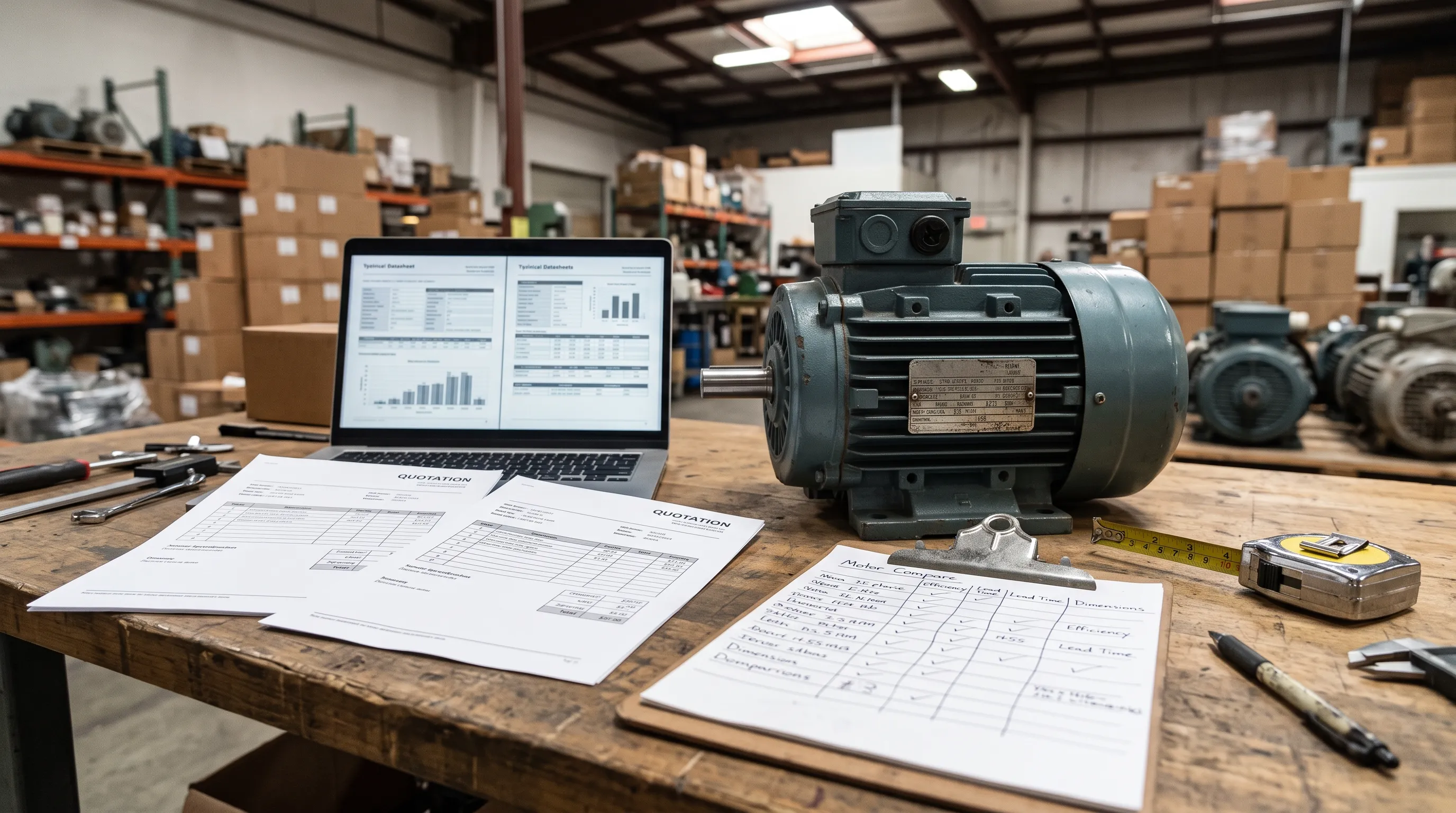
Quick Answer
Learning how to compare motor quotations means going beyond kW and efficiency class: service factor, insulation rise, bearing provisions, warranty triggers, and total cost of ownership decide which bid actually protects your plant.
Two motor quotations land on your desk for the same duty, say a 110 kW end suction pump or a 75 kW cooling tower fan, and they look interchangeable. The kW matches, the voltage matches, and both lines read "IE3" in the efficiency column. Then one vendor's bearing arrangement needs a relubrication schedule nobody budgeted for, and the warranty on the other excludes failures above a stated humidity threshold buried in a footnote. Knowing how to compare motor quotations properly, line by line, before the purchase order goes out, separates a procurement decision from a mistake that surfaces eighteen months into operation.
This is not a guide to writing a motor specification from a blank page; that decision tree is covered in TCC's guide to medium voltage motor selection. It is written for the buyer who already has two, sometimes three, technical quotations in hand and needs a repeatable way to score them before signing. Whether you are running a technical bid evaluation for a refinery turnaround in the Gulf, trying to compare electric motor quotes for a UK water utility, or doing an industrial motor RFQ evaluation for a US food plant expansion, the logic for how to compare motor quotations is the same: the commercial risk hides in the technical detail, not the price on the cover page.
Why Two Motor Quotations Rarely Match Cleanly
A motor quotation is built from a datasheet, a price, and a set of commercial terms, but vendors do not start from the same assumptions when filling those in. One supplier sizes the motor tight to the duty point because the commercial team wants the lowest number on the bid tab; another builds in a service factor and a corrosion-rated paint system because engineering read the site data sheet. Both satisfy the same request for quotation and still carry different risk.
This is the core problem with any industrial motor quotation comparison at the headline level: kW, voltage, and efficiency class are the three fields every vendor fills in correctly, since they get rejected automatically if wrong. What separates a well-engineered motor from a minimally compliant one sits a row further down, in fields a reviewer without an electrical background skims past.
Learning how to compare motor quotations properly comes down to one habit: a line-by-line read of the rows that do not get checked automatically.
The Specifications Both Quotations Usually State Correctly
Before covering what buyers miss, it is worth naming what is genuinely easy to compare, since treating easy fields with the same suspicion as hard ones wastes time.
Rated output. Confirm the quoted kW matches the duty point specified, not a rounded-up catalogue frame one size larger, which changes shaft height and base plate dimensions.
Voltage and frequency. Easy to verify against the RFQ, but check it against the actual site supply. A 60 Hz installation needs a 60 Hz design, not a 50 Hz motor re-rated on a datasheet note.
Frame size. IEC 60072 and NEMA MG 1 both standardise frame dimensions so motors from different manufacturers in the same frame are physically interchangeable at the mounting feet and shaft height. A nonstandard frame limits replacement options years out and complicates drive selection if the motor pairs with a VFD. For US-bound motors up to 1,000 V, confirm a UL 1004-1 listing mark; it is a safety certification, not a performance spec, but its absence can stall a plant's electrical inspection regardless of how good the technical numbers look.
Efficiency class. Both quotations will state IE1 through IE4 per IEC 60034-30-1, or a NEMA Premium designation under NEMA MG 1 Table 12-12. Since 1 July 2021, EU Regulation 2019/1781 has required three-phase motors from 0.75 to 1000 kW to meet at least IE3, with a second stage from 1 July 2023 pushing 75-200 kW, 2, 4, and 6-pole motors to IE4. In the US, EISA 2007 made NEMA Premium efficiency, broadly aligned with IE3, mandatory for general-purpose motors from 1 to 500 hp built after 19 December 2010. Gulf, Russian, and South African buyers typically specify against IEC, so IE3 is the realistic floor today.
These four fields are where a reviewer's eye naturally lands, and where two competent vendors are least likely to differ. The motor specification comparison and motor vendor comparison that decide the outcome start below this line.
The Line Items That Decide the Outcome
Service factor, the overload margin nobody prices. NEMA MG 1 defines service factor as a multiplier that, applied to rated output, states a permissible loading the motor can carry under stated conditions. A motor quoted at 1.0 has zero overload margin; one at 1.15 can carry roughly 15% above nameplate under standard conditions of 40 degrees C ambient. IEC-rated motors generally carry no service factor; IEC 60034-1 instead expects a duty type (S1 through S10), so a NEMA-baseline quote and an IEC-baseline quote use overload margin differently. The risk is a duty that drifts upward over the plant's life, debottlenecking, a process change, a dirtier filter, with no margin designed in.
Insulation class and temperature rise. This pairing is where two quotations that both say "Class F" can still carry different thermal margins. NEMA MG 1 and IEC 60034-1 recognise insulation classes by maximum hot-spot temperature: Class A at 105 degrees C, Class B at 130, Class F at 155, Class H at 180. The nameplate class states the material's thermal limit, not the temperature the motor actually runs at; that second number is the rise. A motor wound with Class F insulation but rise-tested to Class B limits, written as "Class F insulation, Class B rise," runs roughly 25 degrees C cooler than its material's limit, buying margin against a hot ambient without accelerating insulation aging. A competing "Class F insulation, Class F rise" quote carries less margin, and for a 48-50 degrees C summer ambient in the Gulf or inland Russia, that margin often decides whether the motor survives its warranty period.
Bearing type and relubrication provision. Bearing selection rarely gets its own line on a bid tab, yet it drives a large share of lifetime maintenance labour. Grease-lubricated ball bearings dominate general-purpose motors below roughly 200 kW; above that, sleeve or roller bearings with dedicated lubrication systems become more common. Check whether the bearing is sealed for life, no scheduled maintenance but no re-grease option once it runs dry, or fitted with a relubrication provision and a stated interval. A vendor quoting a sealed bearing for continuous three-shift duty in a cement plant has quietly transferred a bearing replacement onto a maintenance calendar it was never budgeted for, the kind of cost TCC's electrical maintenance and reliability team gets asked to absorb after the fact.
Vibration and noise limits. ISO 20816-3:2022, which replaced ISO 10816-3, sets vibration severity zones A through D, grouping motors by power and shaft height: Group 2 covers the 15-300 kW band with shaft height 160-315 mm, where most process-plant motors sit. Zone A is a new machine's baseline, Zone B the boundary for unrestricted long-term running, Zone C vibration unsuitable for continuous operation. State the zone the factory test targets, not a bare "within ISO limits" claim. A sound power level 8-10 dB higher than a competing quote can mean the difference between an open installation and one needing an acoustic enclosure nobody budgeted for.
Paint system and corrosion protection for the actual site. ISO 12944-2 defines atmospheric corrosivity categories from C1 (very low) through C5 (very high), plus CX for offshore exposure. A motor for an onshore desert site in Saudi Arabia or the UAE typically sits in C3 to C4; the same motor relocated to a coastal terminal or a Caspian coast site in Russia moves into C5 or CX, where a single-coat enamel system will not hold up. A quotation omitting coating system and corrosivity category is not comparable to one that states them.
A motor specification comparison that stops at kW, voltage, and efficiency class has compared three fields out of roughly a dozen that actually determine whether the motor survives its design life on your site.
A Motor Technical Comparison Checklist You Can Reuse
This is the practical core of how to compare motor quotations: score each line as a direct value comparison, not a yes-or-no, and require every vendor to state the standard they tested against. A blank cell on a motor technical bid evaluation sheet is itself a finding: it usually means the vendor priced the cheaper option without saying so. This same structure is worth using on an industrial motor RFQ evaluation before the RFQ goes out, since vendors respond more completely to a request that already names the motor purchase evaluation criteria they will be scored on.
| Comparison line item | What to record for each quote | Standard or reference |
|---|---|---|
| Rated output and duty point | kW, confirmed against actual process duty | Site process data sheet |
| Voltage, frequency, tolerance | V, Hz, tolerance band vs. actual site supply | IEC 60038 / site survey |
| Frame size and mounting | IEC or NEMA frame designation, foot or flange | IEC 60072 / NEMA MG 1 |
| Efficiency class | IE2-IE4 or NEMA Premium, test method stated | IEC 60034-30-1 / MG 1 Table 12-12 |
| Service factor or duty type | 1.0 or 1.15 (NEMA) or S1-S10 (IEC) | NEMA MG 1 / IEC 60034-1 |
| Insulation class and rise | Class stated and the rise class tested to | NEMA MG 1 / IEC 60034-1 |
| Bearing type and relubrication | Sealed-for-life or regreasable, stated interval | Manufacturer datasheet |
| Vibration severity | Zone (A-D) and measurement standard used | ISO 20816-3 |
| Sound power level | dB(A) at rated load, test method referenced | ISO 1680 / factory test report |
| Paint system and corrosivity | Coating type, dry film thickness, rating | ISO 12944-2 |
| Enclosure protection rating | IP code for dust and moisture ingress | IEC 60529 |
| Warranty period and exclusions | Duration, start trigger, stated exclusions | Vendor commercial terms |
| Lead time and delivery basis | Weeks from order, Ex-Works vs. delivered | Vendor commercial terms |
Fill this once per vendor and lay the columns side by side. Built this way, it turns a subjective "which quote feels more complete" judgement into a line-item record you can defend to a procurement committee if the cheaper motor fails inside its first year. The same line items are worth confirming again at the factory acceptance test stage, alongside the checks in TCC's guide to motor testing methods.
Warranty Terms: Read the Exclusions First
Every motor quotation states a warranty period, usually 12 to 24 months, and buyers routinely stop reading at the number. The duration is close to meaningless without the trigger date and exclusion list attached to it.
Check when the clock starts. A warranty running "from date of delivery" protects the vendor against your installation schedule slipping; one running "from date of commissioning" protects you against that same slippage. A motor sitting in a warehouse for four months before being energised has already burned a third of a delivery-triggered warranty before it even starts running.
Then read what voids it: operation outside the stated ambient or altitude range, operation above the stated service factor, missed relubrication intervals, use with a VFD not confirmed compatible at order stage (relevant if sourcing the drive alongside the motor), and ingress beyond the quoted IP rating. A longer warranty attached to a longer exclusion list is not automatically the better position; it depends on which exclusions apply to your site.
Lead Time Risk: The Cheaper Quote Isn't Always the Faster One
Lead time belongs on the comparison sheet as a cost line, not a footnote. Industrial motor supply chains have not been uniformly stable: trade press through 2025 described standard-frame motors around 200 hp quoting 20 to 30 weeks in some markets, with units above 500 hp harder to secure, driven by tightness in copper and electrical steel. Stocked, standard low-voltage motors can still move in weeks when the exact rating sits on a distributor's shelf; custom or IE4-rated units sit at the long end of that range.
A motor tender evaluation that ignores delivery basis can hand you a lower price attached to a schedule risk costing more than the price gap once a plant outage or completion date is on the line. Ask each vendor to confirm lead time in writing, in weeks from order, Ex-Works or delivered, with a stated remedy if that date slips. A vendor unwilling to commit a lead time in writing is telling you something about stock position the price line never will.
Total Cost of Ownership When Efficiency Class Differs
This is where a pure price comparison does the most damage: an efficiency difference compounds every hour the motor runs, and a comparison that ranks bids on purchase price alone leaves that running cost out of the decision entirely.
Take a representative case: a 90 kW motor running continuously, roughly 8,000 hours a year on a three-shift duty. An IE3 motor commonly runs 1.5 to 2.5 efficiency percentage points above an older IE2-class design at this frame size, with the exact gap depending on pole count and loading, per the class structure in IEC 60034-30-1. Even a 2-point gap on a 90 kW continuous load translates into several thousand kilowatt-hours of avoidable consumption a year. Multiply that across a realistic 15 to 20-year service life and the lifetime energy cost difference will, on almost any industrial tariff across the Gulf, the UK, the US, Russia, or South Africa, exceed the purchase price gap, often by a wide margin.
Comparing two motor quotations on purchase price alone, when their efficiency classes differ, is comparing the smallest number on the page to decide an outcome driven by the largest one.
This is the comparison a headline-price process misses, and the strongest argument for scoring a motor technical specification comparison on total cost of ownership whenever two quotations sit in different efficiency classes. If you want the energy-cost side modelled against your actual tariff and run-hour profile, that is the kind of analysis TCC's audits and power system optimization team runs as part of a motor replacement business case.
A Real-World Scenario: The Quote That Looked Identical and Wasn't
A Gulf petrochemical complex needed a replacement 160 kW cooling-tower fan motor after a bearing failure took the original unit out mid-summer, with ambient shade temperatures near 48 degrees C. Two vendors quoted against the same RFQ. Both listed IE3, 400 V, 4-pole, IP55, and the two quotes differed by roughly 9%, with the lower one looking like the easy call in this motor vendor comparison.
The technical submittals told a different story once compared line by line instead of by summary page. The lower-priced motor was wound to Class F insulation with a Class F rise, compliant but with essentially no thermal margin above its rated 40 degrees C ambient. The higher-priced quote specified the same insulation with a Class B rise, plus a derating note confirming full-torque output up to 50 degrees C ambient. The site's actual summer ambient, with solar loading on the fan deck, routinely exceeded 45 degrees C.
The plant took the lower quote. The replacement motor ran nine months before a winding failure, traced to accelerated insulation aging from operation closer to its thermal limit than the datasheet implied, not the 40 degrees C test-house ambient the IE3 rating was verified at. The failure cost several multiples of the original 9% gap.
The motor that looked 9% more expensive on the bid tab was the one engineered for the site's real ambient. The 9% was the price of a thermal margin the lower quote never had.
The fix for that site was procedural: every subsequent motor RFQ for outdoor duty now carries an explicit derating confirmation requirement in the evaluation sheet, scored before price is even opened.
Red Flags That Signal an Understated Motor Quotation
A handful of patterns show up repeatedly in motor quotations that look competitive on price but are missing cost elsewhere:
- Blank or "TBC" fields on service factor, bearing type, or vibration class. A vendor who engineered the motor for your duty fills these in; one pricing a generic catalogue listing leaves them blank and promises to confirm later, after the order is signed.
- No stated coating system or corrosivity category, especially for a coastal or chemical-processing site. This is the most common gap on quotations that later fail from corrosion, not an electrical defect.
- A warranty with no stated start trigger. Assume delivery if unstated, since that default favours the vendor.
- A lead time quoted verbally but not written into the commercial terms. Any lead time that influences the decision belongs in the document you can hold the vendor to.
- An efficiency class stated without a referenced test standard. "IE3" with no citation to IEC 60034-30-1 is a claim, not a verified rating; ask for the factory test report before relying on it in a motor bid evaluation.
None of these alone disqualifies a vendor. Two or more on the same quotation signals the price was built by omission: the short version of how to compare motor quotations is that nameplate specifications alone are never enough, since the nameplate says nothing about thermal margin, maintenance burden, or commercial risk.
Working through the motor quotation checklist above takes longer than comparing two price lines, which is the point: the extra hour spent reading temperature-rise notes and warranty exclusions is cheap against a motor that fails inside its first operating summer. When the motor technical comparison checklist surfaces a genuine technical trade-off between two qualified vendors rather than a price gap, that is the point to bring in a second set of eyes before the purchase order is cut. TCC's electrical engineering team reviews technical submittals and quotation packages as part of an electric motor procurement evaluation, checking the line items covered here against your actual site conditions before you commit to either vendor.
Frequently Asked Questions
How do I evaluate two industrial motor technical quotations?
To evaluate motor technical quotations, build a line-by-line comparison that goes beyond kW, voltage, and efficiency class to cover service factor, insulation class and temperature rise, bearing type and relubrication provision, vibration and noise limits, paint system and corrosivity category, warranty trigger and exclusions, and lead time on a written commercial basis. Score every line against the standard each vendor claims (IEC 60034-30-1, NEMA MG 1, ISO 20816-3, ISO 12944-2), and treat a blank field as a finding, not a gap to fill in later.
What efficiency figures should I compare between motor quotes?
Compare the stated IE class under IEC 60034-30-1, or the NEMA Premium designation under NEMA MG 1 Table 12-12, and confirm both vendors tested to the same standard before comparing percentage points directly. Then run the efficiency difference through your actual annual run hours and electricity tariff rather than judging it as a standalone number, since even a 1.5 to 2.5 percentage point gap on a continuously running motor compounds into a meaningful lifetime energy cost difference.
What red flags suggest a motor quotation understates true cost?
Watch for blank or "to be confirmed" fields on service factor, bearing type, or vibration class; no stated coating system for a coastal or corrosive site; a warranty with no clear start trigger; a lead time given verbally rather than in the commercial terms; and an efficiency class claimed without a referenced test standard. Any one can be an oversight, but two or more on the same quotation usually means the price was built by leaving things out.
Should I compare motors on nameplate specs alone?
No. Nameplate data (kW, voltage, frame, efficiency class) confirms the motor meets the baseline request, but says nothing about service factor, thermal margin, bearing maintenance burden, corrosion protection suitability for your site, or the commercial terms attached to the sale. A motor technical comparison checklist that scores those line items against the actual site environment and duty cycle is what separates two quotations that look identical on the nameplate. That is the practical answer to how to compare motor suppliers: score the same line items for every vendor.
Related products
Components from our catalogue relevant to this article — request a quote for availability, lead time and pricing.
/Siemens 1LE1001-1AB42-2KA4-Induction Motor.webp "Siemens 1LE1001-1AB42-2KA4 Siemens - Induction Motor | Low-voltage three-phase induction motor")
1LE1001-1AB42-2KA4 Siemens - Induction Motor
Low-voltage three-phase induction motor
/Siemens 1LE1001-1BB22-2FA4-SIMOTICS GP motor.webp "Siemens 1LE1001-1BB22-2FA4 Siemens - SIMOTICS GP Motor | SIMOTICS GP general-purpose motor")
1LE1001-1BB22-2FA4 Siemens - SIMOTICS GP Motor
SIMOTICS GP general-purpose motor
/Siemens 1LE1003-1AA42-2FA4-Low voltage motor.webp "Siemens 1LE1003-1AA42-2FA4 Siemens - Low Voltage Motor | Low-voltage three-phase motor")
1LE1003-1AA42-2FA4 Siemens - Low Voltage Motor
Low-voltage three-phase motor
/DRN280MP4_FI_DH SEW Eurodrive.webp "SEW-EURODRIVE DRN280MP4/FI/DH SEW Eurodrive - IE3 AC Motor | DRN280 4-pole IE3 AC motor")
DRN280MP4/FI/DH SEW Eurodrive - IE3 AC Motor
DRN280 4-pole IE3 AC motor