
AI in Manufacturing: What Is Actually Deployed, Including in Safety and Compliance

Quick Answer
AI in manufacturing is genuinely in production in four places: predictive maintenance, machine-vision inspection, process optimisation and load forecasting. In safety it belongs above the protection layer as advice only, because IEC 61511 safety instrumented functions stay deterministic.
Ask a plant manager in Jubail or Rustenburg what AI in manufacturing has actually changed on site, and you usually get two answers in the same breath: a vibration analytics dashboard nobody opens any more, and a vision inspection cell that genuinely stopped a defect class from escaping. Both were bought in the same procurement cycle, often from the same integrator. The difference is rarely model quality. It is whether anyone fixed the data, the alarm thresholds and the ownership first. What follows is what runs in production today, and where the line sits once this touches safety and compliance. That second part matters most, because the standing mistake is putting a statistical model where a deterministic function belongs.
A model that is right 97 percent of the time is excellent analytics and an unacceptable safety function. Those are two different jobs and they belong in two different boxes.
What Is AI Used For in Manufacturing Today?
Four applications carry almost all of the genuine deployments: condition-based maintenance on rotating equipment, machine-vision quality inspection, advisory process optimisation, and energy and load forecasting. Everything else is a pilot or a slide.
Predictive Maintenance on Rotating Equipment
This is the most mature category because the discipline predates the machine learning. ISO 17359 sets out the condition-monitoring procedure, ISO 13374 defines the data processing architecture, ISO 20816-3 gives vibration severity zones A through D for machines above 15 kW, and ISO 4406 codes oil cleanliness. Models sit on that framework, not in place of it.
What the algorithms add is pattern separation a threshold cannot do. An overall velocity RMS alarm on a 2.3 kV boiler feed pump trips on any energy increase, while a model trained on that machine's own spectra separates a developing outer-race bearing defect from coupling misalignment from hydraulic instability, because the sidebands and phase relationships differ even when the overall number is identical. The gain is diagnosis more than earliness, and diagnosis decides whether you change a bearing or pull the rotor.
The constraint is data. Anomaly detection needs a clean baseline, which most plants cannot supply because the machine was already degraded when the sensors went in, and supervised classification needs labelled failures, which a well-maintained pump produces three of in a decade. Credible models therefore lean on physics-informed features and fleet data, and the motor testing methods that catch failure before it happens supply the ground truth.
Digital Twin Predictive Maintenance
Digital twin predictive maintenance narrows to one question: does the residual between a calibrated model and the real asset's live output catch a fault before any other signal? On a centrifugal compressor, a 3 percent drop in polytropic head below the value predicted from suction conditions and speed flags fouling before any vibration channel does, but only where the physics is understood and the instrumentation exists. What a digital twin actually is architecturally is broad enough for its own post here.
Machine-Vision Quality Inspection
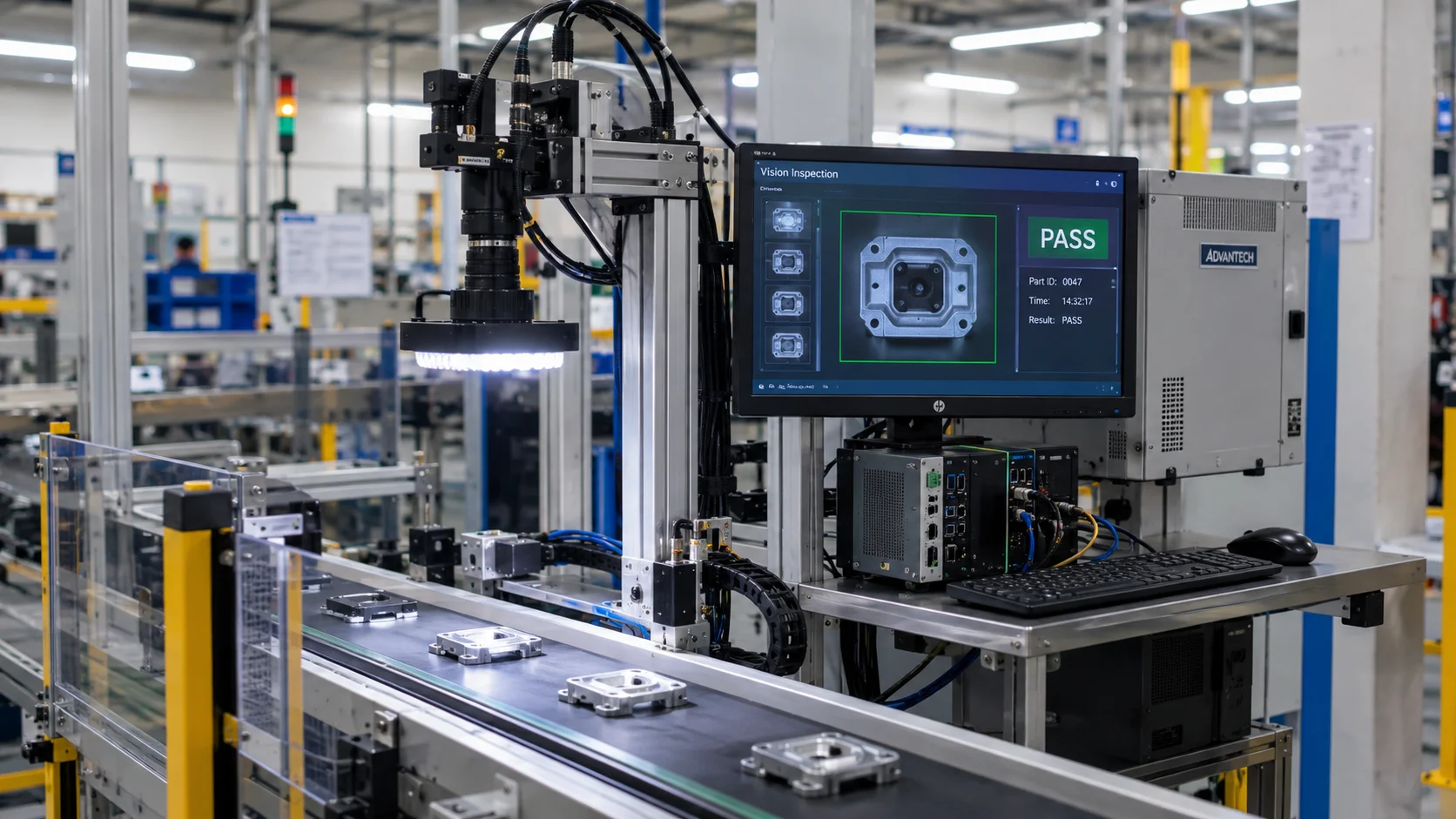
Deep learning replaced rule-based machine vision for one class of problem: defects a human inspector recognises instantly but cannot describe as a geometric rule, such as surface scuffing, weld porosity or label skew under variable lighting. Rule-based vision still wins on measurement, presence-absence and code reading, because you can prove what it does. The cost that surprises people is drift: budget for a retraining loop with a labelled holdout set, or budget for the line to run in bypass inside a year.
Process Optimisation and Energy Forecasting
Soft sensors are the quiet success story. A model inferring cement kiln free lime from temperatures it can actually measure delivers a lab value every thirty seconds instead of every four hours. The operator or the advanced control layer uses it; it does not write to the PID. Load forecasting has the clearest financial case in the Gulf, where a plant on a demand-charge tariff running gas turbines alongside a utility feed needs its next 60 minutes of load to decide dispatch. That overlaps with conventional power system audits and optimisation, and the forecast is worth less than the metering.
What Data Does Industrial AI Need?
Time-synchronised process data sampled at a rate matched to the physics, plus labelled event history. The second half is where projects stall.
A historian logging on a 1 percent deadband compresses away exactly the transients a model needs. Bearing fault frequencies on a four-pole motor sit in the hundreds of hertz to low kilohertz range, so vibration must be captured at the sensor and processed at the edge, and motor current signature analysis needs synchronised voltage and current resolving the sidebands, not a one-second average from a power meter. If the PLC, the meters and the vibration collectors disagree by two seconds, a model correlating electrical and mechanical events learns noise: IEEE 1588 PTP is prerequisite infrastructure.
Then labels. The highest-return preparation task in any AI in manufacturing programme is cleaning up CMMS work-order coding: failure mode, cause, and the timestamp of the failure rather than of the paperwork. A model cannot learn to predict bearing failure when 40 percent of the history reads "breakdown maintenance, pump". Extraction is its own project where a third of the assets speak Modbus RTU and nothing else, covered in reaching legacy serial equipment over Ethernet.
Can AI Improve Industrial Safety?
Yes. Safety is the strongest current case for AI in manufacturing, but only as an advisory layer above the protection systems, never inside them. Vision and sensor-fusion systems catch hazards a fixed guard or light curtain cannot see: a person in a crane swing path, a worker unharnessed at height, a plume drifting off a flange. What they must never do is arbitrate a trip.
Why AI Stays Outside the Safety Instrumented Function
Safety instrumented systems in process plants are governed by IEC 61511-1:2016 plus Amendment 1:2017, the process-sector implementation of IEC 61508:2010. A safety instrumented function has a SIL target, a proof-test interval, a demonstrable probability of failure on demand, and deterministic behaviour you can verify by test. A trained model has none of those. Its behaviour on an unseen input is not predictable from the validation set, and you cannot proof-test it the way you proof-test a logic solver. IEC 61508-3:2010 says so in its technique tables: artificial intelligence as a software technique is Not Recommended above SIL 1, and carries no positive recommendation even at SIL 1.
The architecture that resolves this already exists. NAMUR's NE 175 Open Architecture splits the plant into a Core Process Control domain and a Monitoring and Optimisation domain, with data leaving control through a one-way path and nothing flowing back; IEC 62443 expresses the same idea as zones and conduits. Put analytics in the monitoring zone with read access to the historian and no write path into the safety or control systems. A vendor offering a platform that issues setpoints is moving your control system's failure modes into a stack nobody can audit.
The AI layer advises. The SIS decides. If a vendor blurs that line in the architecture diagram, the answer is no, regardless of how good the demo was.
PPE and Exclusion-Zone Detection: The False-Positive Problem
Computer-vision PPE compliance is the most-sold safety product in AI in manufacturing and the most-abandoned. Detection is not the hard part; modern detectors find hard hats and high-vis vests reliably in good light. The failure modes are association and context. In a group of four workers the system must attribute each helmet to the correct head, and misattribution produces most false positives. Context is worse: a helmet is mandatory on the process deck and irrelevant in the control room doorway two metres away.
What decides whether a PPE system is still switched on after six months is not accuracy but false alarms per shift. A 95 percent accurate detector running 2,000 person-detections a shift produces roughly 100 false calls, enough that the operator stops looking within a fortnight. This is the alarm-management failure EEMUA 191 and IEC 62682 were written to address, in a new form. Two choices fix most of it: restrict detection to defined zones with a documented PPE rule for each, and route output to a supervisor's daily summary rather than a real-time klaxon.
Proximity Detection and Collision Avoidance
This is the one area where perception systems moved from advisory to intervention, because a regulator forced it. South Africa's Mine Health and Safety Act regulation 8.10 came into force on 21 December 2022 and requires diesel trackless mobile machinery to automatically detect pedestrians and other machines, with the collision prevention system failing to safe and, where the operator takes no action, retarding the machine and applying the brakes. That is EMESRT Level 9 intervention written into law, and it is why South African mines are ahead of most Gulf refineries here.
Note what a compliant installation does. The perception stack, which may well be a learned model, generates a detection; the brake application executes through a safety-rated control path assessed to EN ISO 13849-1:2023 or IEC 62061 at a defined performance level. The model proposes, a certified controller acts. The same split governs robot cells under ISO 10218-1:2025 and ISO 10218-2:2025, which replaced the 2011 editions and absorbed the collaborative-application content formerly in ISO/TS 15066.
Gas Leak and Flare Detection
Optical gas imaging with automated plume detection is deployed on LNG trains, tank farms and flare stacks across the Gulf, and it earns its place: a fixed camera watching a flange bank sees a leak developing where you would never install a point detector. It does not replace fixed gas detection. The F&G layer stays hard-wired, SIL-rated, voted and certified for the area classification under IEC 60079 with ATEX or IECEx marking. Sold as justification for thinning point-detector coverage, imaging is a LOPA violation waiting for an incident.
Fatigue Monitoring and the Data Protection Problem
In-cab fatigue monitoring is well proven on haul trucks and is spreading to control rooms and crane cabs. It is also the application most likely to create legal exposure, and the rules differ sharply by jurisdiction. Under the EU AI Act, Article 5(1)(f) prohibits AI systems that infer emotions in the workplace, with a narrow exception for medical or safety reasons, while Recital 18 excludes physical states such as pain and fatigue from the emotion-recognition definition. That is why alertness monitoring on a safety-critical operator remains workable and general stress scoring does not. The Act's high-risk obligations were deferred by Regulation (EU) 2026/1744, the Digital Omnibus published on 24 July 2026, pushing Annex III systems to 2 December 2027 and AI embedded in products under EU product-safety law to 2 August 2028. The Article 5 prohibitions were not deferred.
Outside the EU the constraints differ but are no lighter. Saudi Arabia's PDPL classifies biometric data as sensitive personal data requiring explicit, specific, informed consent, and SDAIA's AI Ethics Principles add transparency and accountability expectations on top. Russia's Federal Law 152-FZ requires personal data on Russian citizens to sit in databases inside Russia, tightened again from 1 July 2025, which rules out a facial analytics platform hosted in Frankfurt for a Russian site. South Africa's POPIA treats biometrics as special personal information, and any plant with a European parent will meet a works council with co-determination rights over technical monitoring. Scope to a real hazard, process on the edge, keep the event record rather than the video, and consult first.
Automated Compliance Record-Keeping
Every SIL-rated layer under IEC 61511-1 carries a proof-test obligation, and that record (date, result, technician, deviation, corrective action) is part of the safety case itself, the first thing an auditor asks for. A system that timestamps results at the point of test and locks the entry against silent edit beats a spreadsheet backfilled later, which reads as a data-integrity finding. The same logic covers LOPA, PHA and permit-to-work: a model drafts the hazard list from a P&ID or flags a permit contradicting its isolation certificate before signing. After an incident, the investigation runs on whatever the historian and alarm log captured, the real argument for treating the historian itself as safety-relevant infrastructure.
Where AI Sits Relative to the Protection Layers
| Layer | Function | Governing standard | AI permitted? |
|---|---|---|---|
| Advisory analytics | Diagnosis, forecasting, compliance records | ISO 17359, ISO 13374, ISO/IEC 42001 | Yes, read-only |
| Operator awareness | Alarm rationalisation, PPE and zone alerts | EEMUA 191, IEC 62682 | Yes, advisory output |
| Basic process control | Regulatory and sequence control | IEC 61131-3, IEC 61512 | Setpoint advice only |
| Machinery safety | Guarding, interlocks, collision intervention | EN ISO 13849-1:2023, IEC 62061, ISO 10218:2025 | Perception only; actuation certified |
| Safety instrumented system | Trips, ESD, fire and gas | IEC 61511-1:2016+A1:2017, IEC 61508:2010 | No |
Is Generative AI Useful in Manufacturing?
Yes, in three places, and no in the fourth. Generative AI in manufacturing earns its cost in document retrieval, drafting and summarisation, and has no business near a control loop. RSM's 2026 Middle Market AI Survey of 129 manufacturers found 88 percent already reporting AI at least partially integrated, and more than 90 percent using or planning to use generative, predictive or language AI within the next 18 months. Read that as procurement activity rather than production value, and judge which generative AI use cases in manufacturing survive an audit.
Document retrieval works. A retrieval-augmented assistant over P&IDs, manuals, procedures and incident reports solves a real problem: a planner at 02:00 needs the torque spec for a valve actuator and the answer is on page 340 of an unindexed PDF. Constrain it to your own documents, make every answer cite its source page, and it is a straightforward win.
Procedure drafting works, with review. First drafts of method statements, job safety analyses, permit templates and management-of-change documentation. The engineer still owns and signs the content, so the risk is contained.
Maintenance log summarisation works, and feeds back. Free-text work-order narratives are the richest and least-used dataset in most plants. A language model that reads three years of technician notes and proposes a consistent failure-mode taxonomy fixes the labelling problem above and makes the predictive models viable, quietly the highest-value of the generative AI use cases in manufacturing.
Anything in the control path does not work. No generative model writing PLC logic that reaches a plant unreviewed, and no language model recommending an action to an operator mid-upset. Generative AI in manufacturing is fluent, confident and occasionally wrong in ways that read exactly like being right.
A Real-World Scenario: The Dairy Plant That Taught Its Operators to Ignore the Inspector
A UHT dairy and juice plant in the Gulf installed a deep-learning vision cell on two aseptic filling lines to inspect cap seating and induction-seal integrity at 24,000 units per hour. Seal defects were its leading cause of spoilage complaints and manual sampling caught them hours late. The cell went live at a validated false-reject rate under 0.5 percent and ran well for seven months, the standard case for AI in food manufacturing: inspection that runs faster than a human eye and never tires.
Then procurement changed the induction-seal foil supplier. The new laminate had a different specular response under the cell's lighting, and the model began reading the reflection as an incomplete bond. False rejects went from under 0.5 percent to roughly 6 percent inside two shifts. Nobody owned a retraining process, so the shift supervisor set the rejector to alarm-only and posted an operator on the screen.
Three weeks later a genuine seal defect cluster from a worn filling head passed through, because by then the operator had been dismissing dozens of alarms an hour and had stopped distinguishing between them. The plant found it through consumer complaints and pulled four days of production. The model had flagged many of the defective units; the alarm had lost its meaning to the person receiving it.
The fix was three changes, none about the model: a change-control trigger tying packaging or lighting changes to revalidation before restart, the same HACCP requirement already applied to hardware but never to software; a weekly 200-image holdout audit against QA inspection so drift shows as a trend; and a rule barring alarm-only mode without a documented, expiring deviation signed by the quality manager.
Vision systems do not fail by being wrong. They fail by being wrong often enough that people stop believing them, and by then the false accepts are invisible.
Where FSMA 204 applies to exported product, with its compliance date now 20 July 2028, a system running in bypass leaves a gap in the traceability evidence chain, a compliance argument for AI in food manufacturing distinct from defect detection.
Getting the Architecture Right Before the Model
The sequence that works is unglamorous. Fix time synchronisation and historian resolution. Clean up CMMS failure coding. Define the zones and conduits so the analytics layer physically cannot write into control. Instrument the assets you intend to model. Then buy the model. A credible smart automation manufacturing roadmap spends its first year on measurement and network architecture, not algorithms, and an integrator who says otherwise is selling licences. ISO/IEC 42001 gives the programme a governance wrapper, though it carries no presumption of conformity with the EU AI Act.
Be honest about what none of this changes: AI does not make an uninstrumented plant observable, does not repair a run-to-failure maintenance culture, and will not compensate for a protection layer undersized at design; all three are fixed with instruments and engineering, not analytics.
Techno Control Corporation works at that layer: the sensors, drives, control systems and network architecture that decide whether an analytics programme has anything to stand on. If you are scoping a smart automation manufacturing project and want the measurement foundation assessed first, our teams cover industrial automation system design, instrumentation and control selection and calibration, and maintenance and reliability programmes built on condition data you can trust. If you are still deciding where the data comes from, our guide to how PLC and SCADA systems improve plant efficiency is the place to start, or talk to our engineers about what your control system can already give you.
Frequently Asked Questions
What is AI used for in manufacturing today?
Four applications account for almost all genuine deployments: condition-based maintenance on rotating equipment, machine-vision quality inspection, advisory process optimisation, and energy or load forecasting. Nearly everything marketed beyond that list is still a pilot.
Can AI improve industrial safety?
Yes, as an advisory layer above the protection systems, never inside them. Vision and sensor-fusion systems can catch hazards a fixed guard can't see, but a safety instrumented function still has to meet IEC 61511 and IEC 61508, and IEC 61508-3 explicitly does not recommend AI techniques above SIL 1.
What data does industrial AI need?
Time-synchronised process data sampled at a rate matched to the physics involved, plus a clean, labelled failure history. Most programmes stall on the second half: a model can't learn to predict a bearing failure if most of the maintenance log just reads "breakdown maintenance, pump."
Is generative AI useful in manufacturing?
Yes, in three places: retrieving answers from manuals and P&IDs, drafting procedures for an engineer to review, and summarising years of free-text maintenance notes into a usable failure-mode taxonomy. It has no legitimate place inside a control loop or a safety function.
Related products
Components from our catalogue relevant to this article — request a quote for availability, lead time and pricing.
/TC625 AF100 ABB - Coaxial Modem 3BSE002224R1.png "ABB TC625 AF100 ABB - Coaxial Modem 3BSE002224R1 | Coaxial modem TC625 AF100")
TC625 AF100 ABB - Coaxial Modem 3BSE002224R1
Coaxial modem TC625 AF100
/SB512 ABB - Power Supply 3BSE002098R1.png "ABB SB512 ABB - Power Supply 3BSE002098R1 | SB512 power supply module")
SB512 ABB - Power Supply 3BSE002098R1
SB512 power supply module
/DSSS 171 ABB - Voting Unit 3BSE005003R1.png "ABB DSSS 171 ABB - Voting Unit 3BSE005003R1 | DSSS 171 voting unit for safety systems")
DSSS 171 ABB - Voting Unit 3BSE005003R1
DSSS 171 voting unit for safety systems
/4NWP100174R0001 ABB - UPS PowerValue 11LI Up 2000 VA.webp "ABB 4NWP100174R0001 ABB - UPS PowerValue 11LI Up 2000 VA | UPS PowerValue 11LI Up 2000 VA")
4NWP100174R0001 ABB - UPS PowerValue 11LI Up 2000 VA
UPS PowerValue 11LI Up 2000 VA