
Industrial Automation Solutions: A Field-Level Guide

Quick Answer
Practical guidance on controllers, drives, communication, sourcing and panel wiring for field engineers and procurement under schedule pressure.
Why Automation Decisions Are Made Under Pressure
Most industrial automation decisions do not happen in a conference room with time to research. They happen after a conveyor stops mid-shift, a VFD throws a fault code the maintenance team has never seen, or procurement discovers the original supplier no longer stocks the relay module that keeps the line running. That is the real context in which industrial automation solutions get evaluated.
Techno Control Corp exists precisely for those moments, supplying verified components, supporting panel builds, and helping engineering teams source the right PLCs, VFDs, HMIs, and control hardware before downtime costs compound.
Understanding the Industrial Automation Stack
Industrial automation is not a single product category. It spans hardware, software, communication protocols, and field instrumentation, all of which must work together reliably in environments where failures carry real cost.
Controllers: PLCs and PACs
Programmable Logic Controllers (PLCs) remain the backbone of discrete manufacturing control. Brands like Siemens, Allen-Bradley, Mitsubishi, and Omron dominate the market, each with its own programming environment, I/O architecture, and communication options.
Selecting the wrong PLC for an application is rarely about raw capability. It is usually about integration fit: what protocols the existing network runs, which SCADA platform the plant uses, and whether the maintenance team already knows the programming software. A technically superior controller that requires retraining three shifts of technicians is a harder sell than a familiar platform with adequate specs.
The best PLC for your application is usually the one your team can troubleshoot at 2 AM without calling support.
Variable Frequency Drives
VFDs control motor speed by varying the frequency and voltage of the power supply. In applications from conveyor belts to HVAC fans to pump stations, they deliver measurable energy savings and extend motor life by reducing mechanical stress on startup.
Key parameters when specifying a drive: motor kW/HP rating, input voltage, output frequency range, ambient temperature rating, and IP enclosure class. For demanding process applications, also check the drive's overload capacity, typically rated as a percentage of full load current for a defined time window such as 150% for 60 seconds.
HMIs and SCADA Systems
Human-Machine Interfaces range from simple panel-mount displays to networked touchscreens running visualization software tied into plant-wide SCADA. The HMI is where operators read process values, acknowledge alarms, and adjust setpoints.
SCADA adds historian capability, remote monitoring, and often integration with ERP systems. For greenfield installations, the choice of SCADA platform should be made before specifying PLCs, since communication protocol compatibility shapes hardware selection all the way down to the I/O card level.
Common Field Problems and How to Approach Them
Scenario: Unexplained VFD Trips on a Water Pump Station
A municipal pump station running three submersible pumps begins tripping its VFDs with overcurrent faults every few days, but only during peak demand hours. The drives are correctly sized on paper.
First check: ambient temperature inside the enclosure during peak operation. Drives derate their output current in high ambient conditions. If the panel is in a sun-exposed building with inadequate ventilation and summer temperatures push the enclosure past 40�C, the drive's effective capacity drops.
Second check: harmonic distortion from multiple drives running simultaneously. Three drives on a shared bus without line reactors can produce enough harmonic current to push the total current above the trip threshold even when each individual motor is within spec. Adding 3% line reactors on the input side of each drive typically resolves this.
Nine out of ten VFD faults trace back to installation conditions, not drive failure.
Scenario: PLC I/O Expansion Hitting Lead Time Walls
A packaging line needs additional analog inputs for a new inspection station. The existing PLC is a Siemens S7-300 series. The project engineer specifies the exact I/O module part number, only to find lead times of 16 to 20 weeks from the primary distributor.
Options to evaluate: 1) Check if the application actually requires the exact module specified, or if a compatible module with the same channel count and signal range can substitute. 2) Source from an authorized secondary distributor with stock on hand. 3) Review whether the S7-300 platform is the right long-term choice, or whether a migration to S7-1500 makes sense given Siemens' published product lifecycle for the 300 series.
For any alternative module sourced outside the primary channel, cross-reference the datasheet against the original spec. Verify signal range, update rate, and isolation class before committing to a substitution.
Industrial Communication Protocols: A Practical Comparison
| Protocol | Topology | Speed | Best For | Common Hardware | Max Nodes |
|---|---|---|---|---|---|
| PROFIBUS DP | Bus | 12 Mbps | Distributed I/O | Siemens S7, ET200 | 126 |
| EtherNet/IP | Star/Ring | 100 Mbps+ | High-speed data | Allen-Bradley, Omron | Unlimited |
| PROFINET | Star/Ring | 100 Mbps+ | Motion + I/O | Siemens, B&R | Unlimited |
| Modbus RTU | Bus | 115 kbps | Simple instruments | Universal | 247 |
| CANopen | Bus | 1 Mbps | Embedded/motion | Drives, sensors | 127 |
Sourcing Industrial Components: What Actually Goes Wrong
Procurement pressure in industrial automation has two failure modes. The first is specifying exact part numbers and discovering long lead times after the project schedule is already locked. The second is accepting substitutes without proper verification and commissioning a system with components that behave differently than expected.
Counterfeit Risk in the Supply Chain
Counterfeit PLCs, drives, and relay modules do exist in the industrial supply chain. They typically enter through grey-market channels, often at attractive price points. The risk is not just functional failure at commissioning. It is latent failure months into production when a non-spec capacitor in a counterfeit drive fails prematurely, or a knockoff PLC module develops intermittent I/O errors that are extremely difficult to diagnose.
Authorized distributors carry manufacturer traceability. Each component can be traced from the factory through the distribution chain. For critical control components in safety-rated applications, that traceability is not optional.
Lead Time Planning
For capital projects with defined commissioning dates, begin the procurement cycle for long-lead items no later than 12 weeks before the required on-site date for standard catalog items. For specialty modules, safety PLCs, or configured hardware such as pre-wired I/O marshalling panels, 20 weeks is a more realistic buffer.
Build a bill of materials with lead time flags early in the design phase. Identify which items have acceptable substitutes and document the substitution criteria in advance, so procurement decisions during the project do not require last-minute engineering reviews.
Panel Wiring Standards and Why They Matter
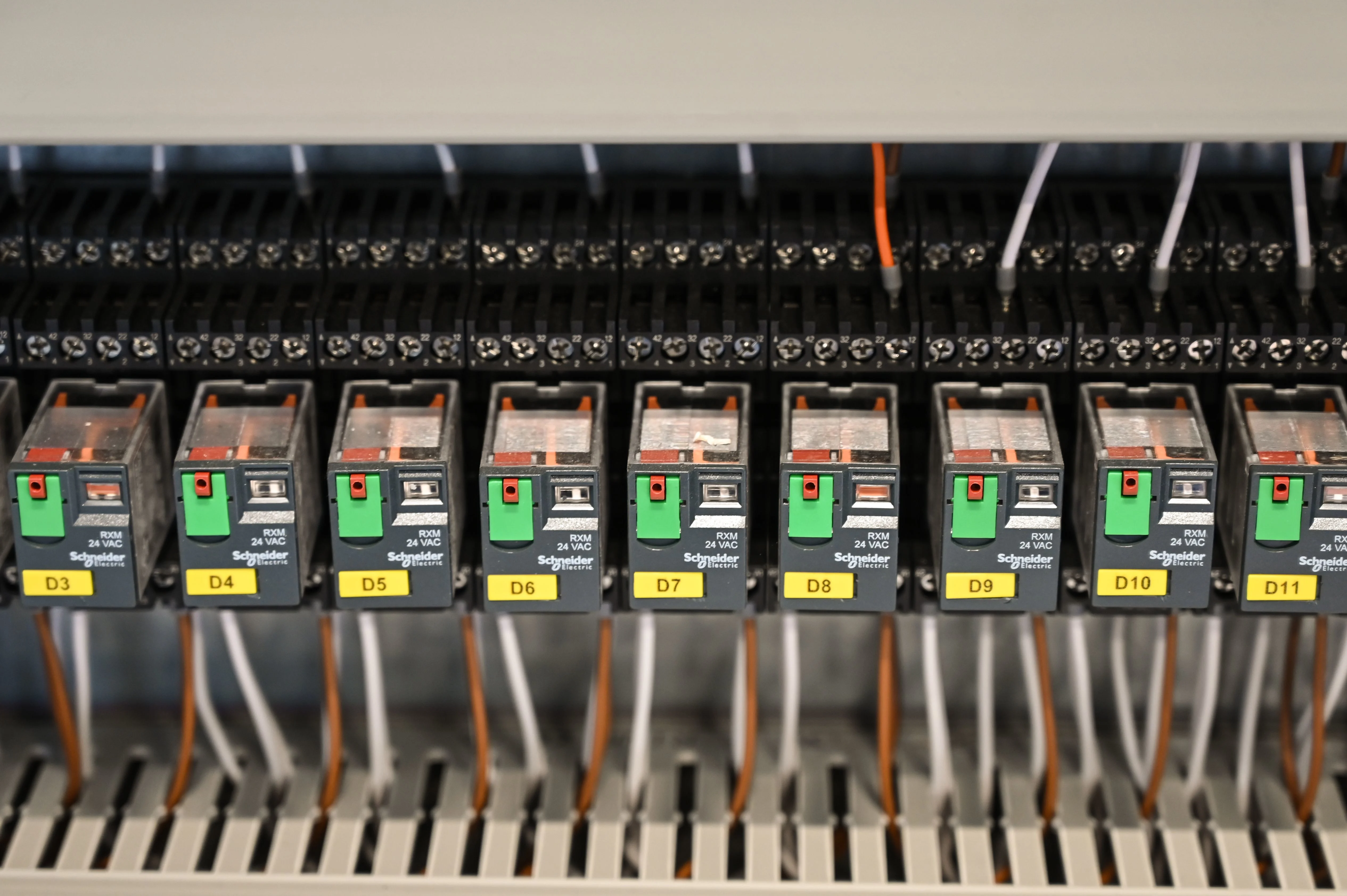
A control panel built to NEMA, IEC, or UL 508A standards is not just a compliance checkbox. It is an operational reliability decision. Panels built to recognized standards have predictable wire routing, labeled terminal blocks, proper grounding, and component spacing that supports both heat dissipation and future maintenance access.
Common failures in non-standard panel builds: undersized wire gauge for the actual load, missing or incorrect fuse sizing on control circuit branches, inadequate separation between power and signal wiring, and missing surge protection on I/O lines connected to field devices exposed to lightning risk.
Grounding and Shielding in Signal Wiring
Analog signal wiring (4-20 mA loops, thermocouple inputs, RTD inputs) is especially sensitive to grounding errors. Shield the cable at one end only, typically the panel end, and connect to the instrument earth bar, not the power earth. Connecting both ends creates a ground loop that introduces noise into the signal.
For long cable runs over 50 meters, specify individually shielded, overall shielded (IS/OS) cable. The individual shielding isolates each pair from adjacent pairs, which matters when multiple analog signals share a conduit.
Maintenance Indicators Worth Monitoring
Predictive maintenance in automation systems does not always require expensive condition monitoring hardware. Several early warning signals are available from equipment already installed on the line.
- VFD operating temperature trending upward over weeks: check input filter condition and enclosure ventilation
- Increasing fault log frequency on a PLC module: check power supply voltage, backplane seating, and battery condition
- Analog input drift without process change: check field device calibration, wiring connections, and shield integrity
- Contactor chatter or delayed pickup: measure control voltage at the coil terminal under load, check for voltage drop on long control wiring runs
- Communication error counters incrementing on a fieldbus: check network termination resistors, cable routing near variable speed drives, and connector seating
Most SCADA systems can trend these values over time. Building threshold-based alerts into the historian is a low-cost way to move from reactive to predictive maintenance without adding hardware.
Related products
Components from our catalogue relevant to this article — request a quote for availability, lead time and pricing.
/TC625 AF100 ABB - Coaxial Modem 3BSE002224R1.png "ABB TC625 AF100 ABB - Coaxial Modem 3BSE002224R1 | Coaxial modem TC625 AF100")
TC625 AF100 ABB - Coaxial Modem 3BSE002224R1
Coaxial modem TC625 AF100
/SB512 ABB - Power Supply 3BSE002098R1.png "ABB SB512 ABB - Power Supply 3BSE002098R1 | SB512 power supply module")
SB512 ABB - Power Supply 3BSE002098R1
SB512 power supply module
/DSSS 171 ABB - Voting Unit 3BSE005003R1.png "ABB DSSS 171 ABB - Voting Unit 3BSE005003R1 | DSSS 171 voting unit for safety systems")
DSSS 171 ABB - Voting Unit 3BSE005003R1
DSSS 171 voting unit for safety systems
/4NWP100174R0001 ABB - UPS PowerValue 11LI Up 2000 VA.webp "ABB 4NWP100174R0001 ABB - UPS PowerValue 11LI Up 2000 VA | UPS PowerValue 11LI Up 2000 VA")
4NWP100174R0001 ABB - UPS PowerValue 11LI Up 2000 VA
UPS PowerValue 11LI Up 2000 VA