
How SCADA Systems Are Changing Water Treatment Monitoring

Quick Answer
SCADA gives water treatment operators continuous, timestamped visibility into chlorine residual, turbidity, and pump status that a manual walkthrough round cannot match. This expanded field guide covers real time monitoring, a slow instrument drift scenario, regulatory reporting, commissioning pitfalls, sourcing lead times, and redundancy planning for a SCADA retrofit.
Why Continuous Monitoring Now Matters
A plant operator walking the aeration basin at 2 a.m. cannot tell you what the dissolved oxygen level was three hours earlier. A SCADA system can, down to the minute, with a trend graph to back it up. That gap, between what a person happens to catch on a walkthrough and what a properly built SCADA system records automatically and without pause, is the entire reason water treatment plants have moved toward centralized monitoring over the past two decades.
For utilities still running on local panel checks and handwritten logs, the useful question is no longer whether SCADA helps. That case is settled. The real questions are where to start, what the system actually changes on the plant floor once it is running, and what it costs a utility to get wrong during commissioning. This article works through each of those in turn, with an eye toward the practical decisions an operator or integrator has to make rather than the marketing around the technology.
What SCADA Actually Does in a Water Treatment Plant
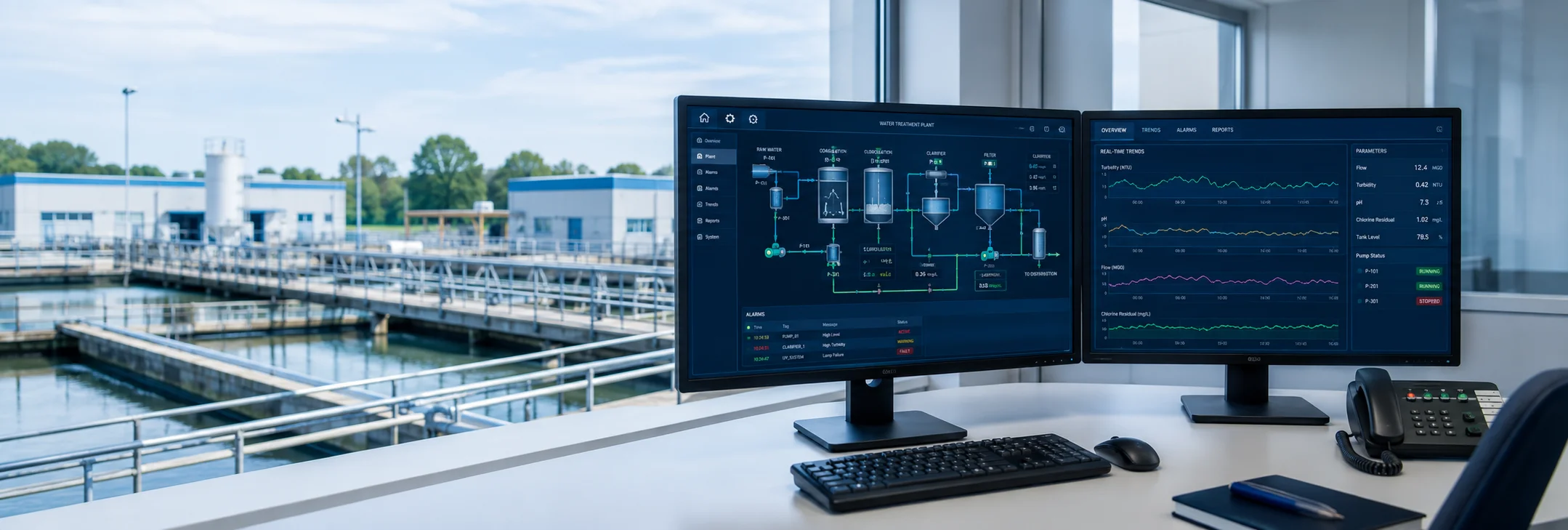
SCADA, which stands for supervisory control and data acquisition, pulls live data from field instruments, PLCs, and remote terminal units across a plant and presents it on centralized HMI screens. In a water treatment setting, that means chlorine residual, turbidity, pH, flow rate, pump status, and tank levels all arrive on a single operator screen instead of being scattered across gauges in multiple buildings. The operator sees the state of the whole plant from one place rather than assembling it from memory and a clipboard.
The Division of Labor Between PLCs and SCADA
The PLCs at each process area, whether that is coagulation, filtration, or disinfection, handle the local control logic. They open and close valves, start and stop pumps, and hold interlocks, all on their own fast scan cycles. SCADA sits above that layer. It aggregates the data those controllers produce, logs it, and gives operators the ability to adjust setpoints remotely without walking to every panel in the plant. The two layers are complementary rather than competing, and understanding that split is the first step to specifying either one correctly.
The value is not the dashboard. It is that a chlorine dip gets flagged in seconds instead of during the next scheduled walkthrough.
Real Time Monitoring Versus the Manual Round
Consider a mid size municipal plant running three shifts with a single operator covering both the intake and the clearwell. A manual round means checking chlorine analyzers, filter differential pressure, and pump amperage every couple of hours, then logging each value by hand. Between rounds, the plant runs effectively unwatched, and the operator is trusting that nothing changes in the gaps. Most of the time nothing does. The problem is the times it does.
If a chlorine feed pump fails at 3 a.m., that operator finds out on the next round, which could be as much as ninety minutes later. In a water treatment context, ninety minutes of missing disinfection is not a minor delay. With SCADA in place, a low residual alarm fires on the HMI the moment the value crosses the threshold and, when the system is configured with remote notification, it texts or calls the on call operator immediately. The failure is known in seconds rather than after more than an hour of unmonitored operation, and the response can begin at once.
A Realistic Field Scenario
Picture a plant with an aging analog turbidity analyzer that shows intermittent signal drift, the kind that never quite trips a hard alarm threshold. On a manual system this behavior gets missed entirely until a compliance sample flags it, at which point the utility is already in a reporting problem rather than a maintenance one. On a SCADA system, historian trending reveals the slow drift pattern days earlier, giving the instrumentation technician time to recalibrate before the drift becomes a reportable exceedance.
This is precisely the kind of catch that manual logging structurally cannot make, and it is worth being clear about why. It is not a matter of operator diligence or effort. It is that nobody can stare at a chart continuously for days, spotting a trend that is invisible in any single reading. A historian does exactly that without fatigue, and surfacing that slow moving pattern is one of the quieter but more valuable things a SCADA system contributes to a plant.
Data Logging and Regulatory Reporting
Water treatment plants answer to state primacy agencies and, depending on the jurisdiction, to reporting requirements under the Safe Drinking Water Act. SCADA historians automatically timestamp and store every process variable, which turns the monthly operating report from a manual compilation task into an export job. Work that once consumed hours of an operator's time, transcribing figures and checking arithmetic, becomes a matter of pulling a report from data the system already holds.
Why Inspectors Increasingly Want Continuous Records
This matters more than it may first appear. Inspectors increasingly ask for continuous monitoring records rather than spot checks, particularly for disinfection byproduct precursors and for chlorine residual at the entry points to distribution. A handful of manual readings per shift cannot demonstrate continuous compliance in the way a historian can. A plant that already logs everything automatically is in a far stronger position when an inspector asks to see the record, because the record simply exists and can be produced on request rather than reconstructed after the fact.
Manual Monitoring vs SCADA Based Monitoring
The table below lines up the two approaches across the factors that matter most to a plant deciding whether to make the move.
| Monitoring Approach | Manual and Local Panel Checks | SCADA Based Monitoring |
|---|---|---|
| Data frequency | Hourly or per shift, logged by an operator | Continuous, typically 1 to 5 second polling |
| Alarm response | Delayed until the next round or a complaint | Immediate alarm on the HMI plus remote notification |
| Historical trending | Paper logs that are hard to correlate | Automatic historian with trend and export tools |
| Staffing requirement | On site presence at each facility | One central operator can cover multiple sites |
| Regulatory reporting | Manual compilation that is prone to error | Exportable logs aligned to compliance formats |
The pattern across every row is the same. Manual monitoring depends on a person being present, paying attention, and recording accurately at the right moment. SCADA monitoring removes that dependence for the routine work, freeing the operator to act on exceptions rather than spend the shift collecting readings. That shift in where human attention is spent is the real change SCADA brings to a plant, more than any single feature in the table.
Integration Considerations During Commissioning
Retrofitting SCADA onto an existing plant is not a weekend job, and treating it as one is where many projects run into trouble. Every instrument needs to be cross checked against the PLC I/O maps before a single tag is built in the SCADA software. A mismatched analog input range on a level transmitter, for example, will silently misreport tank levels for months if nobody catches it during commissioning, and a monitoring system that reports the wrong number confidently is arguably worse than no monitoring at all.
Protocol Choice and Gateway Strategy
Communication protocol choice matters early in the project rather than late. Modbus TCP is common for straightforward instrument integration, while EtherNet/IP or Profibus appears more often in plants built around Allen Bradley or Siemens PLC architecture. Mixing protocols across a distributed plant without a clear gateway strategy is a frequent source of commissioning delays for any industrial automation rollout, because every unplanned translation between protocols becomes a point where data can stall or be misinterpreted. Deciding on a coherent protocol and gateway plan before the panels are built saves a great deal of troubleshooting later.
Sourcing and Lead Time Reality
RTUs, industrial switches, and surge protected panel components for remote lift stations are not always shelf stock items. Plants planning a SCADA rollout across multiple remote sites should account for procurement lead time on networking hardware early in the schedule, not after the integrator has already committed to commissioning dates. A single long lead component can hold up an entire site, and discovering that after the calendar is fixed turns a planning problem into a scheduling crisis.
Verifying Components and Avoiding Counterfeits
Sourcing from authorized distributors and cross referencing datasheets before ordering avoids the counterfeit component risk that shows up more often in gray market RTU and networking gear. A counterfeit part may pass a quick visual check and still fail on a specification that matters, or ship without the firmware support the rest of the system expects. The verification step takes little time and protects both warranty coverage and long term support, which is exactly what a plant relying on the equipment for compliance cannot afford to lose.
Reliability, Redundancy, and Acceptable Downtime
A water treatment plant cannot tolerate the same downtime windows that a discrete manufacturing line might absorb, because the product is drinking water and the consequences of losing visibility are public health consequences. Redundant SCADA servers, typically a primary paired with a hot standby, are standard for any plant serving more than a small rural system. Redundancy planning also extends to the communication paths themselves. A single fiber run to a remote lift station is a single point of failure, and a cellular or radio backup link is what keeps that station visible when the primary path is cut.
Turning SCADA History Into Predictive Maintenance
Predictive maintenance indicators, drawn from motor run hours, from vibration where sensors are installed, and from pump cycle counts logged through SCADA, give maintenance teams a schedule backed by data rather than a run to failure approach that waits for equipment to break. Mean time between failures data collected over several years of SCADA history becomes a genuinely useful planning tool rather than just a compliance artifact. The same records kept for the regulator quietly turn into the basis for smarter maintenance decisions, which is a return on the SCADA investment that rarely appears in the original justification for it.
Where This Leaves a Plant Still on Manual Systems
Plants weighing a SCADA upgrade usually do not attempt a full plant rollout at once. They start with the highest risk process area, which is almost always disinfection, and build out from there. That phased approach limits commissioning risk, lets operators grow comfortable with the HMI before the rest of the plant comes online, and spreads the procurement cost across several budget cycles instead of forcing one large capital request through at once. It is a lower risk path in both engineering and financial terms.
Techno Control Corp works with water treatment operators and integrators on the PLC, HMI, and networking components that go into these upgrades, from the initial panel builds through to sourcing support on hard to find instrumentation. If a SCADA retrofit is on the table, reach out to talk through the I/O architecture and the component sourcing before the commissioning date gets locked in. The earlier those conversations happen, the more room a plant has to phase the work sensibly and to get ahead of the lead times that otherwise dictate the schedule.
Related products
Components from our catalogue relevant to this article — request a quote for availability, lead time and pricing.
/TC625 AF100 ABB - Coaxial Modem 3BSE002224R1.png "ABB TC625 AF100 ABB - Coaxial Modem 3BSE002224R1 | Coaxial modem TC625 AF100")
TC625 AF100 ABB - Coaxial Modem 3BSE002224R1
Coaxial modem TC625 AF100
/SB512 ABB - Power Supply 3BSE002098R1.png "ABB SB512 ABB - Power Supply 3BSE002098R1 | SB512 power supply module")
SB512 ABB - Power Supply 3BSE002098R1
SB512 power supply module
/DSSS 171 ABB - Voting Unit 3BSE005003R1.png "ABB DSSS 171 ABB - Voting Unit 3BSE005003R1 | DSSS 171 voting unit for safety systems")
DSSS 171 ABB - Voting Unit 3BSE005003R1
DSSS 171 voting unit for safety systems
/4NWP100174R0001 ABB - UPS PowerValue 11LI Up 2000 VA.webp "ABB 4NWP100174R0001 ABB - UPS PowerValue 11LI Up 2000 VA | UPS PowerValue 11LI Up 2000 VA")
4NWP100174R0001 ABB - UPS PowerValue 11LI Up 2000 VA
UPS PowerValue 11LI Up 2000 VA